
Fun Facts About Spring Peepers
Spring peepers are one sure sign of the new season. When will you start hearing their call? Learn more about these very vocal frogs and why they sing.
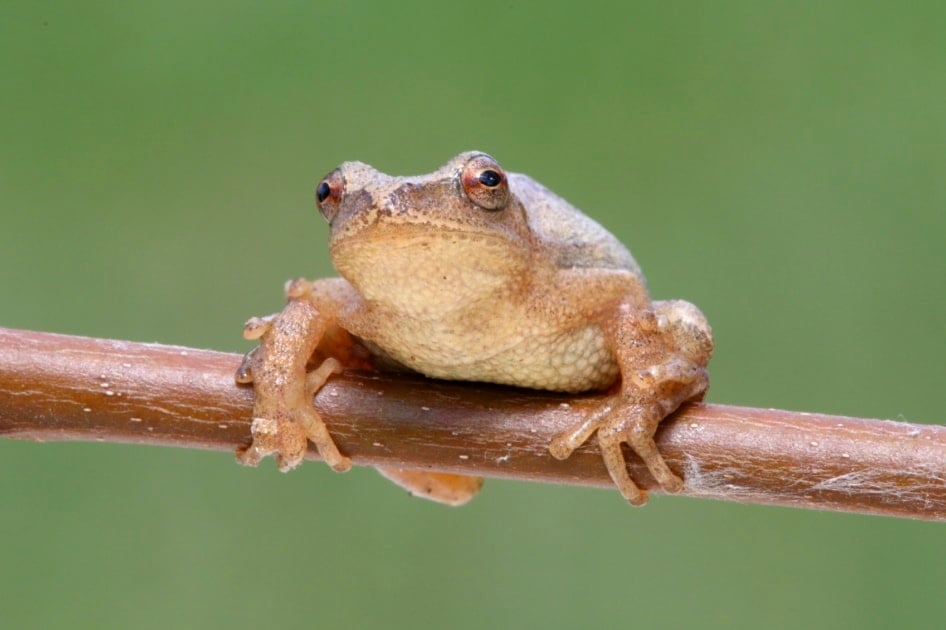
Quick Reference: Spring Peepers
- Species: Pseudacris crucifer, a chorus frog of the eastern half of North America (Florida to Canada).
- The sound: a high, bell-like peep, often 90 dB at close range. A chorus of hundreds sounds like sleigh bells in a swamp.
- Why they sing: males call from breeding ponds in March and April to attract females. The chorus quiets by midsummer.
- Look: small (about 1 inch), tan-brown, with a dark X across the back. The X gives the species name crucifer.
- The deep-freeze trick: can survive up to 70% of body water freezing solid, thanks to glucose “antifreeze” in the cells.
- Best night to listen: first warm rainy evening above 45°F, near a marsh, pond, or wet ditch.
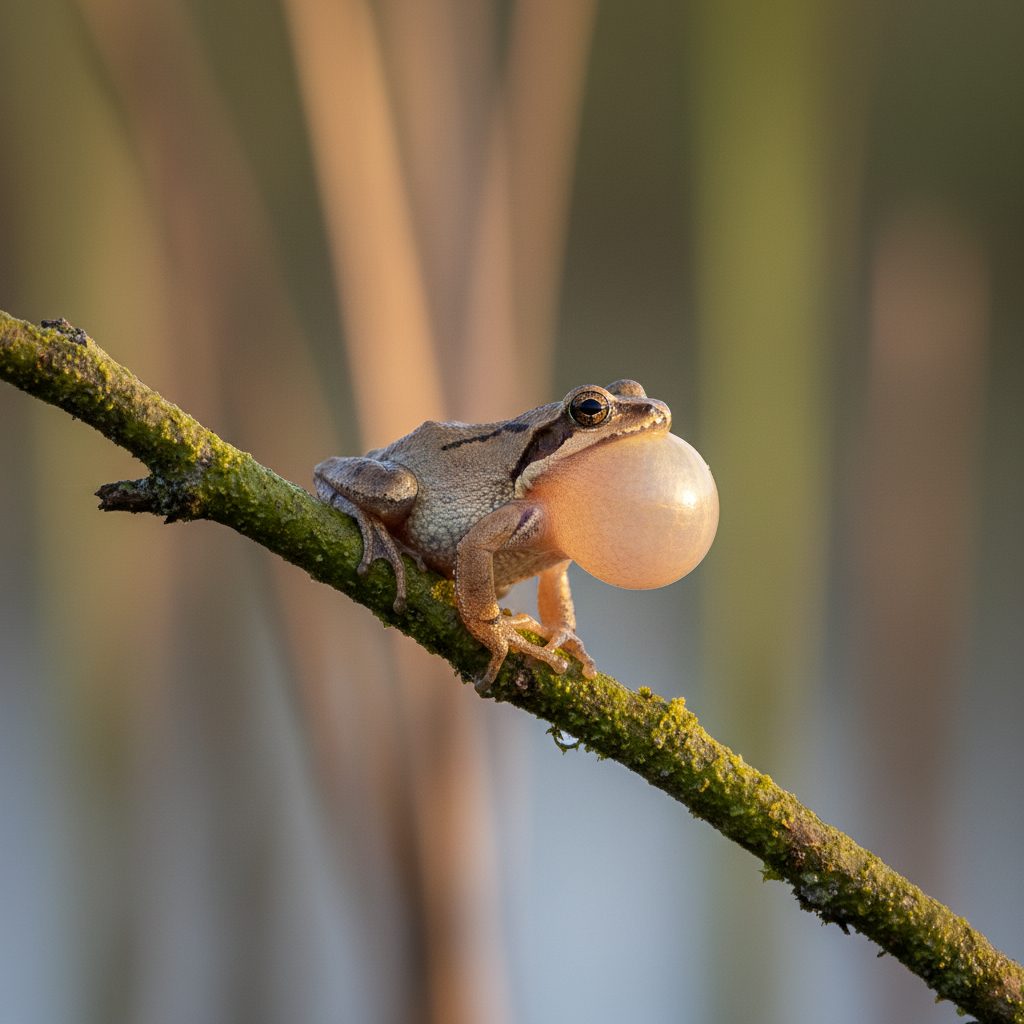
There are unmistakable signs that spring has finally sprung, flowers blooming, the return of the robins, and the unique sound of spring peepers. If you live anywhere east of the Mississippi River, you are probably very familiar with the sleigh-bell-like sound of hundreds of these chirping frogs around swampy areas. Why do peepers peep? And are they the only frogs that sing all night long? Here are some interesting facts about this tiny frog with the big sound. For the natural-history rundown, see the Animal Diversity Web entry on Pseudacris crucifer.
Are Peepers the Only Noisy Frogs?
While spring peepers, Pseudacris crucifer, are the most famous of all the chirping frogs, they are not the only species native to North America. Spring peepers belong to a group of frogs known as “chorus frogs.” Spring peepers live in the eastern half of North America, from northern Florida up into Canada. Then there are Western and boreal chorus frogs that have a range spanning between Ohio and Arizona and north into central Canada.
How Do You Tell the Difference Between These Frogs and Regular Frogs?
The easiest way is to listen to their chirping. Spring peepers make a distinctive peeping noise that can sound a lot like jingling bells when there are a lot of peepers around. Western chorus frogs make a high-pitched creaking sound, and boreal chorus frogs have a raspy chirp that sounds like the noise you make when you run your fingernail over a fine-toothed comb.
Why Do Peepers Peep?
That nightly chorus you hear on warm spring nights is actually a spring peeper mating ritual. The males of this species are calling out to the females, who are drawn to their chirping suitors. After the frogs mate, the females will lay eggs underwater. Those eggs hatch in approximately 12 days.
What’s Up With the Bubble on a Frog’s Chin?
If you have ever seen a peeper peeping, then you have probably noticed the peculiar bubble that seems to form under the frog’s mouth. It is not just spring peepers that can puff up their throats; many frogs can do this, but peepers are more numerous and therefore more easily spotted.
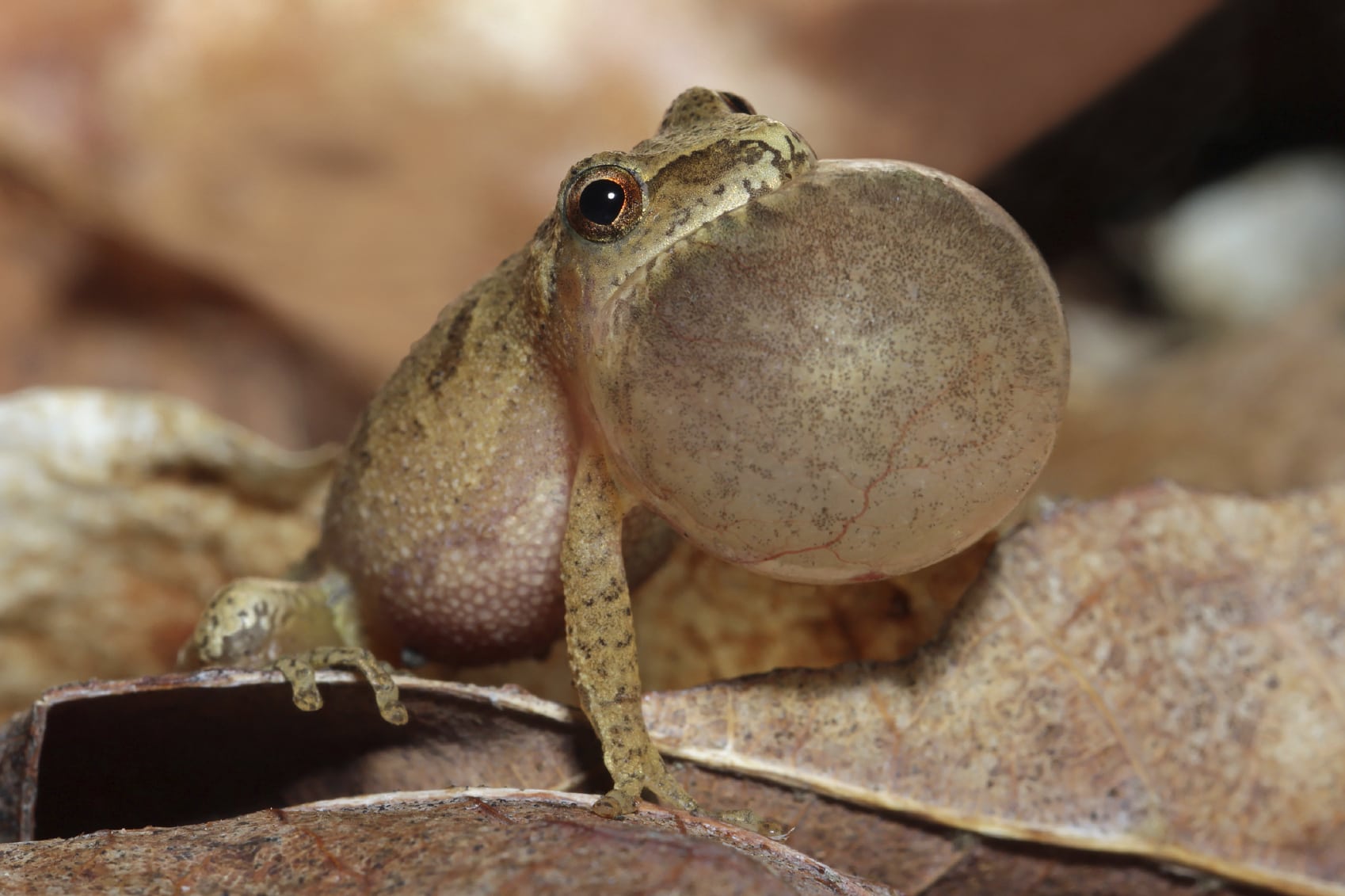
This bubble is actually the frog’s vocal sac. To make their calls, peepers close their nostrils and mouths and squeeze their lungs, which causes the vocal sac in the throat to inflate like a balloon. The peeping sound happens as air leaves the lungs, passes over the vocal cords, and into the vocal sac.
Did You Know Spring Peepers Can Survive Being Frozen?
Not all frogs in cold climates bury themselves deeply enough to avoid freezing temperatures in the winter. There are five species of frogs in North America that can freeze and survive. Two of them are the spring peeper and the western chorus frog. As temperatures dip below 32 degrees, these frogs start producing their own “antifreeze” (glucose) to help preserve the most essential organs. Up to 70 percent of the frog’s body can freeze, to the point that the heart stops pumping and the frog appears to be dead. Scientists still are not sure how frozen frogs can wake up again, but once they thaw out and wake up, most frogs will go through a period of healing before they resume their normal lives.
Habitat, Diet, and Other Froggy Facts
Because chorus frogs need still water to lay their eggs, you will find spring peepers, boreal chorus frogs, and western chorus frogs in predominantly marshy areas. Peepers especially love wooded wetlands or swampy areas near forested areas because they like to hibernate under tree bark or fallen logs.
Most chorus frogs are quite small. Spring peepers and western chorus frogs grow to a maximum of 1.5 inches, while boreal chorus frogs top out at just over an inch. Because of their minute size, these frogs feed on small bugs like ants and small beetles.
When it comes to looks, spring peepers are easily identified by a dark X-shaped marking across their backs. Other chorus frogs have spotted or striped markings.
Chorus Frogs at a Glance
| Species | Where | Sound | Look |
|---|---|---|---|
| Spring peeper (P. crucifer) | Eastern North America | Crisp, high “peep” 90 dB up close; sleigh-bell chorus | 1 to 1.5 in, tan-brown, dark X on back |
| Western chorus frog (P. triseriata) | Ohio to Arizona, north to central Canada | High creaky trill | 1 to 1.5 in, brown with three dark stripes |
| Boreal chorus frog (P. maculata) | Great Plains and Rockies, north to subarctic | Raspy comb-tooth chirp | 0.75 to 1.25 in, brown with three stripes or spots |
| Wood frog (Lithobates sylvaticus) | Eastern N. America, all the way to Alaska | Quacky, duck-like clack | 2 in, brown with dark “robber’s mask” |
A warm rainy night is a peeper night
Time your March walk to the first 45°F evening.
The Farmers’ Almanac extended forecast helps you spot the first warm rainy evening, the night the spring peeper chorus opens for the season.
Spring Peepers FAQ
What is a spring peeper?
A small (1 inch) tan-brown chorus frog of the eastern half of North America, Pseudacris crucifer. Named for the high, bell-like “peep” of the males during spring breeding season.
When do spring peepers start calling?
Usually in late March or April, after night temperatures climb above 45°F and a warm rain wets the leaf litter. The chorus peaks in April and quiets by late May or early June.
Why are they so loud?
A single male can hit 90 dB at close range, about the loudness of a lawn mower. Multiplied by a chorus of hundreds along a wetland, the sound carries half a mile.
Where do spring peepers go in the winter?
They tuck under tree bark, fallen logs, or leaf litter. When temperatures drop below freezing, their bodies pump glucose into their cells as natural antifreeze, allowing up to 70 percent of the body water to freeze without killing the frog.
How long do spring peepers live?
About 3 years in the wild, occasionally up to 5. Predators (snakes, large beetles, fish) account for most early deaths.
What do spring peepers eat?
Small insects: ants, springtails, beetles, gnats, spiders. Tadpoles graze on algae and detritus before transforming into froglets in 6 to 12 weeks.
Are spring peepers endangered?
No. They are listed as “least concern” globally, although local populations crash when wetlands are drained or paved over. Salt and fertilizer runoff also hits them hard.
Warm weather is almost here. If you have the chance, spend an evening outside listening to the sounds of spring. Among them, you will hear the chirps of these amazing little frogs. Take a listen to the sounds of the chorus of spring peepers here.
For more backyard wildlife reading, see our companion guides: animal weather forecasters, 10 fascinating facts about fireflies, and what the cardinal in your yard might mean.
All-Access Membership
Backyard wildlife plus the long-range forecast.
Members get the full archive: backyard wildlife guides, planting calendars by zip code, weekly garden updates, the long-range forecast, and the printable Almanac for the year ahead.


Amber Kanuckel
Amber Kanuckel is a freelance writer from rural Ohio who loves all things outdoors. She specializes in home, garden, environmental, and green living topics.
- Amber Kanuckel

- Amber Kanuckel
- Amber Kanuckel
- Amber Kanuckel





Hi, I’m Nick looking to populate Asheville valley w frogs…looking for natives like spring peepers, greys, leopards , crickets and bulls
I’m not able find hardly any ever
I forgot to mention I’m in NE. FL. and the pool is an inground chlorinated type.
Why do I keep finding so many peepers in my swimming pool? I have both a small swamp and small section of wooded area close by, within 100 yards, so it’s not like they don’t have a water source.
They would prefer the swamp, but a pool also attracts insects that frogs prefer as a meal. So where there are bugs – the peepers will follow.
Quick note: It’s “predominantly” in the context of your sentence. Certain things can “predominate”, but use of “predominately” is becoming one of those toxically common errors that are spreading due to meme-like misinformation people don’t bother to verify with a dictionary.
The article is otherwise informative and helpful; fixing the typo would make it that much closer to perfect! ?
“Predominantly and predominately are interchangeable, they both mean for the main part, mostly. The Oxford English Dictionary accepts both spellings, as both words date back to the mid-1500s. However, many scholars prefer the word predominantly.”
Thanks for sharing your personal preference on this word with us.
are there cycle of birth rights…meaning is there more births per year than other years
We just found a peeper in our toilet. We live in Northeast PA and it is early October. How do you think it got in there? And since it was flushed will it possibly come back up?!
where can you find them in august in southwest ohio, certain trees, bushes, ground covering?
I love listening to the peepers.If i put an airater in my pond will it harm the frog population?
PS.: If keeping adult peepers for a longer time or indoors, please google “spring peepers pet” and you’ll find out which bugs to feed them and other useful information!
I kept tadpoles until they were fully developed, then released them. Very cute.
For those curious about what to feed your peepers, I have raised peepers to maturity. I did not feed them anything, but kept them in an open tank with local marsh water, marsh “muck” and local soil and plants. If you have acquired peepers you can probably also acquire these. The water and marsh muck contains all types of small animals appropriate for peepers and will not become toxic with their wastes as it contains the full lifecycle of bacteria. However, I’d use a fish tank nitrite/nitrate test on occasion just to be sure. Happy peeping!