
Mistletoe Meaning: Why We Kiss Under It, Lore, Etiquette
Ever wonder why kissing under the mistletoe is a Christmas tradition? We have the answer, plus many facts and lore about this strange parasitic plant.

Quick Reference: Mistletoe Meaning at a Glance
- What it is: a parasitic evergreen that roots into the branches of host trees and shrubs.
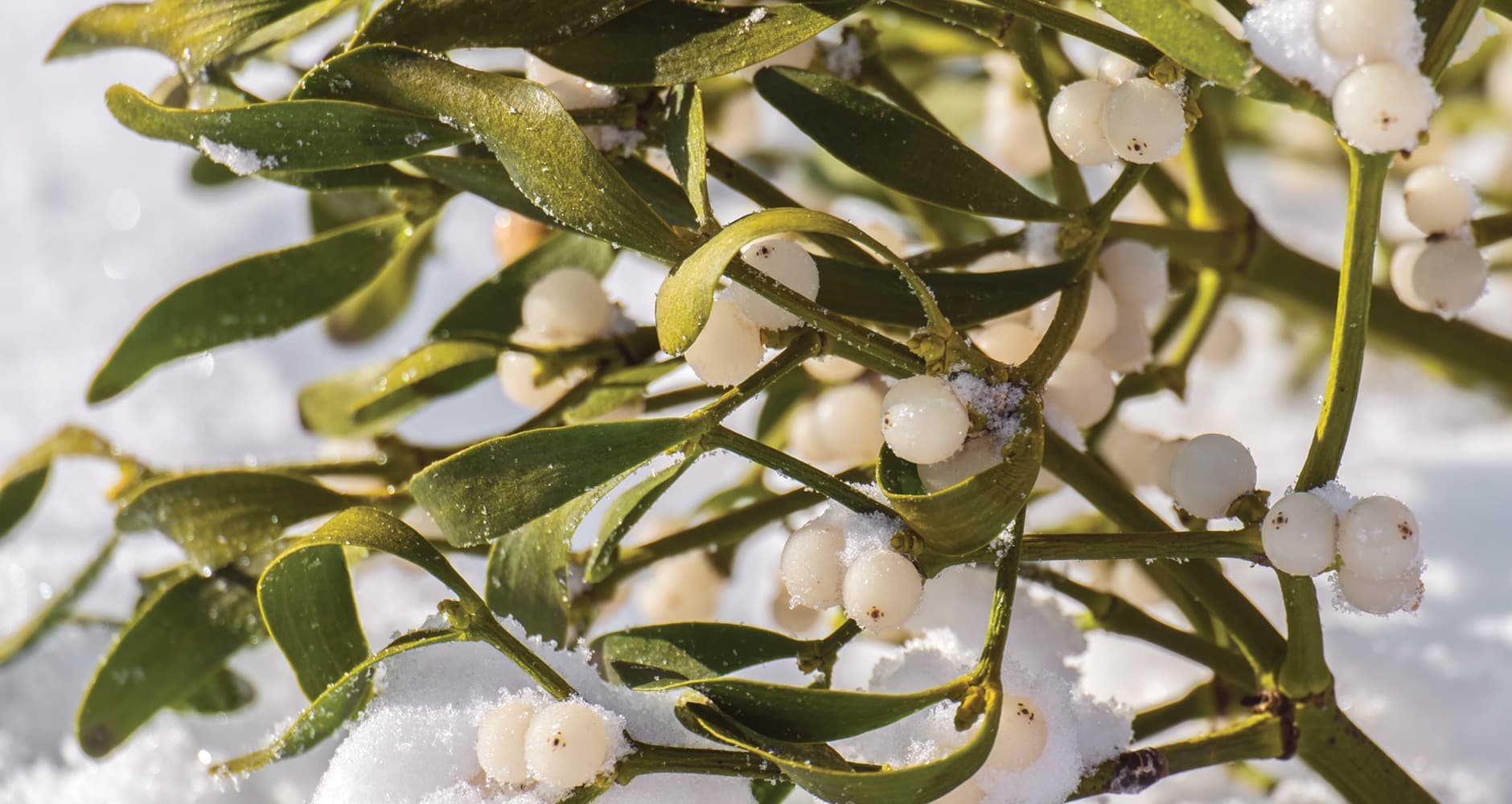
- Look: small, smooth oval leaves paired on a woody stem, with clusters of waxy white berries.
- Why we kiss under it: the custom traces to Norse legend, where Frigga declared mistletoe a symbol of love after her son Baldur was restored.
- Etiquette rule: pluck one berry per kiss; when the berries are gone, the sprig is done.
- Safety note: berries are mildly toxic. Keep them away from kids and pets and wash your hands after handling.
- When to hang it: any time from late November through the holidays, with the most kissing happening around Christmas and New Year’s Eve.
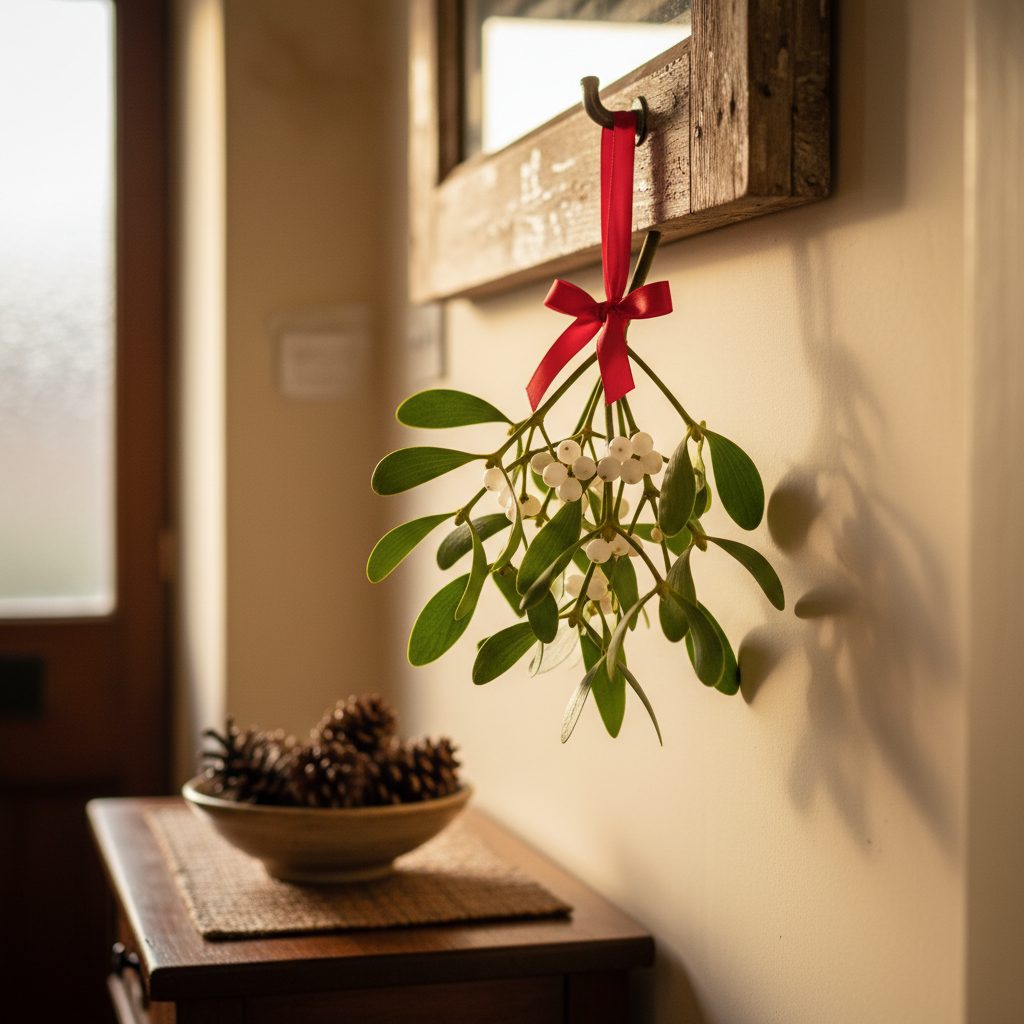
Oh, ho, the mistletoe,
Hung where you can see.
Somebody waits for you;
Kiss her once for me!
The mistletoe meaning most of us were handed (kiss under it, somebody waits for you) is the polite Victorian version. The older meaning is stranger. From hauling a fresh tree into the parlor to banging pots and pans at midnight, this time of year is stacked with colorful, well-worn, and sometimes strange traditions. Kissing under the mistletoe is one of them: a parasite with a soft side, a Norse origin story, and a strict berry-by-berry etiquette that most modern kissers have forgotten. Here is what mistletoe actually is, where the custom came from, and how to handle it without poisoning the dog.
For botanical background on the plant itself, the Encyclopaedia Britannica entry on mistletoe covers the two main genera (Viscum in Europe, Phoradendron in North America) and how each one feeds off its host.
What Is Mistletoe?
Mistletoe is a parasitic plant that grows on, and attaches itself to, the branches of a tree or shrub. As it grows, it burrows into its host and draws nutrients and water straight from the tree’s vascular system. To a healthy, mature tree, mistletoe’s thievery is generally harmless. In fact, some ecologists describe the relationship as loosely symbiotic, because birds drawn to the plant’s evergreen leaves and white berries often spread the host tree’s seeds in winter, increasing the overall tree population in the surrounding woods.
Mistletoe shows small, smooth, oval leaves paired up along a woody stem, with waxy white berries in clusters of up to six or ten, depending on the species. It is an important food source for many bird species (cedar waxwings, robins, bluebirds) and a winter shelter for some songbirds. For humans, it is a different story. The berries can be mildly toxic and cause diarrhea and gastrointestinal discomfort, so it is best to wash your hands after handling them and to keep stray berries off the floor where pets or small children might find them.
European Mistletoe vs. American Mistletoe
| Type | Botanical name | Native range | Typical hosts |
|---|---|---|---|
| European mistletoe | Viscum album | Britain, continental Europe, western Asia | Apple, hawthorn, poplar, lime |
| American (eastern) mistletoe | Phoradendron leucarpum | Eastern U.S., from New Jersey south to the Gulf | Oak, elm, black gum, pecan, hickory |
| Dwarf mistletoes | Arceuthobium spp. | Western U.S. and Canada | Conifers (pines, firs, spruces) |
The sprigs sold at Christmas markets in the U.S. are usually American mistletoe, often harvested from oak or pecan stands in the Southeast. European mistletoe is the one in most of the old folk tales, and it is the species the Norse and the Druids would have known.
Why Do We Kiss Beneath The Mistletoe?
The custom of kissing under the plant most likely originates in Norse mythology, then picks up extra layers from Druidic ritual, English servant-hall customs, and Victorian-era parlor games. By the time it reaches the modern family Christmas tree, it has been re-told so many times that almost nobody remembers the spear-throwing god at the bottom of it.
The Norse Legend Behind the Mistletoe Meaning
According to legend, Baldur, the Norse god of light, began to have terrible nightmares that he would soon be killed. To ease his mind, Baldur’s mother, Frigga, undertook a journey to make everything in heaven or on Earth, plants, animals, weapons, stones, and so on, swear an oath not to harm her son. Because Baldur was so universally loved, everything she asked gladly made this promise. Unfortunately, the goddess overlooked the humble mistletoe, which she judged too small and harmless to bother with.
Realizing Frigga’s mistake, Loki, the god of mischief and fire, fashioned a spear (or in some versions a dart) of mistletoe and tricked Baldur’s blind twin brother, Hodur, into throwing it at the light god during a game in which the other gods, knowing nothing could hurt Baldur, were pelting him with stones and weapons for sport. The mistletoe pierced Baldur’s heart, killing him and bringing darkness to the world. Being magical, the gods were eventually able to resurrect Baldur. To celebrate his return, Frigga declared that mistletoe would be a symbol of love, and commanded gods and humans to kiss beneath its leaves in memory of her son.
Some versions of the myth say Loki foiled the gods’ attempt to restore Baldur to life. In that telling, it is prophesied that the light god will return at Ragnarok, the destruction and rebirth of the world, and the mistletoe kiss is a foretaste of the joy that is yet to come. Either way, the plant ends up standing for love after a brush with death, which is a pretty Norse way to start a holiday tradition.
Druids, Romans, and the Victorian Revival
The Celtic Druids of Britain and Gaul revered mistletoe that grew on oak, which was rare and considered sacred. The Roman writer Pliny the Elder described white-robed Druids cutting it with a golden sickle on the sixth day of the moon, catching the sprigs in a cloth so they never touched the ground. The plant was believed to heal disease, neutralize poisons, and bring fertility to people and livestock. The Romans themselves used mistletoe at the midwinter feast of Saturnalia, which is one of the lines of descent that eventually fed into our December holidays alongside the gift-giving traditions tied to Saint Nicholas.
The mistletoe kiss as we know it (a stolen kiss under a sprig hung indoors) shows up clearly in 18th-century England, often as a custom of the servant class, where a young man could claim a kiss from any woman caught standing under the plant. Each successful kiss meant plucking one of the white berries. Victorian writers, including Washington Irving and Charles Dickens, popularized the custom for middle-class readers in the 1820s, 1830s, and 1840s, and from there it crossed the Atlantic and settled into the American holiday playbook.
Superstitions and Lore
Like many plants tied to rebirth myths, mistletoe came to stand for fertility and protection. People once placed it above babies’ cradles to guard them from evil or mischievous spirits, and young girls placed it under their pillows on Christmas Eve hoping to dream of their future husbands, the same way other unmarried women later did on New Year’s Eve or on the night before Valentine’s Day. In parts of rural England, a sprig was kept above the door year-round and replaced each Christmas, with the old sprig burned to keep bad luck from settling on the house.
The plant was also called “all-heal” in Druidic and folk medicine and was thought to ward off lightning, witches, and the evil eye. Modern researchers have studied compounds from European mistletoe (Viscum album) in cancer therapy in Germany and other parts of Europe; this is a separate, modern medical topic and the berries you bring home for the holiday are not a home remedy.
Mistletoe Etiquette
The traditional rule is that the man removes one white berry each time he kisses a woman beneath the sprig. When all the berries are gone, the kissing is over, and it is considered bad luck to kiss beneath that particular sprig after that. Modern households can read the rule however they like, but the berry-per-kiss limit was the original brake on the custom. Throw all plucked berries away as soon as the kissing is done and wash your hands. The berries can be mildly poisonous and can cause minor skin irritation, especially on children with sensitive skin.
Grow Your Own!
To cultivate mistletoe, squeeze the thick, sticky pulp out of several mistletoe berries and rub the seeds, spaced about an inch apart, into the bark of a young, thin tree branch on a willing host (apple is the classic choice for European mistletoe; oak, elm, or hawthorn work for American). Late winter through early spring, when the host tree is starting to wake up but still leafless, is the easiest window. Unless they are eaten by birds, the seeds should grow on their own without much help from you, taking nutrients from the host tree. Expect 3 to 5 years before you have a sprig worth cutting, and choose a host you do not mind sharing with a long-term tenant.
Mistletoe FAQ
What is the mistletoe meaning, and why do people kiss under it?
The custom most likely traces back to the Norse myth of Baldur, in which Baldur’s mother Frigga declared mistletoe a symbol of love after her son was restored. The kissing-under-a-sprig version of the tradition shows up clearly in 18th-century England and was popularized for middle-class readers in the Victorian era by writers like Washington Irving and Charles Dickens.
Is mistletoe poisonous to humans, dogs, or cats?
The white berries and leaves contain compounds that can cause stomach upset, vomiting, and diarrhea in humans, and similar reactions in dogs and cats, sometimes worse in small pets. Reactions are usually mild but can be serious in children or animals who eat several berries, so hang the sprig out of reach and sweep up any fallen berries. If a child or pet has eaten mistletoe, call Poison Control or your veterinarian.
What is the proper mistletoe-kissing etiquette?
The traditional rule is one berry per kiss. The man (in the original custom) plucks a single white berry from the sprig each time he kisses a partner under it, and when the berries are gone, the kissing is over. Modern households reinterpret the rule freely, but the berry count was the original built-in limit.
When should you hang mistletoe, and when should you take it down?
Most households hang mistletoe with the rest of the holiday greenery, anywhere from late November to mid-December, and leave it up through New Year’s Eve or Twelfth Night (January 5 or 6). In old English tradition, the sprig was burned when it came down to keep bad luck from settling on the house.
Is mistletoe a parasite, and does it kill the tree it grows on?
Mistletoe is a hemiparasite. It taps the host tree for water and nutrients but also produces its own chlorophyll. A healthy mature oak, apple, or elm can carry several clumps with little harm. Heavy infestations on already-stressed trees, or any infestation of dwarf mistletoes on western conifers, can slow growth and shorten the tree’s life.
What is the difference between European mistletoe and American mistletoe?
European mistletoe (Viscum album) is native to Britain, continental Europe, and western Asia and prefers apple, hawthorn, poplar, and lime trees. American mistletoe (Phoradendron leucarpum) is native to the eastern and southern United States and is most often found on oak, elm, black gum, pecan, and hickory. The two look similar, with paired oval leaves and white berries, and both carry the same kissing tradition.
Why is mistletoe associated with Christmas instead of, say, Easter?
Mistletoe stays green and bears its white berries in midwinter, when most other plants are bare. Pre-Christian midwinter festivals (Saturnalia in Rome, Yule in Northern Europe) used evergreens as symbols of life carrying through the dead season. When those festivals were absorbed into Christmas, the holly, ivy, and mistletoe came with them, and mistletoe held on as the kissing plant.
If you want more of the season’s strange customs, our guide to unusual winter traditions is a good next stop, and our luck-and-superstition file covers the Friday the 13th and New Year sides of the same family.


Jaime McLeod
Jaime McLeod is a longtime journalist who has written for a wide variety of newspapers, magazines, and websites, including MTV.com. She enjoys the outdoors, growing and eating organic food, and is interested in all aspects of natural wellness.
- Jaime McLeod

- Jaime McLeod
- Jaime McLeod
- Jaime McLeod





Here in Georgia, after the leaves are off the oaks, you can see big bundles of mistletoe growing because it’s always green. But it seems it’s always way up in the trees beyond reach.
Oh wow! That’s awesome you can see it, but too bad you can’t pick it. Thanks for leaving a comment!
I have put a lead sinker on a fishing line and and cast with the line and used the reel to “catch mistletoe”..Safer in some areas than shooting it out of a tree.
We used a .22 rifle to knock it off cottonwood trees. I haven’t known of anyone doing that since the 70’s.
Here in North East Ohio you can no longer find mistletoe to buy. The only thing available are the plastic ones. It used to be available at the Christmas tree lots and garden centers and sometimes even in the grocery and hardwares stores. Once it was declared “poisonous” it was taken off the market. I miss the real stuff.
I have never seen mistletoe kill a tree ever.
I’ve used a shotgun to remove it from trees at Christmas time. I’ve only seen it grow on the black gum tree.
Mistetoe species are adapted to on a particular species or genus of tree, so trying to grow mistetoe on a tree will require getting the right spp of mistetoe, and many tree and shrub spp are not hosts for mistetoe. Mistetoe is rarely fatal for a tree but does make a tree much better for many wildlife species due to the large branches that often form, making great perches and nesting platforms.
went yestarday an shot some out do it every year
Mistletoe actually causes a growth on meskite trees. It’s growth causes the wood to make burly wood used in knife handles,gun grips, and exotic woodworking.
A Christmas Eve tradition in my neck of the woods was to shoot it out of the top of oaks…proving your skills with a .22 rifle and carrying it home for Christmas Eve kiss from your girl.
Roupes Valley Alabama