
Do You See A Sun Dog or Sun Halo?
Quick Reference
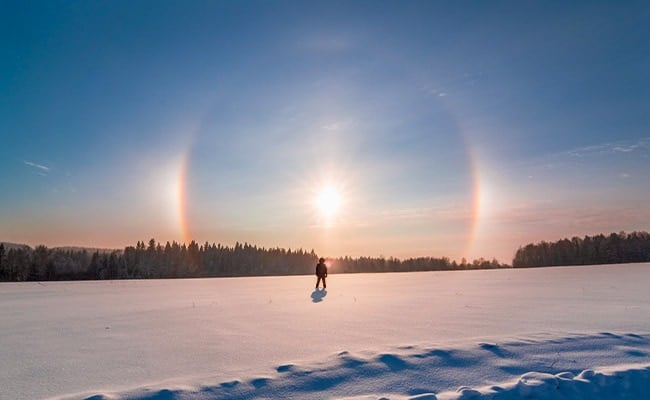
- Sun dog: A dim, fuzzy “second sun” 22 degrees to the left or right of the Sun.
- Sun halo: A full ring of light, usually 22 degrees, when ice crystals fill the sky.
- Sun pillar: A vertical shaft of light extending straight up from the rising or setting Sun.
- Cause: Hexagonal ice crystals high in the atmosphere refracting or reflecting sunlight.
- Sailor’s lore: A halo means unsettled weather is 18-24 hours away.
Is there a little piece of rainbow hanging in the sky next to the Sun? How about a strange circle of light around it? You may be seeing a Sun dog (sundog) or Sun halo. Learn what causes these sunny sensations and what they may say about the weather coming your way.

What Is A Sun Dog (Sundog)?
Sun dogs, also known as mock Suns or false Suns, are dimmer, fuzzier copies of the Sun that appear to the left and right. They form when sunlight bends through hexagonal ice crystals high in the sky, especially when cirrus clouds are present. Sun dogs often display the colors of the rainbow (with reds facing toward the Sun and blues away from it).
Depending on the sky conditions, you may only see one or two Sun dogs approximately 22 degrees (about the distance of two fists) away from the Sun. When there are more ice crystals in the atmosphere, Sun dogs can extend all the way around to create a full circle, a Sun halo.
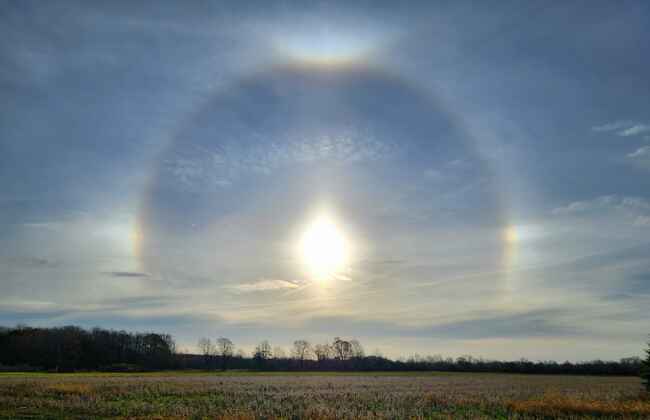
Sun dogs and sun halos may occur at any time of the year, but are almost always noticeable when the Sun is lower in the sky, about an hour or two before the Sun sets or an hour or two after sunrise. If wispy clouds are in the sky, their colors are more pronounced.
The most common Sun halo is a circle with a 22-degree radius around the Sun that is often brighter on the top and bottom. (If you block the Sun with your thumb, your pinky should touch the edge of the halo. Note: Do not look directly into the Sun.)
Related: Moon Halo And Night Rainbow (Moonbow) Explained
Sun Halo Weather Lore
Sailors who saw a halo or ring around the Sun or Moon often believed that unsettled weather was 18-24 hours away.
The lore tracks the science. Halos form in cirrus clouds at 20,000 to 40,000 feet, the leading edge of an approaching warm front. The cirrus arrives 12 to 24 hours ahead of the front itself, which brings the rain, snow, or wind. Old Almanac weather watchers used the halo as a free 24-hour forecast.
Sun Pillars
On rare occasions, you may see a narrow, vertical shaft of light extending straight up from the Sun at sunrise or sunset. This is a Sun pillar.
Sun pillars develop when ice crystals slowly fall through the air. Air resistance causes these crystals to lie nearly flat as they flutter to the ground.
Unlike halos, the crystals do not refract or bend light. Instead they reflect the rays of the Sun. When the crystals align they create a pillar effect.
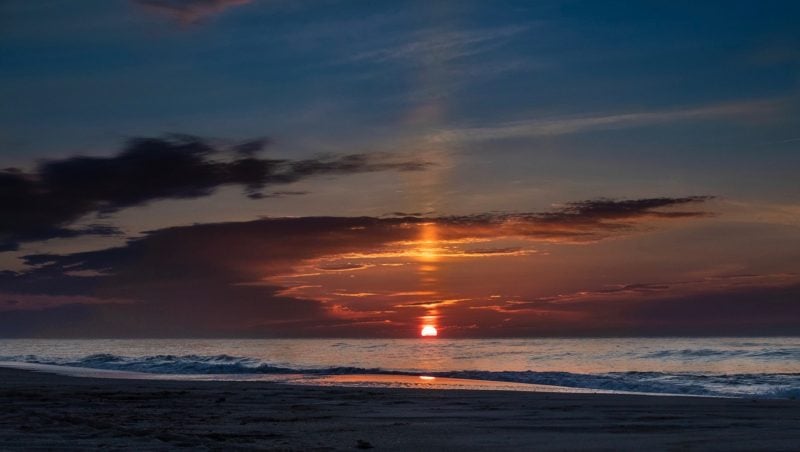
Sun pillars usually appear 5-10 degrees high, sometimes even higher. (Your clenched fist held at arm’s length measures roughly 10 degrees.) Pillars can sometimes appear even longer and brightest in the moments just before sunrise or just after sunset.
They may take on the colors of the Sun and clouds or appear white. Other times they are shades of yellow, red, or (infrequently) purple.
On rare occasions, the same phenomenon occurs with rising or setting of the Moon, though it is not as bright.
Quick Comparison
| Phenomenon | Shape | Crystal action |
|---|---|---|
| Sun dog | Bright spots 22 degrees left and right of Sun | Refraction through hexagonal crystals |
| Sun halo | Full 22-degree ring | Refraction through randomly oriented crystals |
| Sun pillar | Vertical shaft above or below Sun | Reflection off flat-falling crystals |
The National Weather Service includes optical phenomena in its public-education guides, since they are reliable indicators of upper-atmosphere conditions and approaching fronts.

Frequently Asked Questions
What is a sun dog?
A bright, often rainbow-colored spot that appears 22 degrees to the left or right of the Sun. Also called a mock Sun or false Sun. Caused by sunlight refracting through hexagonal ice crystals in cirrus clouds.
What is a sun halo?
A complete circle of light around the Sun, usually with a 22-degree radius. When ice crystals fill the sky in random orientations, sun dogs extend all the way around into a halo.
Does a sun halo predict rain?
Sailor lore says rain or unsettled weather follows a halo within 18 to 24 hours. The science backs the lore: halos form in the cirrus clouds at the leading edge of a warm front, which brings the precipitation a half-day later.
What is a sun pillar?
A narrow vertical shaft of light extending up from the Sun at sunrise or sunset. Caused by sunlight reflecting off flat-falling ice crystals, not refracting through them.
When is the best time to see a sun dog?
When the Sun is low, about one to two hours after sunrise or one to two hours before sunset. Cirrus or wispy high clouds make the colors more pronounced.
Can I see these phenomena around the Moon?
Yes. Moon dogs, moon halos, and moon pillars all happen for the same optical reasons. The dimmer light makes them harder to see but easier to photograph.
How do I measure 22 degrees in the sky?
Two fists held at arm’s length cover roughly 20 degrees. If you cover the Sun with your thumb at arm’s length and your pinky just reaches the edge of the halo, that is the classic 22-degree halo.
Join The Discussion
Have you ever seen a Sun halo or Sun dog?
Share your photos of sunny sightings.
Have any questions? Let us know in the comments section below.


Dean Regas
Dean Regas is an astronomer and author of seven books including 100 Things to See in the Night Sky and How to Teach Grown-Ups About Pluto and host of the popular astronomy podcast Looking Up with Dean Regas. He can be reached at: www.astrodean.com

Joe Rao
Joe Rao is an esteemed astronomer who writes for Space.com, Sky & Telescope, and Natural History Magazine. Mr. Rao is a regular contributor to the Farmers' Almanac and serves as an associate lecturer for the Hayden Planetarium in New York City.
-
Joe Rao

-
Joe Rao
-
Joe Rao
-
Joe Rao



seen my first sun-dog and it was beautiful i am 76 and always outside and my first citing-i would put a picture here but don’t know how