
Thundersnow Explained:When Lightning and Thunder Hit During a Snowstorm
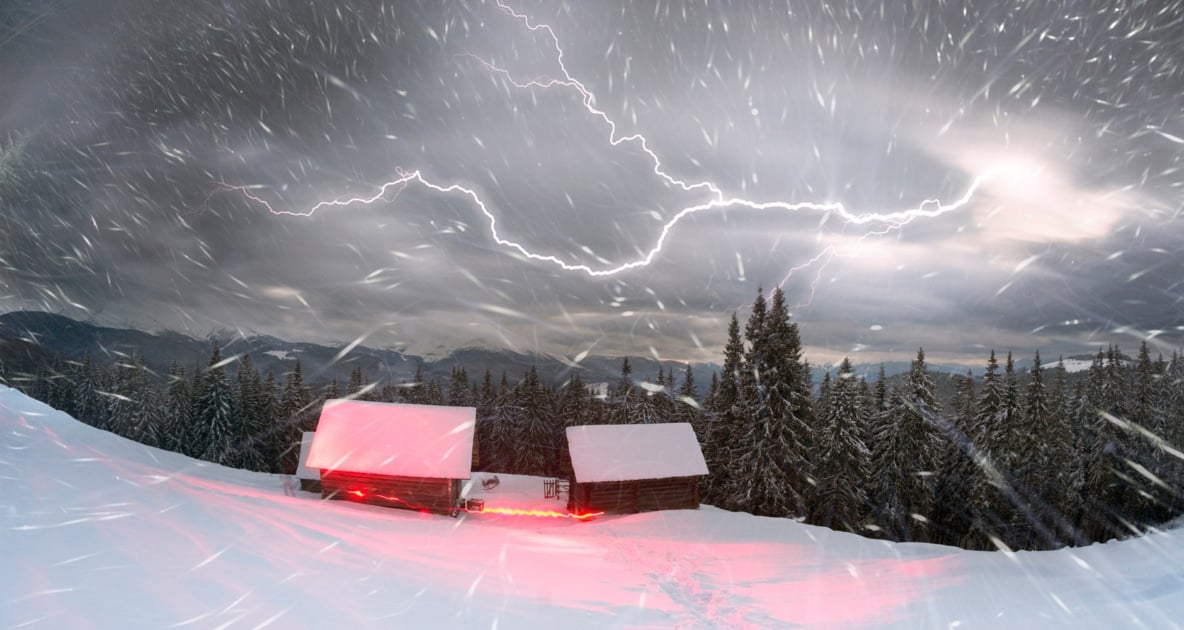
Thunder and lightning during a snowstorm? Thundersnow is a real thing, and may be coming to your neighborhood soon!
Quick Reference
- What it is: Thundersnow, a thunderstorm that drops snow instead of rain. Rare, but real.
- Where it happens most: The Great Lakes region in winter and the East Coast during strong nor’easters.
- Why it is rare: Winter air is colder and drier near the ground, which reduces the kind of overturning instability that fires regular thunderstorms.
- How to spot it: Heavy snow, lightning, and a low rumbling thunder muffled by the snow itself.
- Famous examples: The 1966 Donner and Blitzen Christmas Eve snowstorm, the Blizzard of ’78, and the Blizzard of ’96.
- Best companion read: Almanac Nor’easter explainer and historic blizzards archive.
Spring and summer thundershowers are common in most parts of North America. What about thunderstorms in the winter time? Winter thunderstorms, also known as “thundersnow,” are a somewhat rare type of thunderstorm during which snow, rather than rain, falls as the primary form of precipitation.

What Is Thundersnow?
Thunderstorms occur when an air mass becomes so unstable that it overturns violently. This usually happens when drastically different temperatures meet, such as when the air closer to the ground is unusually warm and humid and the air above it is unusually cool. Because the lower layers of air are colder, and have a lower dew point, in the wintertime, these kinds of atmospheric clashes are very unusual during colder months. Still, thundersnow does happen.
Thundersnows are most common in the Great Lakes region, when cold air blows across the relatively mild water of the Great Lakes, forcing the air upwards rapidly enough that the instability causes lightning and thunder in conjunction with heavy snow. This same effect can happen along the East Coast, when an icy cold Nor’easter moves into a region on the heels of a warmer front.
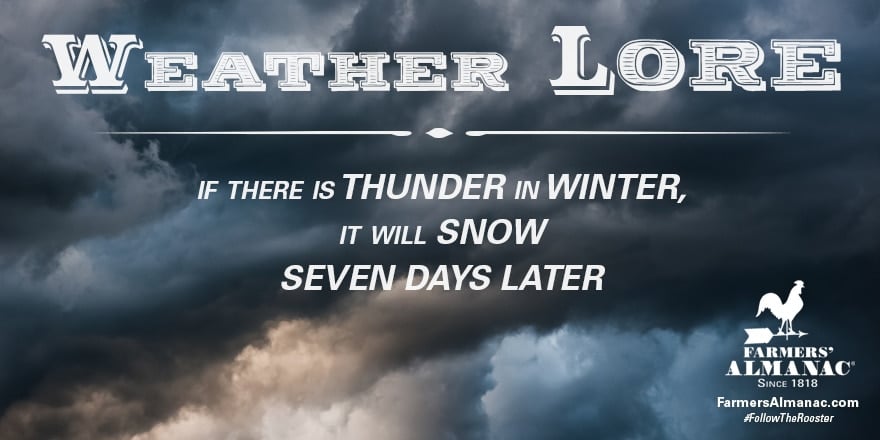
Thunder has accompanied some of the most memorable snow storms of the last several years. A Christmas Eve snowstorm that hit parts of the Middle Atlantic and New England in 1966 was accompanied by so much lightning and thunder that weather historian David Ludlum referred to it as the “Donner and Blitzen Snowstorm.”
Thundersnows were also observed during the Blizzard of February 1978 over New England, and the Blizzard of 1996 over the Northeast US.
Who can forget the Weather Channel’s Jim Cantore and his enthusiastic encounter with 5 thundersnows in a row? See the video below.
How Thundersnow Forms
- Cold air aloft. A pocket of very cold air aloft sits above slightly warmer air at the surface.
- Lift. A storm system, a lake, or a coastal front pushes the warmer surface air upward.
- Instability. The temperature difference fires the same vertical motion that creates summer thunderstorms, but in winter.
- Snowflakes electrify. Ice crystals collide inside the cloud, separating positive and negative charge the way ice and water do in a summer storm.
- Lightning fires. When the charge difference exceeds the dielectric strength of the air, you get lightning. Snow muffles the thunder, which is why thundersnow rumbles low and short instead of cracking sharp.
Where to Hear It
| Region | Common trigger | Typical timing |
|---|---|---|
| Great Lakes (US + Canada) | Cold air across mild lake water | December through early February |
| Northeast (US) | Strong nor’easter on the heels of a warm front | January and February |
| Mid-Atlantic | Coastal nor’easter or Gulf low | December through March |
| Mountain West | Strong upslope flow with cold dome above | December through April |
| Pacific Northwest | Atmospheric river with cold core | November through March |
| South (US) | Major Gulf low with arctic intrusion | Rare; once-a-decade events |
What It Sounds Like
Snow absorbs sound the way carpet absorbs footfalls. Thundersnow rumbles low and short, often described as a long muffled boom rather than a sharp summer crack. Lightning still flashes through the storm. Sometimes the flash will reflect off snowflakes overhead and turn the cloud bottom briefly green or purple. Reports of “purple snow” usually trace back to a thundersnow strike at close range. For more on related cold-weather phenomena, see our explainers on diamond dust snow and the science of lake-effect snow.

Frequently Asked Questions
What is thundersnow?
Thundersnow is a thunderstorm that drops snow instead of rain. The same kind of vertical instability fires lightning and thunder, but the precipitation falls as snow. The phenomenon is rare but real.
Why is thundersnow rare?
Winter air near the ground is colder and drier than summer air, which reduces the temperature contrast that fires regular thunderstorms. The contrast still develops in places like the Great Lakes shoreline and within strong nor’easters, which is where thundersnow shows up.
Where does thundersnow happen most often?
In the Great Lakes region, where cold air blows across mild lake water, and along the East Coast during strong nor’easters that move in on the heels of a warmer front. The Mid-Atlantic and Mountain West also get it occasionally.
Why does thundersnow sound different?
Snow absorbs sound, so the thunder rumbles low and short rather than cracking sharp like a summer storm. Some witnesses describe a long muffled boom that seems closer than it really is.
What is the Donner and Blitzen Snowstorm?
A Christmas Eve snowstorm in 1966 that hit the Middle Atlantic and New England with so much lightning and thunder that weather historian David Ludlum gave it the name. It is one of the best-documented historical thundersnow events.
Is thundersnow dangerous?
The lightning is just as dangerous as in a summer storm. The bigger danger is usually the heavy snow that comes with it, since thundersnow often pairs with snowfall rates over two inches per hour. If you hear thunder during a snowstorm, treat it like a regular thunderstorm and stay indoors.
Has Jim Cantore really filmed five thundersnows in a row?
Yes. Cantore’s reactions on The Weather Channel during a 2015 nor’easter showed five thundersnow strikes in a single broadcast. The clip is in the embedded video above and remains the most-shared thundersnow footage in television history.
Join The Discussion
Lived through a thundersnow? Tell us where you were, when it hit, and what the sky looked like at the strike. Share your experience in the comments below.


This article was published by the Staff at FarmersAlmanac.com. Any questions? Contact us at questions@farmersalmananac.com.
- Farmers' Almanac Staff

- Farmers' Almanac Staff
- Farmers' Almanac Staff
- Farmers' Almanac Staff





We had thunder snow here in Albuquerque, New Mexico about 3:00 pm today 1/29/25. It blew through and now we have a clear blue sky right before the sun goes down
We got thundersnow in Kentucky yesterday, scared me pretty good when the first thunderstrike hit
It is 1:25am in Portage county Ohio and it is thunder snowing here. I seen the lightning and heard 2 very loud thunder roars.
Maybe Jim may want to slow down on the coffee, I’ve heard thundersnow a bunch of times right here in KC, pretty rare but ……
???
It’s 2:16 a.m. and thunder lightning and snow is happening near south haven michigan 12/27/2021
.
Hi. It is almost 4a.m. in Southeasr Texas and we are experiencing our first thunder snowstorm! Feb. 15,2021!
I remember driving home from work one night during a blizzard in southern Minnesota. Outside my car windows I saw flashes of light, several a minute. I didn’t know what it was. At first I thought maybe it was the light from a cell tower. Then I realized it was lightning. Weird thing is, there was no thunder. The snow was so thick it blocked the sound. I barely made it home.
I believe I first experienced thundersnow during the Blizzard of 1978, in Toledo, Ohio, when I was in first grade, or so, but not exactly sure. However,I definitely remember it distinctively in a January, 1992 storm, where I had to drive to work in it. It was early morning, my shift started at 6, and I backed out of the driveway all right, but got stuck as soon as I hit the street. Seven inches had fallen overnight little did I know. I had to dig a path out with a shovel just to get going. Later, at work, I witnessed the thunder and lightning several times. I witnessed this unusual phenomena a handful of times during the 1990s, but never since for some reason.
Incredible, isn’t it, Brian S.?
Susan you are so right,March 13,1993,thunder woke me up and I knew it was suppose to snow so I got up and looked out the window and we had 8 plus in. in Douglasville GA
The “Storm of the Century”
It is a rare event indeed, but sometimes it does thunder during snow storms, hence the term Thunder Snow. However, in the U.S. there has never been a case of lightening during a snow storm. You can factcheck by going to weatherpedia and overgroundweather.com.
Hi Jimmy, sorry but lightning and thunder go hand in hand, snow or no snow. From this nor’easter alone on 3/7, there were 2,000 lightning strikes. Even directly from Weather.com, “Thundersnow is a snowstorm event in which thunder and lightning occur. “
We’ve had lightning come into the house and jump across the room to the fireplace during a thundersnow storm. Fact is, you can’t have thunder without lightning.
It’s like you didn’t read or watch the video of the American meteorologist literally filming it. Just another troll who uses a fake name …