

Moon Garden: How to Plant a Night-Blooming Garden That Glows by Moonlight
As you plan your spring garden, why not create a backyard oasis with a Moon Garden that you can enjoy on moonlit night? Try these easy ideas to create yours!
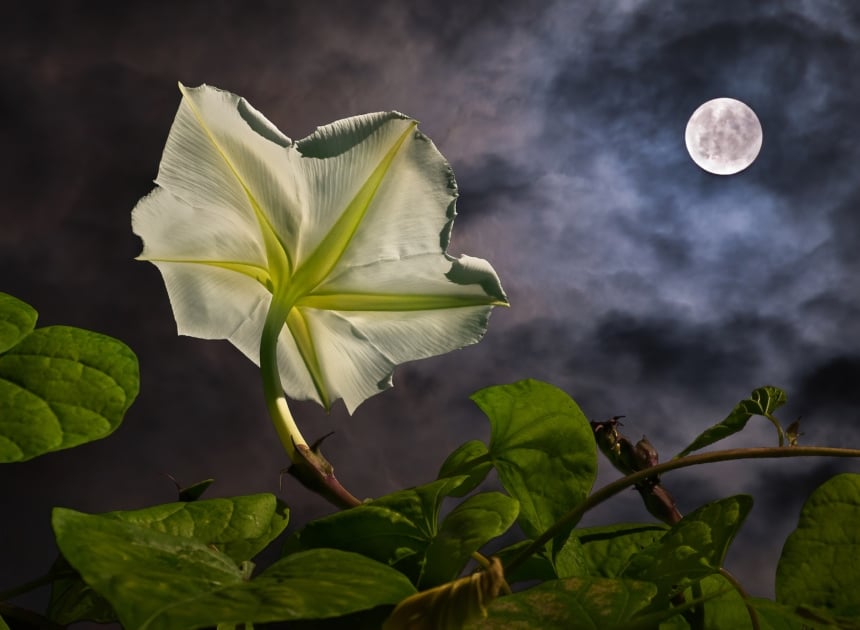
Quick Reference: The Moon Garden
- What it is: a garden of white and silver-foliage plants that reflect moonlight after dark.
- Best location: a patio, deck, or path edge where you spend evenings.
- Color rule: all-white flowers, silver-leafed plants, or pale yellow.
- Fragrance bonus: include night-scented species like jasmine, moonflower, or evening primrose.
- Top picks: moonflower vine, white nicotiana, datura, silver lamb’s ear, dusty miller, white phlox.
- Best season: June through September, peak bloom and warmest evenings.
A moon garden is a garden built specifically to glow under moonlight: all-white or silver-foliage plants, ideally fragrant ones that release their scent after sunset. The first famous moon garden was designed by Vita Sackville-West at Sissinghurst Castle in 1949. The concept has spread because the result is striking: by day the garden reads as elegant; by night, under any moon brighter than a quarter, the white plants almost seem to fluoresce.
Design Principles
The rule of thumb is simple: white flowers and silver foliage reflect moonlight, while colored flowers absorb it and disappear into the dark. Design choices that work:
- Plant in clusters of three or five of the same species for visual density at night.
- Choose plants of different heights to create vertical layers: tall datura at the back, mid-height white nicotiana, low silver lamb’s ear at the edge.
- Include some night-blooming species so the garden actively opens after sunset.
- Place it where you can see it from the porch, patio, or kitchen window.
Best Plants for a Moon Garden
A working short list, selected for visibility in low light and (where possible) night fragrance.
- Moonflower vine (Ipomoea alba): giant white flowers open at dusk, intensely fragrant.
- White nicotiana (Nicotiana sylvestris): trumpet-shaped white flowers, jasmine-scented at night.
- Datura (Datura inoxia): dramatic white trumpets, but toxic to pets and children if eaten.
- White phlox (Phlox paniculata ‘David’): fragrant clusters, mid-summer to fall bloom.
- Silver lamb’s ear (Stachys byzantina): soft silver foliage, reflects moonlight beautifully.
- Dusty miller (Senecio cineraria): low silver edging.
- Evening primrose (Oenothera biennis): pale yellow flowers that open in late afternoon.
- White cosmos: tall, airy, white blooms throughout summer.
When to Visit Your Moon Garden
A moon garden reads best at first quarter moon to full moon, and best on clear nights without much light pollution. The Almanac’s moon phases page tells you which nights in your area will have the most moonlight. Plan one or two evenings each month around the brightest moonrise.

Frequently Asked Questions
Where did the moon garden concept come from?
Vita Sackville-West designed the famous White Garden at Sissinghurst Castle in Kent, England in 1949. The idea spread through gardening magazines and is now a common feature in modern American garden design.
What kind of soil and sun do moon-garden plants need?
Most do well in full sun to part shade with well-drained soil. Many are drought tolerant once established.
Are moon gardens just for big yards?
No. A moon garden can be three pots of white nicotiana on a patio or a single border along a walkway. The concept scales down to balcony size.
Are any of these plants dangerous?
Datura is highly toxic if eaten, and should not be planted where children or pets browse. Other plants on the list are safe but, like most flowering plants, not edible.


Sheryl Normandeau
Sheryl Normandeau, BA, is a Master Gardener and writer from Calgary, Alberta, Canada. Her articles and short stories have appeared in several international publications. She is the co-author (with Janet Melrose) of the Guides for the Prairie Gardener series.
- Sheryl Normandeau

- Sheryl Normandeau
- Sheryl Normandeau
- Sheryl Normandeau



You could also add some glow products from Ambient Glow Technologies. They are charged by sunlight and glow at night.
Great idea, Trevor. Thanks for sharing suggestions with your community here!
Thank you for the great post I really enjoyed it! I really enjoyed your creativity in designing such a unique lawn and garden.
You have given me a great idea for a garden revamp. I don’t what I was thinking when I created a circle garden divided into 5 pie-shaped areas that was supposed to be filled with hundreds of annuals. 1/5 of the garden is planted with Dusty Miller which is the only good plant in the garden. The rest was supposed to be filled with pansies and summer annuals. It’s so labor intensive and expensive that it’s no longer feasible. I think if I kept the Dusty Miller and added what you suggested to the other pie-shaped areas; snowdrops, white daffodils, sweet alyssum, and white bleeding hearts it would look beautiful. And the perennials would spread in time to fill each area. I even have lots of Daisy Becky and white Siberian Iris I could transplant into the moon garden. I’m kind of looking forward to this project!
Molly, we would LOVE to see pictures when you’re done! How exciting!
Does anyone have tips for moongarden plants that deers will leave alone?
Hi Mariah, we’ve been talking about deer resistant plants all week at FA. We have an article for the top 10 but keep in m ind that deer seem to be eating everything, this list is of plants that deer tend to steer clear of. Some of these, like lambsear, might be nice in a moon garden. Take a look here.
?
I’ll plant my MOON GARDEN by my stream! There’s a nice clearing that just needs a little work!
We’d love to see pictures when it’s in full bloom! Thanks, Patricia!
love this idea, i have moonflower seeds to plant. Now i know what i’m going to do
Wonderful, Renee, we look forward to seeing pictures when it’s in bloom!
Love it. Must have a go. Thank you.
This is awesome! I’m going to try it. Thanks
Wonderful! Be sure to share pictures with us on our Facebook page when it’s ready!
For an incredible scent..have a magnolia tree nearby!
Moon flowers are beautiful when they are blooming. Sometimes I can get them to grow, sometimes they won’t grow. But I do love them.