Look Before Sunrise November 16: Mars and Jupiter Will Appear Almost Side by Side

If you’re up before sunrise on Monday, November 16, take a look toward the southern sky. Two planets will be shining unusually close together, and you won’t need a telescope to see them.
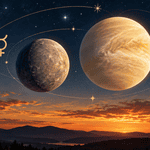
Brilliant Jupiter and the orange-tinted planet Mars will appear just 1.2 degrees apart. That’s a little more than twice the width of the full Moon as we see it from Earth.
It’s one of November’s most interesting skywatching sights, and people across the United States will have a chance to enjoy it, provided the skies are clear.
Here’s when to look, where to find the planets, and how to tell them apart.
Quick Reference: Mars and Jupiter, November 2026
|
When and Where to See Mars and Jupiter
The best mornings are Sunday, November 15, and Monday, November 16, 2026. The planets will appear nearly as close on both dates.
For most of the continental United States, a good viewing window is approximately 4:00–5:30 a.m. local standard time. You can also look during the hour before sunrise, while the sky is still relatively dark.
Face south or south-southeast and look well above the horizon. By the hours before dawn, Mars and Jupiter will be fairly high in the sky, so you won’t need an unobstructed eastern horizon to find them.
Jupiter will be much brighter than Mars, making it the easiest place to start.
Look for a brilliant, steady, whitish point of light. Nearby, you’ll see a noticeably dimmer planet with a warm orange tint. That’s Mars.
From much of the United States, Mars will appear slightly above and to the left of Jupiter on November 16.
If you’re unfamiliar with the night sky, the Farmers’ Almanac guide to visible planets can help you recognize the planets throughout the year.
Just How Close Will the Two Planets Appear?
Astronomers call this kind of apparent meeting a planetary conjunction or close approach.
Mars and Jupiter will appear about 1.2 degrees apart at their closest, according to the Abrams Planetarium at Michigan State University.
For comparison, the full Moon measures approximately half a degree across our sky. So the gap between the planets will be a little more than two Moon-widths.
You can cover that distance with a fingertip held at arm’s length.
Of course, Mars and Jupiter won’t actually be anywhere near each other in space. They’re following separate orbits around the Sun. They simply happen to line up closely from our viewpoint on Earth.
It’s the same kind of perspective trick that sometimes makes the Moon appear to pass close to a bright planet.
Which Planet Is Brighter?
Jupiter will be the obvious standout.
As the largest planet in our solar system, Jupiter reflects enough sunlight to shine brilliantly in Earth’s sky. On November 16, it will look considerably brighter than nearby Mars.
Mars is smaller and will appear as a dimmer orange point. Its rusty color comes from iron-rich minerals on its surface.
Try comparing the two without binoculars first. The difference in brightness and color should be fairly easy to notice.
Both planets will be in the constellation Leo, not far from its brightest star, Regulus.
Do You Need a Telescope?
No. Both Mars and Jupiter will be visible to the unaided eye, even from many suburban locations.
Binoculars can make the pairing especially enjoyable because both planets should fit comfortably within the same field of view.
A small telescope may reveal Jupiter’s four largest moons, depending on viewing conditions and your equipment.
You won’t see Mars and Jupiter as two enormous planets filling the sky. To your eyes, they’ll look like two unusually close points of light.
That makes their appearance no less interesting. Watching two planets seemingly approach and pass each other is a chance to see the motion of our solar system reflected in the night sky.
What If It’s Cloudy November 16?
You have several chances to catch the pairing.
Mars and Jupiter will remain relatively close for days before and after November 16. Try looking on November 14, 15, 17, or 18 if the weather interferes with your plans.
Their positions will change slightly from morning to morning as Mars moves past Jupiter against the background stars.
If you happen to be awake before dawn on two different mornings, take a moment to compare the view. You’ll be able to see that change for yourself.
And while you’re outside, look toward the eastern sky for Venus, which will be shining brightly before sunrise this month.
November’s colder mornings aren’t always inviting, but this is one celestial sight that doesn’t require a long observing session. A few minutes outside with a clear view of the southern sky will be enough to appreciate the pairing.
So if you’re putting on the coffee before sunrise on November 16, consider stepping outside before the day begins. Two neighboring points of light will be putting on a quiet show, even though the planets themselves are separated by hundreds of millions of miles.

- Maggie Konrad

- Maggie Konrad
- Maggie Konrad
- Maggie Konrad