

Quick Reference: Earth Day
- Earth Day date: April 22, every year
- Earth Day 2026: Wednesday, April 22, 2026 (already passed)
- Next Earth Day (2027): Thursday, April 22, 2027
- The rule: Fixed April 22 annually since 1970
- First Earth Day: April 22, 1970, with 20 million Americans participating
- Founder: US Senator Gaylord Nelson of Wisconsin
- Reach today: More than 1 billion people in 190+ countries
Earth Day 2026 has already passed. The next Earth Day is Thursday, April 22, 2027, and every Earth Day after that lands on April 22 too. The rule is simple: April 22, every year. Once you know the date is fixed, the only question left is how you plan to mark it.
The first Earth Day was observed on April 22, 1970, when 20 million Americans filled streets, parks, and auditoriums to demand a healthy environment. They were tired of cities laden with smog, polluted rivers, and rampant industrial waste. The day worked. Inside the next three years, the United States had the Environmental Protection Agency, the Clean Air Act, the Clean Water Act, and the Endangered Species Act on the books.
Since then, Earth Day has been celebrated around the world by people from all walks of life concerned about building a sustainable future for their children. More than 1 billion people in over 190 countries now mark the day, and the questions every household asks are the same: what is it, when is it, and what can we actually do?
When Is Earth Day 2026 and 2027?
Earth Day 2026 was Wednesday, April 22, 2026. As of today, that date has passed. The next Earth Day on the calendar is Thursday, April 22, 2027. If you missed Earth Day 2026 entirely, you are not late on the rule: April 22 comes around every spring, and the planning window for next year opens the moment the leaves return.
The date is fixed. It does not float, it does not move with the moon, and it does not depend on a weekend. April 22 is April 22 whether it falls on a Tuesday in 2025, a Wednesday in 2026, a Thursday in 2027, or a Saturday in 2028. The day of the week shifts; the date never does.
Earth Day 2027 lands on a Thursday, which means classroom and workplace events tend to anchor the day itself, with community cleanups and tree plantings on the weekend either side. For most of North America, late April is when the ground is workable, the dogwoods are blooming, and the first warm-weather chores of the year are within reach. That is exactly why Senator Gaylord Nelson picked the date.
Earth Day Dates Each Year
| Year | Earth Day | Day of the Week |
|---|---|---|
| 2025 | April 22 | Tuesday |
| 2026 | April 22 | Wednesday |
| 2027 | April 22 | Thursday |
| 2028 | April 22 | Saturday |
| 2029 | April 22 | Sunday |
| 2030 | April 22 | Monday |
If you are marking the date for a school assembly, a community group, or a workplace volunteer day, the calendar above is the planning grid. Earth Day 2028 falls on a Saturday, which makes it the easiest year of the next five to organize a Saturday cleanup or a family planting day. Earth Day 2029 lands on a Sunday, another weekend-friendly year. Most other years you are working around a midweek date, which is a good argument for splitting the celebration between the day itself and the nearest weekend.
The History of Earth Day
Earth Day was the idea of US Senator Gaylord Nelson of Wisconsin. Nelson had spent the 1960s watching American rivers catch fire, watching DDT thin the shells of eagle eggs, and watching smog choke American cities. The 1969 Santa Barbara oil spill was the last straw. That same year, after touring the damage in California, he sketched out the idea for a nationwide environmental teach-in modeled on the campus anti-war teach-ins of the moment.
The first Earth Day was held on April 22, 1970. Roughly 20 million Americans, one in ten people in the country at the time, took part. Cities held marches; campuses held teach-ins; congregations held sermons; classrooms held lessons; and the press covered all of it. It is still one of the largest single-day public mobilizations in US history.
The legislative payoff arrived fast. In December 1970, President Richard Nixon signed the executive order creating the Environmental Protection Agency. The Clean Air Act passed in 1970. The Clean Water Act followed in 1972. The Endangered Species Act passed in 1973. The EPA credits the first Earth Day directly for the bipartisan support that made all four laws possible.
For its first twenty years, Earth Day was a mostly American observance. That changed in 1990, when organizer Denis Hayes led the campaign to take it global. The 1990 Earth Day mobilized 200 million people in 141 countries, and it put recycling on the international policy agenda for the first time. By the fiftieth anniversary in 2020, more than 1 billion people in over 190 countries were marking the day. EarthDay.org keeps the running tally.
How the Date Was Decided
Senator Nelson picked April 22 for a practical reason: it was the day on the calendar most likely to get college students out the door. Spring break was over by then on most campuses, and final exams were still three to four weeks away. The window between the two was the only stretch of the semester when student turnout could be counted on. The first Earth Day was, by design, a campus-friendly date.
Late April had a second advantage. It is the season when the ground is workable across most of the United States, when planting calendars come off the shelf, and when the urge to be outside is at a peak. The day Senator Nelson chose for political reasons turned out to fit the seasonal rhythm of the country too. Once the date was set, no one had any reason to move it. April 22 has been Earth Day ever since.
Earth Day Themes
Each year, EarthDay.org sets a single theme to focus the global campaign. Recent themes:
- 2024: Planet vs. Plastics
- 2025: Our Power, Our Planet (focused on tripling clean electricity by 2030)
- 2026: Our Power, Our Planet (continued)
Themes are useful prompts, not assignments. If plastics is the theme and your household is already past disposables, pick the next thing on the list. The point of the theme is to give every participant a shared reference point, not to limit what counts as participation.
How to Celebrate Earth Day
You might think protecting the Earth is a monumental task, one that can only be performed by superheroes. It is not. Even small changes have a real impact, and the day works best when the whole household joins in. A few of the most common ways to mark the day:
- Join a community cleanup. Parks departments, watershed groups, and neighborhood associations run cleanup days the week of April 22 in most US and Canadian towns. Bring gloves and a sturdy bag.
- Plant a tree. Earth Day and Arbor Day fall in the same week for a reason. The cost is low; the payoff is generational.
- Start a compost pile. Composting is nature’s original way of recycling. A corner of the yard is enough.
- Switch to a citizen-science app. iNaturalist, eBird, and Project BudBurst feed your spring observations directly into research databases.
- Cut one plastic. Pick the one disposable plastic your household uses most. Replace it with a reusable. One swap, kept, is worth ten attempted.
- Buy local food. Farmers’ markets opening for the season the week of Earth Day is not a coincidence. Spending the day’s grocery money inside a 50-mile radius keeps the food fresher and the fuel cost lower.
Recycling Tips

15 Things You Can Do to Protect the Earth
In honor of Earth Day, here are 15 practical steps you can take toward a more sustainable life. None of them are dramatic. All of them stack up.
Smart Heating and Cooling
1. Weather seal your home. This is the big one. So much of the energy most of us use to heat our homes just slips out through the cracks. Have an energy audit performed on your home (some communities and utilities offer them for free) and insulate, insulate, insulate.
2. Put on a sweater. Why heat the whole house when you are using one room? Dress for the season. You should not expect to be comfortable in shorts and a tank top when it is snowing outside. Put on layers, even indoors, and bundle up under blankets when you are not moving around.
3. Use your curtains and blinds. Curtains do more than give you privacy. They help regulate the temperature inside the house. In winter, open them during the day to let the sunlight in and close them at night to hold the heat. In summer, do the opposite.
4. Cool cooking. During those Dog Days of Summer, try grilling outside or using the microwave more. It keeps the heat out of the house so you do not have to crank the air conditioning.
Reduce Waste
5. Reduce. Try to fix old things before buying new things. Buy used whenever possible. Say no to drinking straws at the restaurant and plastic cutlery at takeout.
6. Reuse. Whenever possible, opt for reusable versions of common disposable items: water bottles, coffee cups, diapers, razors. Reuse plastic food containers for storage. Do not just throw away unwanted items. Donate them. Repurpose them. Turn them into craft projects. Be creative.
7. Recycle. We all know to do it by now, but a reminder never hurts. It is easy to toss that one tin can into the trash just this one time. Be conscientious about what goes in the trash, and recycling becomes second nature.
8. Compost. When you say “recycle,” most people think of bottles, cans, and paper. Composting is nature’s original way of recycling, turning trash into healthy new soil. You do not need a complicated bin. Set aside a corner of the yard for food scraps and yard debris, and turn it over every so often. Do not have a yard? Many cities, towns, and community gardens have a public compost pile. Or try worm composting.

Eat Green
9. Eat locally. Eating foods that are in season and grown in your local area supports your local ecosystems, and the food itself is fresher and requires less fuel (and carbon output) to reach you. If you can, grow your own vegetables.
10. Eat less meat. Environmental advocates and health experts agree that Americans eat too much meat. Cutting out meat for even one day a week reduces the environmental impact of meat production, and it is good for your health.
Change Behind the Wheel
11. Drive less. Find ways to combine errands and make fewer trips. With many of us still working from home some days, the math is easier than it used to be.
12. Keep your car well maintained. A poorly running car is a gas-guzzling car, no matter what the owner’s manual says. Keep your tires properly inflated, your engine tuned, and your recommended maintenance schedule on track.
Remember Mom’s Advice
13. Turn it off. If you leave a room, turn off the lights. Same with the television, the stereo, or any other appliance. Switch to LED bulbs while you are at it.
14. Be water wise. Take shorter showers. Wait until you have a full load of laundry. Shut off the water when brushing your teeth or hand washing dishes.
15. Hang it up. Instead of using the clothes dryer, hang clothes up to dry, whether inside or outside. You only need to toss clothes in the dryer for about 10 minutes if you miss that soft out-of-the-dryer feeling.
And a Bonus
Beware of phantoms. Those little red or green lights you see when you turn off your computer, DVD player, TV, and other devices require power to light up. Unplug these things when they are not in use, or put them on a power strip you can switch on and off.
Earth Day Activities for Kids
The day is built for kids. A scavenger hunt in the yard, a few hours pulling invasive weeds with the parks department, a fresh row in the family garden, or a quiz around the dinner table on what gets recycled and what does not, are all easy on-ramps. Five activities that work for any age:
- Go on a hike. A short trail with a parent and a checklist of native plants is a lifelong introduction.
- Plant a tree. Earth Day and Arbor Day are in the same week. A sapling from a local nursery is a long-haul gift.
- Ditch the lawn. Grow a garden instead. Even one raised bed turns the yard into a science experiment for the whole season.
- Go plogging. Pick up trash while out for a jog or a walk. Remember the gloves.
- Reduce plastic waste. Pick one disposable plastic the family uses every week and trade it for a reusable.
For a quick classroom or kitchen-table quiz, ask the kids whether the following items go in the recycling, the compost, or the trash: a pizza box with grease, a yogurt cup, a banana peel, a juice pouch, a glass jar with the label still on. Answers and the reasoning are halfway down the next section.
Help Reduce Plastic Waste
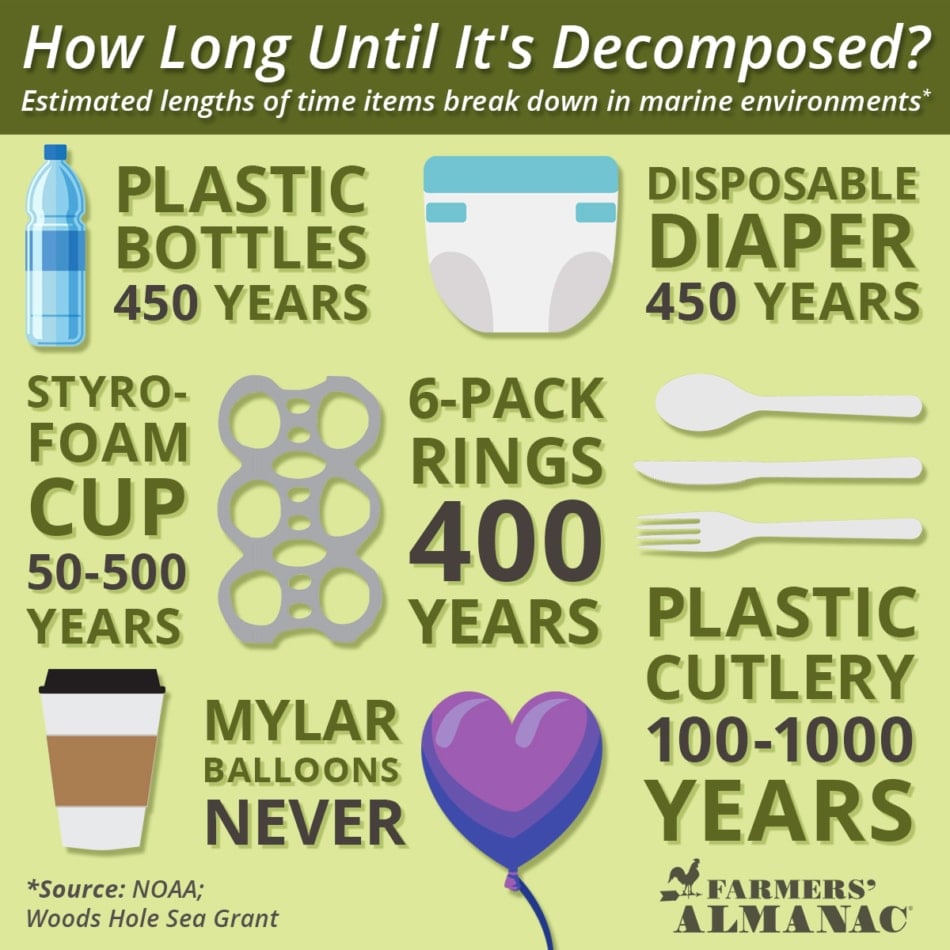
Plastic does not break down. It breaks apart. A water bottle in a landfill is still recognizably a water bottle 450 years from now. A piece of fishing line in the ocean is still fishing line on the day your great-great-grandchildren retire. The infographic below shows the rough decomposition timeline for the disposables we hand over every week without thinking.
Quiz answers, in order: pizza box with grease (compost or trash, never recycling, because the oil contaminates the paper); yogurt cup (recycle, after a rinse, if your municipality takes #5 plastic); banana peel (compost); juice pouch (trash, because the foil-plastic laminate is not currently recyclable in most US programs); glass jar with the label still on (recycle, label and all, the lid removed).
Earth Day Anniversary: Milestones
There is a lot still to do, but there has been notable progress (and recognition of new problems) over the past five decades. A few highlights, courtesy of the US EPA:
1970
The first Earth Day on April 22 draws 20 million Americans. President Richard Nixon signs the executive order creating the Environmental Protection Agency in December. The Clean Air Act passes the same year.
1972
The Clean Water Act passes. DDT is banned for agricultural use in the US.
1973
The Endangered Species Act passes, giving federal protection to plants and animals at risk of extinction.
1982
Congress enacts laws for the safe disposal of nuclear waste.
1983
Cleanup actions begin to rid the Chesapeake Bay of pollution stemming from sewage treatment plants, urban runoff, and farm waste.
1985
Scientists report a giant hole in the Earth’s ozone layer opens each spring over Antarctica.
1990
Congress passes the Clean Air Act Amendments, requiring states to demonstrate progress on improving air quality. Earth Day goes global the same year, mobilizing 200 million people in 141 countries.
1991
Federal agencies begin using recycled-content products.
1992
The EPA launches the Energy Star program to help consumers identify energy-efficient products.
1996
The EPA requires that home buyers and renters be informed about lead-based paint hazards.
1998
President Bill Clinton announces the Clean Water Action Plan to continue making America’s waterways safe for fishing and swimming.
1999
President Bill Clinton announces new emissions standards for cars, sport utility vehicles, minivans, and trucks, requiring them to be 77 to 95 percent cleaner than 1999 model-year vehicles.
2003
More than 4,000 school buses are retrofitted through the Clean School Bus USA program, removing 200,000 pounds of particulate matter from the air over the next 10 years. Clear Skies legislation and alternative regulations are proposed to create a cap-and-trade system to reduce SO2 emissions by 70 percent and NOx emissions by 65 percent below 2003 levels.
2020
Earth Day marks its 50th anniversary. More than 1 billion people in over 190 countries take part, much of it online for the first time.
See the full list of US environmental milestones.
Famous Earth Day Quotes and an Earth Day Poem
A handful of lines that have stayed with the Almanac office over the years:
- “The Earth is what we all have in common.” Wendell Berry
- “In every walk with nature one receives far more than he seeks.” John Muir
- “What we are doing to the forests of the world is but a mirror reflection of what we are doing to ourselves and to one another.” Mahatma Gandhi (often attributed)
- “We do not inherit the Earth from our ancestors; we borrow it from our children.” A Native American proverb popularized in the 1970s
And the poem the page has carried for years. According to legend, this Earth Day poem was attached by Portuguese villagers to the trees of their forests, a quiet warning to anyone tempted to take an axe to them:
Ye who passes by and would raise your hand against me, harken ‘ere you harm me.
I am the heat of your hearth on the cold winter nights, the friendly shade screening you from summer sun, and my fruits are refreshing, quenching your thirst as you journey on.
I am the beam that holds your house, the board of your table, the bed on which you lie, the timber that builds your boat.
I am the handle of your hoe, the door of your homestead, the wood of your cradle, and the shell of your coffin.
I am the bread of kindness and the flower of beauty.
Ye who pass by, listen to my prayer, harm me not.
Plan Your Earth Day
Earth Day 2026 is in the rearview mirror. Earth Day 2027 is Thursday, April 22, 2027, and the planning window opens the day the daffodils come up. Mark the date, pick one habit from the list of 15 that is honestly within reach, and bring the kids in on the planning. The Almanac has been making this case since 1818, and the rule has not changed: small, repeated, household-scale work is what actually moves the needle.

Frequently Asked Questions
When is Earth Day 2026?
Earth Day 2026 was Wednesday, April 22, 2026. The date has passed. Earth Day 2027 is Thursday, April 22, 2027.
Is Earth Day always on April 22?
Yes. Earth Day has fallen on April 22 every year since the first one in 1970. The date is fixed; only the day of the week changes from year to year.
Who founded Earth Day?
US Senator Gaylord Nelson of Wisconsin proposed Earth Day after touring the damage from the 1969 Santa Barbara oil spill. The first Earth Day was held on April 22, 1970, with about 20 million Americans taking part. Activist Denis Hayes coordinated the 1990 global expansion.
Why is Earth Day on April 22?
Senator Gaylord Nelson chose April 22 because it sat between college spring break and final exams, giving the campus teach-ins the best chance of strong turnout. Late April also lands in the planting-and-cleanup season across most of North America, which made the date a natural fit once it was set.
What laws came from the first Earth Day?
The first Earth Day in 1970 led directly to the creation of the Environmental Protection Agency in December 1970, the Clean Air Act in 1970, the Clean Water Act in 1972, and the Endangered Species Act in 1973. The EPA credits the bipartisan support generated by Earth Day for all four.
How big is Earth Day now?
More than 1 billion people in over 190 countries mark Earth Day each year, making it one of the largest annual civic observances in the world. EarthDay.org coordinates the international campaign and sets the annual theme.
What was the 2025 Earth Day theme?
The 2025 theme was “Our Power, Our Planet,” focused on tripling global clean electricity generation by 2030. EarthDay.org has carried the theme into 2026 as a multi-year campaign.
What can kids do for Earth Day?
Plant a tree with a parent, run a kitchen-table recycling quiz, join a local park cleanup, log spring observations in a citizen-science app like iNaturalist, start a small vegetable bed, or go plogging (picking up trash while jogging or walking). Five activities, ages five and up.

Sam is my only friend.
My uncle touched me when me 5?
Have you ever dranked soggy milk and it slipped down your throat
.
Your mom has the estimated mass of two suns
hihiurmomurmomurmomurmomurmom
Deez nuts
Doin yo mom
gugyugabah!
Yes
No