

Collecting Rainwater for the Garden: A Step-by-Step Guide
Collecting and saving rainwater for use in the garden just makes sense, and was a common practice by our ancestors. See how it's done, and start saving money on your water bill.
Quick Reference
- Why collect rainwater: Soft, chemical-free water that plants prefer. Saves on the water bill.
- Simple setup: A 55-gallon barrel under the downspout with a spigot near the base.
- Yield formula: Roof area (sq ft) x rainfall (inches) x 0.62 = gallons collected.
- Important: Rainwater is for the garden. Not drinkable without treatment.
- Check the law: A few U.S. states regulate or restrict rainwater collection. Check yours.
The patter of rain on the roof can make a gardener’s day. Not only is nature watering the plants, the same rain can be collected and stored for later use. Collecting rainwater for the garden conserves water, saves money, and uses a resource that Mother Nature is already delivering for free. In a hot dry summer or a drought year, a rain barrel can be the difference between a thriving garden and a long string of hard choices. Here is the Almanac’s step-by-step guide.
Why Collect Rainwater?
Tap water is treated to be safe for drinking. The chlorine, salts, and dissolved minerals that make it drinkable are not always ideal for plants and soil. Rainwater is naturally soft. It contains much lower concentrations of magnesium, calcium, and chlorine, and a slightly acidic pH that most garden plants prefer. Many gardeners notice container plants and seedlings respond visibly better to rainwater than to municipal water.
Rainwater Collection Methods
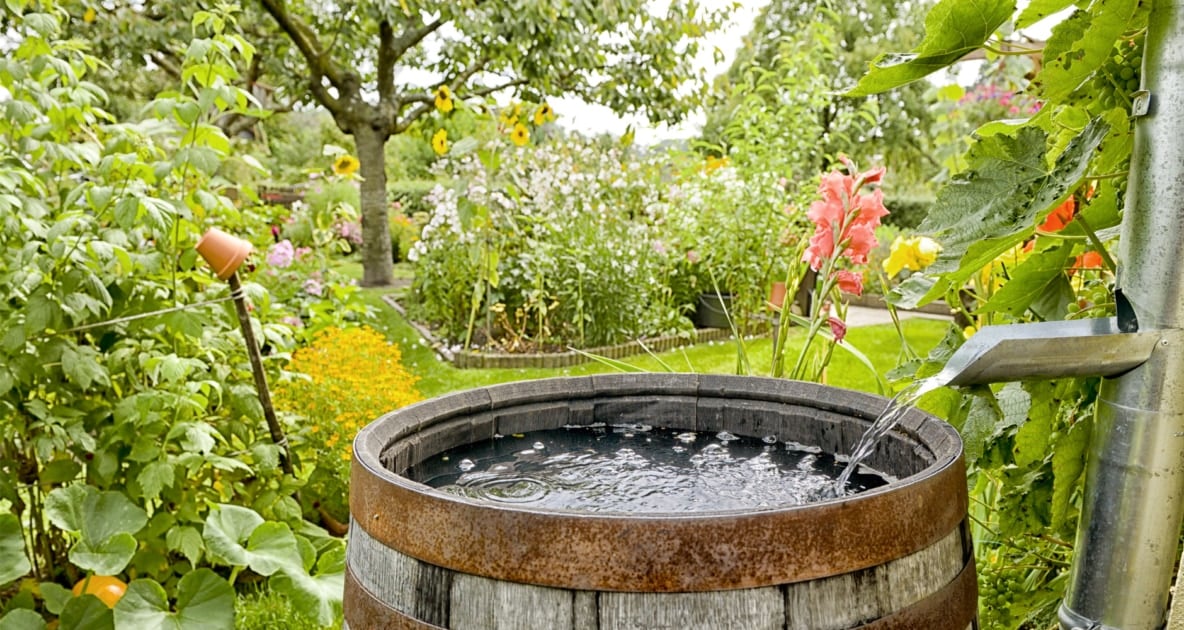
Collecting rainwater can be as simple as a downspout flowing into a barrel with a spigot, or as elaborate as pipes feeding a tank and pump for redistribution. The most common method, and the one that pays back fastest, is a roof-fed barrel.
How to Set Up a Rain Barrel
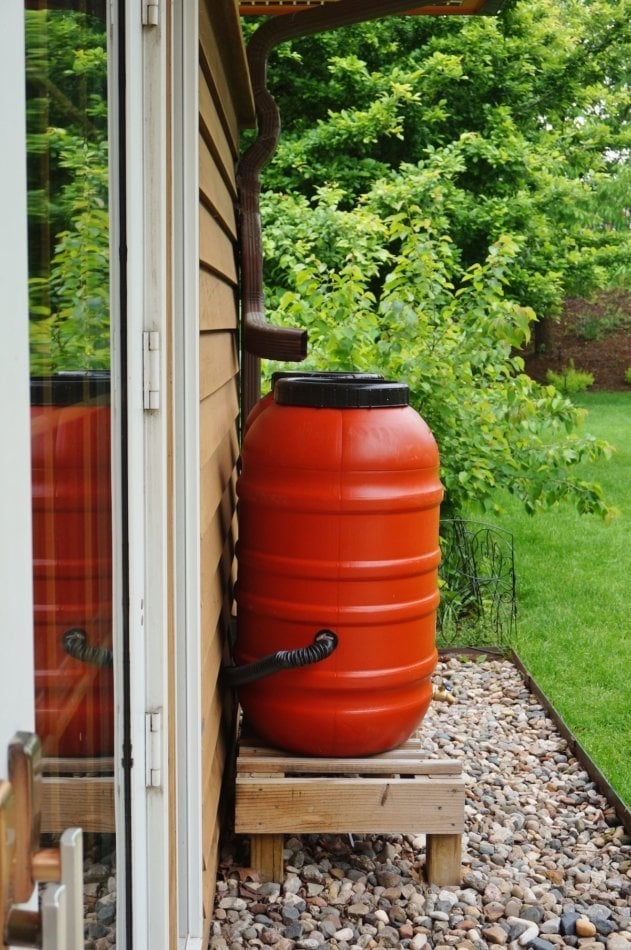
- Pick a clean 55-gallon barrel. Use a new food-grade plastic drum or one that previously held nothing toxic. Garden supply centers sell ready-made barrels with screens and lids included.
- Install a spigot near the base. About 2 to 3 inches up from the bottom so sediment can settle below the outflow.
- Build a sturdy stand. A gallon of water weighs about 8.3 pounds. A full 55-gallon barrel weighs around 460 pounds. Cinder blocks set on a level pad work well.
- Position under a downspout. Cut the downspout so it discharges directly into the barrel’s screened top opening.
- Add an overflow. Drill a second opening near the top with a hose barb so excess water can be routed away from the foundation.
- Cover with mesh. Mosquitoes will breed in open water. A fine screen at the inlet stops both insects and leaves.
Linking Multiple Barrels
If one barrel is not enough, connect several with a short pipe near the top. When the first barrel fills, overflow feeds the next. Commercial barrels often sell kits for this. Three barrels in series will hold about 165 gallons, enough to water most home vegetable gardens through a two-week dry stretch.
How Much Water Can You Collect?
Use this simple formula:
Roof area (sq ft) x rainfall (inches) x 0.62 = gallons collected.
A 300-square-foot section of roof catching 1 inch of rain yields about 186 gallons. A 1,000-square-foot roof in a 2-inch storm yields 1,240 gallons. Most U.S. homes can collect 1,500 to 3,000 gallons a year off a single downspout. That is enough to water a typical 200-square-foot vegetable garden for an entire growing season.

Cautions and Rules
- Not for drinking. Roof runoff carries dust, bird droppings, and sometimes shingle residue. Rainwater is fine for vegetable gardens (rinse leafy greens before eating) but should not be consumed without filtration and disinfection. Texas A&M AgriLife Extension has a thorough guide to potable use and treatment.
- Keep barrels covered. Open water attracts mosquitoes and is a drowning risk for small children and pets.
- Empty for winter in cold climates. Heavy-duty plastic can crack under repeated freeze-thaw. Store the barrel in a shed or garage where falling ice from the roof cannot hit it.
- Clean the gutter twice a year. Leaves and grit reduce yield and add silt to the barrel.
Is Rainwater Collection Legal Where You Live?
It is legal in most U.S. states, but a few have restrictions. Colorado limited residential rainwater collection until 2016. Utah, Washington, and Arizona have specific size and use rules. Texas, Florida, and California actively encourage it with rebates. Run a quick search for “is it legal to collect rainwater in [your state]” before you scale up, especially if you plan to install a cistern over about 100 gallons.
Regional Rainfall Yields
| Region | Typical annual rainfall | Yearly yield from a 1,000 sq ft roof |
|---|---|---|
| Southeast and Gulf Coast | 50 to 60 inches | About 31,000 to 37,000 gallons |
| Northeast and Mid-Atlantic | 40 to 48 inches | About 25,000 to 30,000 gallons |
| Pacific Northwest, west of the Cascades | 38 to 50 inches | About 24,000 to 31,000 gallons |
| Midwest and Great Lakes | 32 to 38 inches | About 20,000 to 24,000 gallons |
| Great Plains | 20 to 30 inches | About 12,000 to 19,000 gallons |
| Mountain West and Great Basin | 10 to 20 inches | About 6,000 to 12,000 gallons |
| Coastal and southern California | 12 to 15 inches | About 7,500 to 9,300 gallons |
| Desert Southwest | 4 to 12 inches | About 2,500 to 7,500 gallons |

Frequently Asked Questions
How much rainwater can I collect from my roof?
Multiply the roof area in square feet by rainfall in inches by 0.62. A 1,000-square-foot roof in a 1-inch storm gives you about 620 gallons. Most U.S. homes can collect 1,500 to 3,000 gallons annually off a single downspout.
Can I drink rainwater I collect at home?
Not without treatment. Roof runoff carries dust, bird droppings, and sometimes shingle residue. Collected rainwater is fine for the garden but should be filtered and disinfected before drinking. See Texas A&M AgriLife Extension for current guidance.
Is collecting rainwater legal in my state?
In most U.S. states, yes. A few states (Colorado historically, Utah, Washington, Arizona) regulate volumes or uses. Texas, Florida, and California actively encourage it. Search “is it legal to collect rainwater in [your state]” before installing a large cistern.
How do I stop mosquitoes in my rain barrel?
Cover the inlet with a fine screen. Add a tablespoon of vegetable oil to the surface (forms a thin film that suffocates larvae). Or drop in a mosquito dunk (Bti) every 30 days, which kills larvae without harming plants, fish, or wildlife.
What should I do with the barrel in winter?
In cold climates, empty the barrel and store it in a shed or garage. Heavy-duty plastic cracks under repeated freeze-thaw. Disconnect the downspout and route runoff away from the foundation until spring.
Is rainwater really better for plants than tap water?
For most garden plants, yes. Rainwater is soft, slightly acidic, and free of chlorine and added salts. Seedlings, container plants, and acid-loving species (blueberries, azaleas, rhododendrons) respond visibly better to rainwater than to municipal tap.


Janine Pineo
Janine Pineo has been gardening all her life in Maine and writing about it for more than two decades. More of her writing can be found on her website, GardenMaine.com.
- Janine Pineo

- Janine Pineo
- Janine Pineo
- Janine Pineo




you will also grow a large quantity of mosquito’s even if you seal the barrel. been there done that.
Can be easily cleared of mosquito larvae…buy something garden style NEEM leaves crushed leaves or powder form. Sprinkle a pinch over the top of the water ….. not a lot …try just a pinch over the top of the water first.. All larvae should be be dead next day. If more seem to be coming up,,put another healthy pinch in on the top of the water. It will filtrate to the bottom while killing the larvae or bugs. Best news to that is they NEEM isn’t poisonous usually to mankind nor beast. And it’s good for the garden too…won’t hurt most plants. I’ve read to be more cautious with NEEM oil sprays on plants tho. Do a search engine full explanation about NEEM before you use any. But it shouldn’t hurt anyone or anything but bug pests. And possibly other insects that are considered beneficial..so it needs user to be. To read up on it first to decided to use it and what bugs it does affect….because your collected water will bear its essence …I definitely. .
Correct
How do the larvae get in the barrel if it’s sealed. ? I understand how , if it’s not completely sealed. Or even has close knit screen over the openings? ?