When Is Kwanzaa 2026? Dates, Meaning, and the Seven Principles
Kwanzaa is a celebration of African-American culture and the rich history of African traditions. It is an integral part of many families’ holiday celebrations. Learn more about this holiday.
Quick Reference: Kwanzaa 2026
- Kwanzaa 2026 begins: Saturday, December 26, 2026
- Kwanzaa 2026 ends: Friday, January 1, 2027
- Length: 7 nights, one candle lit each evening
- Date rule: Fixed December 26 through January 1 every year
- Karamu feast: Thursday, December 31, 2026
- Created by: Dr. Maulana Karenga, 1966
- Religious or cultural: Pan-African cultural celebration, not a religious observance
Kwanzaa 2026 runs from Saturday, December 26, 2026 through Friday, January 1, 2027. The dates do not move. Every year Kwanzaa begins on December 26 and closes seven nights later on January 1. The holiday was created in 1966 by Dr. Maulana Karenga, then a professor and chairman of Africana Studies at California State University, Long Beach. It is a Pan-African cultural celebration rooted in African first-fruits harvest festivals, not a religious holiday, and many families observe it alongside Christmas, Hanukkah, or other traditions.
When Is Kwanzaa 2026?
Kwanzaa 2026 begins at sundown on Saturday, December 26, 2026 and ends on Friday, January 1, 2027. Seven nights, seven candles, one principle observed each evening. The first candle is lit on the night of December 26; the seventh is lit on December 31, the night before the closing karamu feast on January 1.
The dates are fixed. Unlike holidays that drift with the lunar calendar or the church calendar, Kwanzaa sits on the same seven calendar days every year: December 26 to January 1. What changes year to year is the day of the week the celebration opens on. In 2026 that opening day is a Saturday, which lines the karamu feast up with a Thursday, December 31, and the closing day with a Friday, January 1.
Kwanzaa Dates Each Year
Because Kwanzaa is fixed to December 26 through January 1, the only thing the calendar changes from one year to the next is which day of the week it opens on. Here is how the next several years line up:
| Year | Kwanzaa Begins | Karamu Feast | Kwanzaa Ends |
|---|---|---|---|
| 2026 | Saturday, December 26, 2026 | Thursday, December 31, 2026 | Friday, January 1, 2027 |
| 2027 | Sunday, December 26, 2027 | Friday, December 31, 2027 | Saturday, January 1, 2028 |
| 2028 | Tuesday, December 26, 2028 | Sunday, December 31, 2028 | Monday, January 1, 2029 |
| 2029 | Wednesday, December 26, 2029 | Monday, December 31, 2029 | Tuesday, January 1, 2030 |
| 2030 | Thursday, December 26, 2030 | Tuesday, December 31, 2030 | Wednesday, January 1, 2031 |
If you are planning a karamu menu, ordering ingredients, or coordinating travel for the family, those are the dates to circle. The closing day of Kwanzaa always doubles as New Year’s Day, which means the last night of the celebration shares the calendar with one of the most travel-heavy days of the year.
What Is Kwanzaa?
Kwanzaa is a Pan-African cultural celebration of community, family, and heritage. It is observed for seven nights each year and is built around seven core principles known as the Nguzo Saba. Unlike Christmas, Hanukkah, or Ramadan, Kwanzaa is not a religious holiday. It is a secular cultural observance, and many Black families in the United States and the wider African diaspora celebrate it alongside their own religious traditions rather than in place of them.
The name comes from the Swahili phrase matunda ya kwanza, meaning “first fruits,” a reference to the harvest festivals long celebrated across the African continent at the close of the growing season. The holiday was created in 1966 by Dr. Maulana Karenga, then a professor and chairman of Africana Studies at California State University, Long Beach. The first observance was held on December 26, 1966. An extra “a” was added to the spelling, turning kwanza into Kwanzaa, so the name itself would carry seven letters and echo the holiday’s central number.
Kwanzaa draws on the rich history of African traditions and African-American cultural heritage. The end-of-year harvest festivals that resonate in cultures across the African continent are part of that foundation. So is the lived experience of African-American families in the twentieth century, which is the audience Dr. Karenga had in mind when he built the holiday. The result is a celebration that is at once African, African-American, and intentionally new.
Origins of Kwanzaa
First celebrated in 1966, Kwanzaa was developed by Dr. Maulana Karenga, professor and chairman of Africana Studies at California State University, Long Beach. He created the celebration in honor of a variety of African traditions and heritages, including the harvest festivals that occur at the end of the year to celebrate the fruits of a community’s collective labor. The word kwanza is Swahili for “first fruits” to signify that connection. The extra “a” was added to the spelling to retain the symbolism of the number seven, which resonates through Kwanzaa symbolism and celebrations.
Dr. Karenga’s stated intent was to create a holiday that gave African-Americans a moment of cultural reaffirmation, a space on the calendar to gather, reflect, and honor a shared heritage. The choice of late December was deliberate. The seven nights run from the day after Christmas through New Year’s Day, the quietest stretch of the American year, when most families are already home from school or work. That window made room for a long, slow, intentional observance rather than a one-day event.
The Seven Principles of Kwanzaa
Kwanzaa highlights seven key principles of African-American culture, philosophy, and heritage, and each is celebrated throughout the holiday. Together they are called the Nguzo Saba, Swahili for “Seven Principles.” One is observed on each night of the celebration, in the order below.
- Umoja (Unity). Of family, community, nation, and race.
- Kujichagulia (Self-Determination). To define, name, and speak for oneself.
- Ujima (Collective Work and Responsibility). To work together to solve problems.
- Ujamaa (Cooperative Economics). Building and supporting community businesses and profits.
- Nia (Purpose). To restore the African people to traditional greatness.
- Kuumba (Creativity). To add beauty to the world with one’s natural talents.
- Imani (Faith). To believe, especially in oneself, one’s family, and one’s community.
The first night, December 26, is dedicated to Umoja. December 27 is Kujichagulia. The order continues through the week, and the seventh and final night, December 31, is Imani. Each evening a candle is lit, the principle is named, and someone in the family speaks to what that principle means in the year just past and the year ahead.
How Kwanzaa Is Celebrated
Kwanzaa is a secular celebration rather than a religious observance, and is not intended to replace Christmas, Hanukkah, Ramadan, or other religious holidays. In fact, many people of African descent celebrate multiple holidays, including Kwanzaa, but care is taken not to mix the celebrations so the distinct messages of each are not lost.
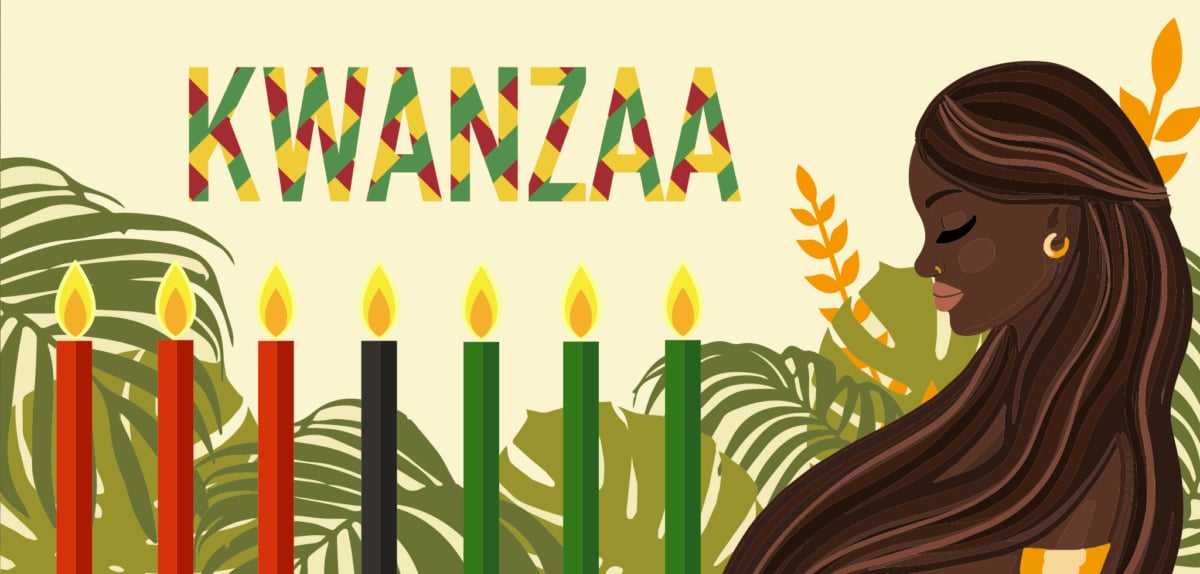
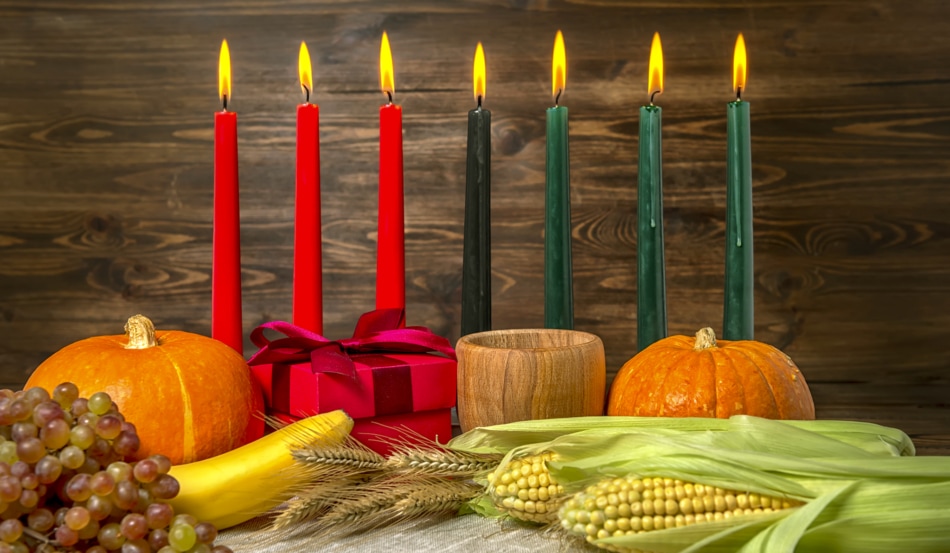
Kwanzaa is celebrated annually from December 26 through January 1. During the weeklong event, the kinara, a candle holder representing African influence and the foundation of the culture, is lit. It holds seven mishumaa saba or candles, three of which are red to represent the past struggles and blood of ancestors, three of which are green to represent the land and hope for the future, and one that is black to represent all the people who share this heritage. The black candle sits in the center for Umoja, the three red candles to the left, and the three green candles to the right. As each candle is lit, a new one on each night of Kwanzaa, the family reflects on and discusses one of the principles of the celebration.
The kinara sits on the mkeka or woven placemat that represents the foundation of African-American culture and building on the past. Other symbols may be placed around the kinara on the mkeka, including different crops (mazao) to represent the harvest, corn (mahindi, sometimes spelled muhindi) to represent children, and the kikombe cha Umoja or unity cup from which ceremonial drinks will be shared during each night’s festivities.
In addition to these symbolic decorations, other African decorations are often displayed, including artwork, baskets, colorful cloth, or flags. Festivities may include drumming and other music as well as dancing and storytelling to share African culture and connect with one another.
- Kinara. The seven-branched candleholder at the center of the table.
- Mishumaa saba. The seven candles, one black, three red, three green.
- Mkeka. The woven mat the kinara sits on, representing the foundation of culture and history.
- Mazao. Crops and fruits, representing the harvest.
- Mahindi (muhindi). Ears of corn, one for each child in the household.
- Kikombe cha Umoja. The unity cup, used to pour libations and share a ceremonial drink.
- Zawadi. Gifts, usually handmade or cultural, exchanged through the week.
During Kwanzaa, zawadi or gifts are exchanged, and are usually handmade or cultural items to reinforce African-American culture and heritage, as well as to encourage creativity and self-worth. One day is often dedicated as a Day of Remembrance to focus on elders and ancestors, and the traditional karamu or communal feast is typically held on the last day of Kwanzaa, January 1. This is also a day of self-reflection and meditation to ask “Who am I?” “Am I really who I say I am?” and “Am I all I ought to be?”
The History and Founding of Kwanzaa
Kwanzaa is younger than most of the holidays it sits next to on the December calendar, but its roots are older than any of them. Dr. Maulana Karenga built the celebration in 1966, in the years immediately following the Watts Rebellion of 1965 in Los Angeles. His intent was to give African-American communities a moment of cultural reaffirmation, a holiday that drew directly on African heritage rather than borrowing from European or Christian traditions.
The structure of the holiday borrows from African first-fruits harvest festivals, which were celebrated across the continent long before colonization. Karenga studied harvest traditions among the Ashanti of Ghana, the Zulu of southern Africa, and other Pan-African cultures while designing Kwanzaa. The result is a synthesis: a single holiday that draws threads from many older ones and arranges them around the seven principles of the Nguzo Saba.
Kwanzaa spread from California through Black communities across the United States in the late 1960s and the 1970s. By the 1980s it was being observed in Caribbean nations and parts of Africa as well. Modern estimates put US observance in the millions, though no agency tracks the number formally and figures vary widely by source. For a primary-source explanation of the holiday’s principles and structure, the Smithsonian’s National Museum of African American History and Culture publishes a Kwanzaa overview that is worth reading in full.
Traditional Kwanzaa Foods
The karamu feast on December 31 is the longest meal of the week and the centerpiece of the celebration. There is no single Kwanzaa menu. Families draw from the food traditions of the African diaspora, which means dishes from West Africa, the Caribbean, Latin America, and the American South all show up on the same table.
- Jollof rice. A one-pot West African rice dish in a tomato and pepper base, claimed by Ghana, Nigeria, Senegal, and several other countries with equal passion.
- Collard greens. Slow-cooked with smoked turkey or ham hock, a Southern American staple with deep African roots.
- Black-eyed peas. A New Year’s-eve and New Year’s-day tradition across the South, said to bring luck for the year ahead.
- Sweet potato pie. A Southern dessert that traveled from West African yam traditions through the American South.
- Jerk chicken. The Jamaican grilling tradition of pimento, scotch bonnet, and slow heat.
- Cornbread. A bread of the African-American kitchen, often served alongside the greens.
- Plantains. Fried sweet plantains or savory tostones, common across the Caribbean and West Africa.
Whatever is on the table, the karamu is built around the unity cup. The kikombe cha Umoja is filled, a libation is poured to honor the ancestors, and the cup is passed around the room.
Kwanzaa and Christmas
Kwanzaa and Christmas are often celebrated in the same household, and that was Dr. Karenga’s intention from the start. Christmas is a religious holiday for many families and a cultural one for many others; Kwanzaa is a cultural holiday for everyone who keeps it. The two are not in competition.
Many Black families observe both: Christmas on December 25 with the traditions of their faith and family, and Kwanzaa from December 26 through January 1 with the kinara, the Nguzo Saba, and the karamu. The decorations differ, the symbols differ, and the meaning of each holiday stays distinct so neither one is diluted. For households that do not celebrate Christmas, Kwanzaa stands on its own as a Pan-African cultural observance of family and heritage. For an authoritative description of the holiday’s principles and ceremonies straight from its founder, the Official Kwanzaa Website remains the primary source.
Plan Your Kwanzaa
Kwanzaa is a rich cultural celebration focused on the heritage and traditions of African cultures and African-American communities. By understanding more about this celebration, it is easier to reflect on cultural diversity and appreciate all the richness found in one’s community throughout the year. If you are keeping Kwanzaa for the first time in 2026, a few practical notes:
- Mark Saturday, December 26, 2026 as the first night, and plan the karamu for Thursday, December 31, 2026.
- Set the kinara out a few days early so the table is ready. Black candle in the center, three red on the left, three green on the right.
- Talk through the seven principles with the family in advance. One night, one principle, in order: Umoja, Kujichagulia, Ujima, Ujamaa, Nia, Kuumba, Imani.
- Plan zawadi for the children. Handmade or cultural gifts work best; a book and a homemade item is a traditional pairing.
- Build the karamu menu around the food traditions that matter to your family. There is no single right answer.
- Read the winter solstice page for context on why this stretch of the calendar carries so much weight across so many cultures, and our full Moon dates page for the December Cold Moon.

Frequently Asked Questions
When is Kwanzaa 2026?
Kwanzaa 2026 begins on Saturday, December 26, 2026 and ends on Friday, January 1, 2027. The karamu feast falls on Thursday, December 31, 2026. The dates are fixed each year regardless of the day of the week.
What is Kwanzaa?
Kwanzaa is a Pan-African cultural celebration observed for seven nights, from December 26 through January 1. It honors African and African-American heritage through seven core principles known as the Nguzo Saba. It is a secular cultural holiday, not a religious one, created by Dr. Maulana Karenga in 1966.
Who created Kwanzaa?
Dr. Maulana Karenga, then a professor and chairman of Africana Studies at California State University, Long Beach, created Kwanzaa in 1966. The first observance was held on December 26, 1966. Karenga drew on African first-fruits harvest traditions and on his own scholarship of Pan-African cultures.
What are the seven principles of Kwanzaa?
The Nguzo Saba, or Seven Principles, are Umoja (unity), Kujichagulia (self-determination), Ujima (collective work and responsibility), Ujamaa (cooperative economics), Nia (purpose), Kuumba (creativity), and Imani (faith). One principle is observed each night of Kwanzaa, in that order.
Is Kwanzaa a religious holiday?
No. Kwanzaa is a secular Pan-African cultural celebration. It is not tied to any religion and is not intended to replace Christmas, Hanukkah, Ramadan, or any other religious observance. Many families celebrate Kwanzaa alongside their own religious traditions.
What does Kwanzaa mean?
The name comes from the Swahili phrase matunda ya kwanza, meaning “first fruits,” a reference to harvest festivals long celebrated across the African continent. The extra “a” was added to the spelling so the word would carry seven letters, echoing the seven principles and seven nights of the holiday.
What do the Kwanzaa candles mean?
The mishumaa saba are the seven candles set in the kinara. The black candle sits in the center and represents the people; it is lit first, on the night of Umoja. The three red candles to the left represent the past struggles and the blood of ancestors. The three green candles to the right represent the land and hope for the future. One candle is lit each night, alternating between the red and green sides.
When is Kwanzaa 2027?
Kwanzaa 2027 begins on Sunday, December 26, 2027 and ends on Saturday, January 1, 2028. The karamu feast falls on Friday, December 31, 2027. The dates are the same every year; only the day of the week shifts.


Melissa Mayntz
Melissa Mayntz is a writer who specializes in birds and birding, though her work spans a wide range—from folklore to healthy living. Her first book, Migration: Exploring the Remarkable Journeys of Birds was published in 2020. Mayntz also writes for National Wildlife Magazine and The Spruce. Find her at MelissaMayntz.com.
- Melissa Mayntz

- Melissa Mayntz
- Melissa Mayntz
- Melissa Mayntz