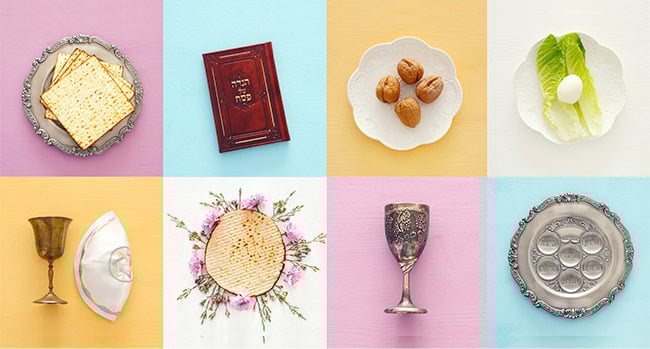
Quick Reference: Passover
- Passover 2026 (past): Sundown Wednesday, April 1 through the evening of Thursday, April 9, 2026
- Next Passover (2027): Sundown Wednesday, April 21 through the evening of Thursday, April 29, 2027
- Hebrew calendar rule: Begins on 15 Nisan (the first month of the Hebrew year)
- Length: 8 days outside Israel, 7 days in Israel
- Greeting: Pesach Sameach (PEH-sakh sah-MAY-akh), “Happy Passover”
- Centerpiece meal: The Seder, held on the first two nights
Passover 2026 ended at sundown on Thursday, April 9. The next Passover begins at sundown on Wednesday, April 21, 2027, and ends the evening of Thursday, April 29, 2027. The holiday always starts on the 15th of Nisan on the Hebrew calendar, which is why the Gregorian date slides from year to year. This page covers the dates, the Seder, the symbolic foods, the traditions, and a small library of Passover recipes you can cook from this week or save for next spring.
Jump to the Matzo Ball Soup Recipe
When Is Passover 2027?
Passover 2027 begins at sundown on Wednesday, April 21, 2027, and ends the evening of Thursday, April 29, 2027. The first Seder is held the evening of April 21; the second Seder is the evening of April 22. Passover 2028 is April 10-18, Passover 2029 is March 31 to April 7, and Passover 2030 is April 18-25.
Jewish people in Israel observe Pesach (Passover) for 7 days rather than the 8 days that are customary for those living outside of Israel. Learn more about the 7-versus-8 question via ReformJudaism.org.
Passover Dates for the Next Five Years
| Year | Begins (sundown) | Ends (evening) | Hebrew year |
|---|---|---|---|
| 2026 (past) | Wednesday, April 1 | Thursday, April 9 | 5786 |
| 2027 | Wednesday, April 21 | Thursday, April 29 | 5787 |
| 2028 | Monday, April 10 | Tuesday, April 18 | 5788 |
| 2029 | Friday, March 31 | Friday, April 7 | 5789 |
| 2030 | Wednesday, April 17 | Thursday, April 25 | 5790 |
Passover lands in March or April every year because the Hebrew calendar tracks the Moon while the Gregorian calendar tracks the Sun. The two calendars stay in sync through occasional leap years on the Jewish side. For other lunar-tied holidays, see When Is Easter? and When Is Hanukkah?
Why Are Passover Dates Different Each Year?
The Hebrew calendar is luni-solar. It tracks the phases of the Moon for the months while keeping the year roughly aligned with the Sun and the seasons. Passover, which celebrates the start of spring, begins on the 15th day of Nisan (also called Abib), the first month of the Hebrew year.
The Gregorian calendar that most of the world uses is solar only. To keep the year in step with Earth’s trip around the Sun, the Gregorian calendar adds one extra day every four years, called a Leap Year. The Hebrew calendar does something similar but bigger. Roughly every two or three years it adds a 13th month called Adar II, which has 29 days. That extra month closes the 11-day gap between the Gregorian solar year (365 days) and the Hebrew lunar year (354 days), and it keeps Passover anchored to spring. Without Adar II, Passover would drift earlier and earlier on the Gregorian calendar until, after 33 years or so, it landed in winter.
What Is Passover?
Historically, the word Passover refers to the death angel passing over the Israelites during the final plague, the death of the first-born sons in Egypt. Following instructions to paint lamb’s blood on the doorposts of their houses in Egypt, God spared the Israelites and delivered them. Passover (Pesach) commemorates the Israelites’ triumphant deliverance from Egyptian bondage.
Families and friends gather annually during the first month (Nisan) on the Hebrew calendar to recount the liberation and commemorate the meal eaten by the Israelites in Egypt on the original Passover. (Seder dinner explained below.)
As instructed in Exodus 12:18, Passover begins and ends at nightfall: “In the first month, on the fourteenth day of the month at even, ye shall eat unleavened bread, until the one and twentieth day of the month at even.” (Even refers to evening.) You can read the biblical account of the first Passover in Exodus, chapter 12 in the Old Testament.
How to Wish Someone “Happy Passover”
The Hebrew greeting for “Happy Passover” is Pesach Sameach (pronounced PEH-sakh sah-MAY-akh). Pesach means “Passover.” Sameach means “happy.” A more general greeting that works for any Jewish holiday is Chag Sameach (KHAG sah-MAY-akh), which means “happy holiday” or “happy festival.”
You don’t need to speak Hebrew or Yiddish to extend a cordial Passover greeting. In English, you can wish someone a Happy Passover, a Happy Holiday, a Joyous Passover, or a Blessed Passover. Any of those is welcome.

What Is a Seder Dinner?
The phrases “Seder dinner” and “Passover Seder” mean the same thing. Both refer to the special meal and ceremony held on the first two nights of Passover, the centerpiece of the holiday in most observant homes. (You may choose to hold a Seder on every night of Passover, but it is not customary. See “What To Do on Nights Without a Seder Dinner” below.)
“Seder” is a Hebrew word that means “order,” and the Passover Seder follows a set order of rituals, prayers, and special foods set out in the Haggadah, the guidebook for this event. Around the table, families tell the story of how the Jews left Egypt, moving from slavery to freedom. Here is what usually happens at a Seder:
Reading the Haggadah: The Haggadah contains all the prayers, blessings, stories, and steps for the Seder. Everyone takes turns reading from it to retell the story of leaving Egypt and to reflect on why it still matters. Download a free copy of the Haggadah, including a 34-page guide to conducting a Passover Seder.
Special foods: The Seder plate holds several symbolic foods, each one a piece of the Exodus story. They are tasted at set moments during the Seder while their meaning is read aloud. (See “Symbolic Seder Dinner Foods” below.)
Four cups of wine: Over the course of the Seder, everyone drinks four cups of wine (or grape juice), each one tied to a different stage of the journey from slavery to freedom.
Eating matzah: Matzah, the flat unleavened bread, is central to the Seder. It is a reminder of how quickly the Israelites had to leave Egypt and a humble counterpoint to the four cups of wine.
Talking and thinking: The Seder invites everyone, especially children, to ask questions and reflect on the story. The Four Questions, traditionally asked by the youngest at the table, set the conversation in motion.
A Seder is also a chance to consider how the themes of freedom, liberation, and redemption speak to today. Many families use the evening to reflect on justice, equality, and human dignity in their own time, alongside the ancient story.
Beyond the Seder plate and the recitation of the Haggadah, families often weave their own traditions, songs, and family stories into the evening. That layering, generation on generation, is part of what gives the Seder its weight.
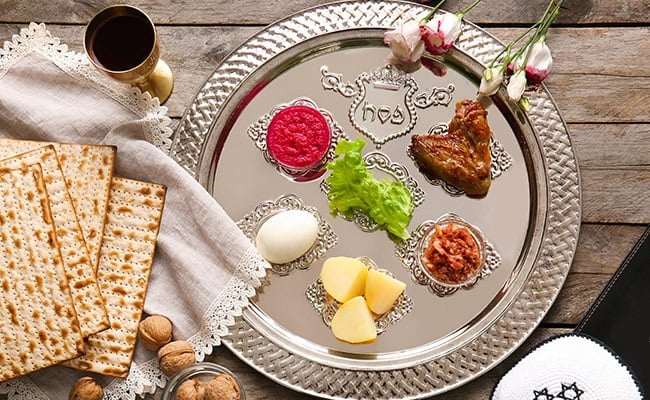
Symbolic Seder Dinner Foods
Small portions of symbolic foods are arranged on a Seder plate and set in the middle of the table. Each one is tasted as the Israelites’ miraculous Exodus story is retold.
Bitter herb (Maror): Horseradish or endive, representing the years of bitter slavery the Hebrews endured.
Chopped fruit, nuts, and wine (Charoset, Haroset, or Charoses): A sweet paste made from fruits (typically apples), nuts, and wine. It stands for the mortar that the enslaved Israelites used to make bricks while building the Egyptian pharaohs’ cities, and at the same time for the sweetness of freedom regained.
Mild green vegetable (Karpas): Celery, parsley, or lettuce. At the start of the Seder, the karpas is dipped into salt water and eaten. The green stands for new growth in spring; the salt water stands for the tears shed during enslavement.
Roasted shank bone (Zeroah): Traditionally a lamb shank, though chicken is used too. It calls back to the lamb roasted on the night of the Exodus and to the paschal lamb once offered at the Temple in Jerusalem.
Roasted egg (Baytzah or Beitzah): A roasted egg, symbol of the festival offering once brought to the Temple on Pesach. The egg also carries the mourning Jews feel for the loss of the Temple.
Other Customary Practices
In addition to the Seder plate and the Haggadah, several other practices run through the holiday:
Removing chametz: Before Passover begins, Jewish households clean thoroughly to remove every trace of chametz from the home. The cleaning stands for the removal of impurity and the start of a spiritually clean year. Chametz means any food product made from wheat, barley, rye, oats, or spelt that has come into contact with water and been allowed to ferment and rise.
Eating matzah: Throughout the holiday, participants set aside leavened bread and eat matzah instead. The unleavened bread is a daily reminder of how quickly the Israelites had to leave Egypt, with no time for the dough to rise.
Avoiding fermented foods: Beyond chametz, fermented foods and beverages like beer are set aside during Passover to honor the prohibition against leavening agents.
Using special Passover utensils: Some observant Jews keep separate sets of dishes, utensils, and cookware for Passover use only, to avoid any contamination from chametz the rest of the year.
Kosher for Passover: Kosher means “fit.” Kosher food is food that is fit to eat under the dietary regulations of Jewish law, certified by rabbinical authorities. When shopping for the holiday, look for products labeled “Kosher for Passover.” These foods are free of chametz and have been produced without contact with machinery that has touched chametz.
Taken together, these practices deepen the connection to the Exodus story, reinforce core Jewish values, and bind the household into a community across generations.
Foods You Won’t Find at a Passover Seder
Many delicious foods grace the Passover table, but several common ingredients are set aside. Restrictions can vary in the details from community to community, but the widely followed Passover dietary rules prohibit these:
- Leavening agents (baking powder, baking soda, and yeast). The bread served at Passover stands for the hasty departure of the enslaved Jews from Egypt, who were instructed not to wait for their dough to rise. To honor that moment, no leavening agents are used during the holiday.
- Ordinary grains (wheat, oats, barley, rye, and spelt) made into breads or other risen products. Only kosher matzo, unleavened flatbread made from flour and water, is served at Passover. It is a steady reminder of how quickly the Israelites left Egypt as God instructed.
- Legumes (peas, beans, lentils, rice, soy). Among Ashkenazi Jews especially, food products containing any of these legumes (collectively known as kitniyot) are set aside during the week.
Recipes for Passover
We have gathered a small library of Passover recipes for you to try. You will see them on many Seder tables and on regular weeknight tables across the eight days of the holiday. You do not have to be hosting a Seder to make any of these; each one is a delicious dish on its own.
Date and Pecan Haroset Recipe
(No cooking, food-processor recipe.)
Yield: 1½ cups.
Ingredients:
- 1 cup pitted dates
- 1 apple, peeled and diced
- ¾ cup pecan pieces (or walnuts, if preferred)
- 1 teaspoon cinnamon powder
- 1 teaspoon freshly grated ginger
- 2 tablespoons raw honey
- 3 tablespoons dessert red wine
Instructions:
- Chop the dates in the food processor. Add the diced apple and nuts and pulse to chop the nuts and combine. Add the cinnamon, ginger, and honey, and pulse again. Lift the lid and run a spatula around the sides of the bowl to fully incorporate the mixture.
- Pour in one tablespoon of the sweet red wine and pulse. Add a second tablespoon and pulse again. Add the last tablespoon of wine, and pulse to incorporate.
- Transfer the haroset to a glass storage container with a lid and chill in the refrigerator until ready to serve. This can be made a day or two ahead.
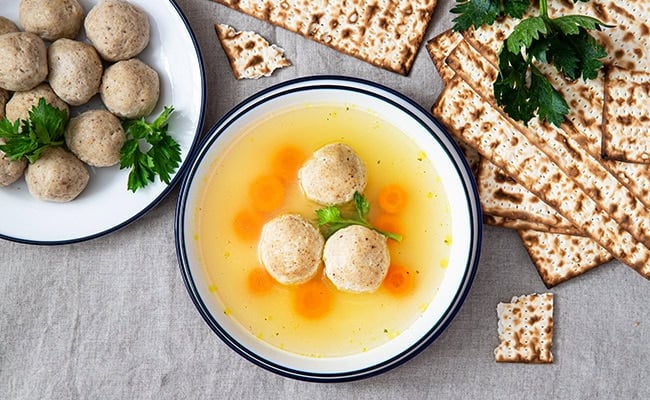
Matzo Ball Soup Recipe
“Delicious homemade chicken soup with matzo balls.” Recipe via Tori Avey.
Yield: 16, 1½ cup servings.
Chicken Soup Ingredients:
- 4 pounds whole chicken
- 2 pounds celery stalks, cut into chunks
- 1 pound carrots, peeled and cut into chunks
- 1 yellow onion, skin on, rinsed, halved
- 2 ounces fresh parsley (one large handful), rinsed
- 1.5 ounces fresh dill (one handful), rinsed
- 2 teaspoons black peppercorns
- 3 whole cloves (optional; do not add unless you like the flavor of cloves)
- 2 bay leaves
- 1 tablespoon sea salt, or more to taste
Instructions:
- Place the whole chicken (without gizzards) in a 10 to 12-quart stock pot. Cover with 5 quarts of water.
- Bring the water to a boil over medium heat, then reduce to a simmer for 10 to 15 minutes. Skim off foam and particles as they rise to the surface, until most of the foam is gone.
- Replenish the liquid removed during skimming with hot water, about 1 to 2 cups.
- Add the first pound of celery, the onion, the parsley (unchopped), two-thirds of the dill (unchopped), the peppercorns, cloves, and bay leaves to the pot. Add 1 tablespoon of sea salt to the water. Bring back to a simmer. From this point on, do not let the soup come to a rolling boil. A slow, even simmer is best; if the soup boils hard, the broth can turn cloudy.
- Put the lid on the pot and vent it. Reduce the heat to medium low so the soup is slowly simmering. Let it cook for roughly 90 minutes.
- Test for doneness by pulling on the leg of the chicken. It should separate easily, which means the meat is tender. When the chicken is ready, turn off the heat. Use a pair of tongs to lift the chicken carefully from the broth (it may fall apart as you do, which is a good sign). Place it on a plate or in a bowl.
- Let the chicken and the broth cool down for 20 to 30 minutes. Carefully strain the broth into another pot or large bowl (6 quart) through a mesh strainer. Discard the celery, onion halves, spices, and herbs, which will be soft and flavorless at this point.
- Pull the meat from the chicken bones and cut it into bite-sized pieces.
- Add the reserved fresh-cut vegetables to the pot (the second pound of celery and the pound of carrots). Bring the broth to a simmer (not a boil) and let the vegetables cook for 20 to 30 minutes until tender.
- Remove the stems from the remaining fresh dill and chop it up.
- Stir the cooked chicken pieces and the dill into the soup with the vegetables, and simmer for a few minutes more. Taste the broth and season with additional sea salt if desired.
Floater Matzo Soup Balls:
“The lightest, fluffiest floater matzo balls ever.” Recipe via Tori Avey.
Yield: 24 servings.
Ingredients:
- 1 cup matzo meal
- 1/4 teaspoon sea salt, heaping
- 1/4 teaspoon garlic powder, heaping
- 1/4 teaspoon onion powder, heaping
- 1/4 teaspoon white pepper (optional)
- 4 large eggs
- 1/4 cup avocado oil, or safflower oil
- 1/4 cup unflavored seltzer
- 1 tablespoon minced fresh dill or parsley (optional)
- 5 quarts chicken stock
Instructions:
- Separate the egg whites from the yolks, putting the whites in a medium mixing bowl and the yolks in a small mixing bowl. Use a fork to stir together the egg yolks and oil, stirring briskly to combine. Gently stir in 1/4 cup of bubbly unflavored seltzer.
- In a second medium mixing bowl, use a fork to combine the matzo meal, salt, garlic powder, onion powder, and white pepper.
- Pour the egg yolk mixture into the dry ingredients and add the minced dill or parsley. Mix with a fork until just combined. Do not over-mix.
- Whip the egg whites with an electric mixer to form stiff peaks.
- Fold the whipped egg whites into the batter. You want the whites well integrated, but over-mixing will deflate them. Put the bowl of matzo ball mixture in the refrigerator and let it rest for 30 minutes.
- Bring your 5 quarts of chicken stock to a boil over medium heat.
- While the broth warms, form the chilled matzo ball mixture into 1-inch balls (roughly walnut-sized). Do not overwork the mixture when you roll them.
- When the broth boils, reduce the heat to a simmer and drop the matzo balls gently into the liquid.
- Cover the pot with a lid and let the balls cook for 30 to 50 minutes until fluffy and soft. Keep the pot covered. No peeking for at least 30 minutes. The balls should be floating on the surface. If they seem dense, they need to cook longer. (Note: when you first open the lid, the matzo balls may sink to the bottom of the pot. That does not mean you have failed to make floaters; it just happens when the lid comes off.)
- Test for doneness by slicing a matzo ball in half. It should look the same all the way through the center: tender, with no dark spot in the middle. If the center is darker than the edges, it needs to simmer a little longer. The matzo ball will not be light and fluffy unless it is fully saturated with broth and cooked all the way through.
- Serve two or three matzo balls per bowl with hot chicken soup ladled over them. If you do not plan to serve the whole pot at one sitting, remove the matzo balls from the broth and let them come to room temperature before storing in a separate sealed container in the refrigerator. (Note: if left to sit in the broth, they will turn mushy.)
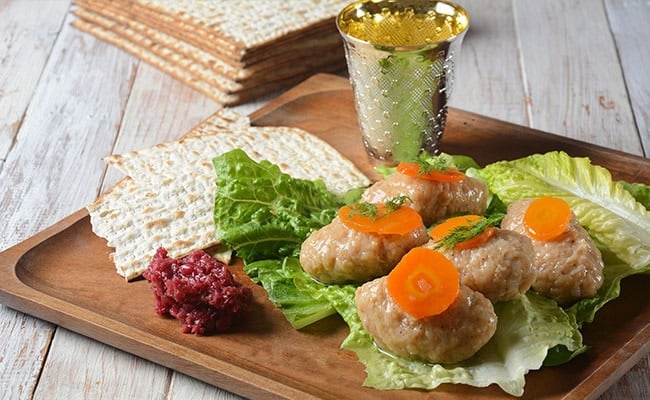
Easy, Homemade Gefilte Fish Recipe
Poached and deboned ground fish balls or patties. Recipe by Moran Pinto.
Fish Ingredients:
- 1 carrot
- 1 onion
- 1 lb. ground carp (to grind fish, pulse without bones in a food processor)
- 2 tbsp. sugar
- 1 tbsp. ground black pepper
- 1 tbsp. kosher salt
- 1 cup matzo meal (approximately)
- 2 eggs
Broth Ingredients:
- 3 quarts (12 cups) water
- 4 bay leaves
- 5 whole peppercorns
- ½ cup sugar
- 1 tbsp. cracked black pepper
- 1 onion
Instructions:
Place the carrot and onion into a food processor and grind finely. Mix the carrot and onion into the ground carp. Add the salt, sugar, pepper, eggs, and matzah meal. Mix and form into balls. Place all the broth ingredients into a pot and bring to a boil. Drop in the fish balls and cook for 1 hour. Remove and refrigerate until serving. Serve with beet horseradish, if desired.
Notes: Carp is the traditional fish used in gefilte, but you can also use boneless cod, halibut, pike, or white fish. Gefilte fish means “stuffed fish” in Yiddish.
Miracle Bars
“Easy and yummy.” Recipe contributed by Dr. Eric Mintz of West Bloomfield, Michigan.
Ingredients:
- 2 large eggs, slightly beaten
- 2 cups ground almonds or almond meal
- 1 cup brown sugar
- 1 cup chocolate chips
Instructions:
- Preheat the oven to 375°F.
- Grease a 9″ x 13″ pan with kosher vegetable oil or coconut oil.
- Mix all the ingredients in a bowl until thoroughly combined. The batter will be thick; do not add any water.
- Transfer the batter into the prepared pan and smooth with a spatula.
- Bake for 23 minutes.
- Cool in the pan and cut into squares.
Chocolate Matzo
“This recipe was given to me by a friend several years ago. It was such a hit, I make it every year.” -Dr. Eric Mintz of West Bloomfield, Michigan.
Ingredients:
- 24 ounces (2 packages) semi-sweet chocolate chips
- ¼ cup kosher vegetable oil
- 8 ounces matzah farfel (Jewish cuisine, sold in packages; matzo broken into small pieces)
- 1 cup walnut pieces
- 1 cup raisins
- 10.5 ounces mini marshmallows (labeled Kosher for Passover)
Instructions:
- Carefully microwave the chocolate and oil in a large glass bowl for one minute and stir. Repeat the process until the chocolate is almost melted.
- Add the remaining ingredients into the bowl and mix together with a large spoon.
- Line a tray with wax paper.
- Spread the mixture onto the wax paper and place in the freezer overnight.
- The next day, break the candy into pieces.
- Place in sealable containers and keep refrigerated, or freeze.
More Classic Jewish Cuisine to Enjoy
Want to try more Jewish culinary favorites? If you have a Jewish deli nearby, look for the three classic cured and braised meats on the menu: pastrami, brisket, and corned beef.
Latkes (fried potato pancakes) are a Hanukkah staple, served with sour cream or apple sauce.
Knishes (baked or fried pockets) filled with meats and vegetables such as caramelized onions, mashed potatoes, and cheese are a savory crowd-pleaser.
Doughless potato knishes are a Passover-friendly take, made without the wheat dough.
Do not forget dessert. Macaroons are a traditional Passover treat, naturally chametz-free.
What To Do on Nights Without a Seder Dinner
The Seder happens on the first two nights. The rest of the eight-day holiday still carries weight, and households continue to honor the food rules and the spirit of the week. Here are some of the ways the days between are observed:
Eating special food: For the whole eight days of Passover, leavened bread stays off the table. The rule holds at every meal, not just at the Seders.
Going to religious services: Many families attend services at their synagogue or take part in community events for Passover.
Studying religious texts: Passover is a good time to read and learn more about Jewish teachings, especially those about leaving Egypt and the idea of freedom.
Reflecting on the Exodus story: Even on non-Seder nights, families return to the story of how the Jews left Egypt and what it means for life today. That might happen at the table, in a study group, or in a quieter moment.
Eating together: Families still gather for regular meals during Passover, following the special food rules. These ordinary meals knit the household together and carry the holiday through the week.
Doing good for others: Passover speaks plainly about freedom and fairness. Many people use the week to give, volunteer, or work toward making things a little fairer in their own corner.
So even on non-Seder nights, Passover is a time to think, to celebrate, and to live the values the holiday teaches.

Frequently Asked Questions
When is Passover 2027?
Passover 2027 begins at sundown on Wednesday, April 21, 2027, and ends the evening of Thursday, April 29, 2027. The first Seder is the evening of April 21; the second Seder is the evening of April 22. Observers in Israel keep Passover for 7 days; observers elsewhere keep it for 8.
Why does Passover fall on a different date each year?
Passover is set by the Hebrew calendar, which is luni-solar. The holiday always begins on the 15th of Nisan, and the Hebrew calendar adds a leap month (Adar II) roughly every two or three years to keep the spring holidays anchored to spring. The Gregorian calendar, which is solar only, sees that adjustment as Passover shifting by a couple of weeks from year to year.
How long is Passover?
Passover is 8 days in the Diaspora and 7 days in Israel. The first two nights are the Seder nights for most Jews outside Israel; in Israel, only the first night is the Seder. The eight-day length has roots in the uncertainty of sighting the new moon in ancient times, which led communities outside Israel to keep an extra “second day of the diaspora” to be safe.
What do you say to someone celebrating Passover?
The Hebrew greeting is Pesach Sameach (PEH-sakh sah-MAY-akh), which means “Happy Passover.” A more general Jewish-holiday greeting is Chag Sameach (KHAG sah-MAY-akh), “happy holiday.” In English, “Happy Passover,” “Joyous Passover,” or “Blessed Passover” are all welcome.
What is on the Seder plate?
Five symbolic foods sit on the Seder plate: maror (a bitter herb, usually horseradish or endive), charoset (a sweet paste of fruit, nuts, and wine), karpas (a mild green like parsley or celery), zeroah (a roasted shank bone), and beitzah (a roasted egg). Matzah (unleavened bread) sits separately on the table and is tasted at set points in the Seder.
Why no leavened bread during Passover?
When the Israelites left Egypt, they left in such a hurry that there was no time for their bread dough to rise. Eating only matzah (unleavened bread) during Passover and removing chametz from the home are how households remember that moment. The food restriction is one of the most physically present parts of the holiday, a daily reminder of the rush from slavery to freedom.
When is Passover 2028?
Passover 2028 begins at sundown on Monday, April 10, 2028, and ends the evening of Tuesday, April 18, 2028. As always, the holiday begins on the 15th of Nisan on the Hebrew calendar.
Is Passover connected to Easter?
Yes. The Last Supper in the Christian tradition is a Passover Seder, which is why Easter is calculated in relation to the spring full Moon, the same Moon that anchors Passover. The two holidays often fall in the same week, though not always. See our When Is Easter? page for that calendar story.
Join the Discussion
Are you planning a Seder dinner this year, or remembering one from last year?
What family traditions do you carry to the Seder table? A grandmother’s haroset recipe, a particular tune for Dayenu, a special chair for Elijah, the youngest child’s reading of the Four Questions?
Share your thoughts and photos with the Farmers’ Almanac community in the comments below.
Related
Traditional Jewish Apple Cake Recipe

Deborah Tukua
Deborah Tukua is a natural living, healthy lifestyle writer and author of 7 non-fiction books, including Pearls of Garden Wisdom: Time-Saving Tips and Techniques from a Country Home, Pearls of Country Wisdom: Hints from a Small Town on Keeping Garden and Home, and Naturally Sweet Blender Treats. Tukua has been a writer for the Farmers' Almanac since 2004.
-
Farmers' Almanac Staff

-
Farmers' Almanac Staff
-
Farmers' Almanac Staff
-
Farmers' Almanac Staff