

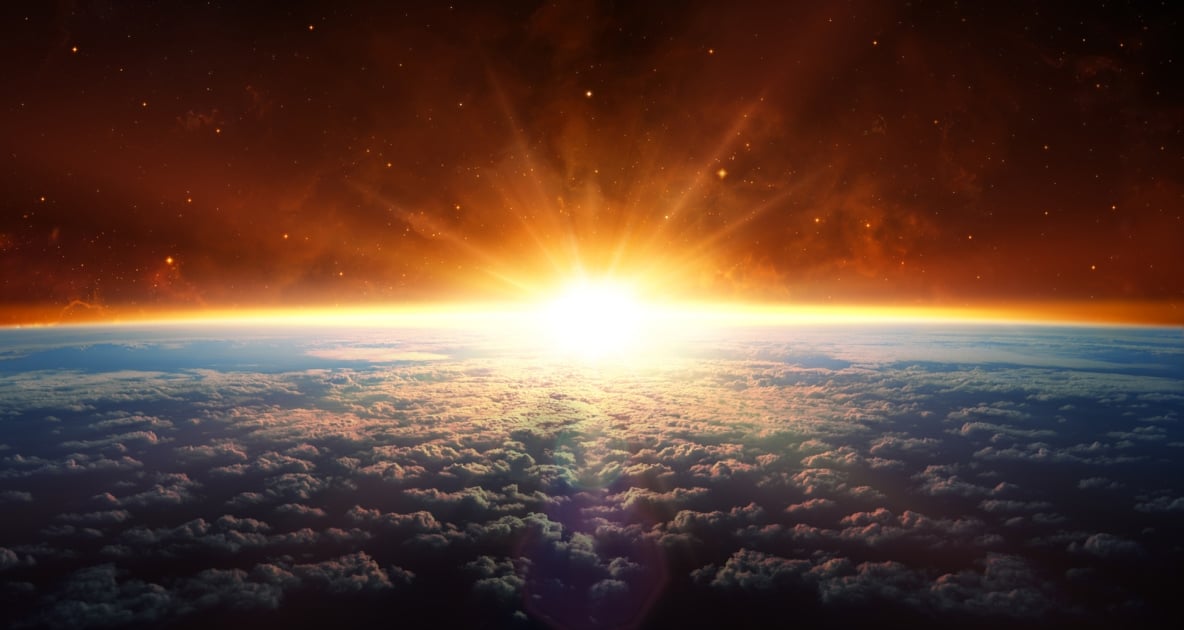
The terms perihelion and aphelion describe the closest and farthest distances of the Earth to the Sun, respectively. The Earth is closest to the Sun (at perihelion) roughly 2 weeks after the winter solstice and farthest from the Sun (at aphelion) roughly two weeks after the summer solstice. Yet these distances don’t affect the seasons or weather. See upcoming dates and learn common misunderstandings.
When Is Perihelion 2026?
Perihelion 2026 occurs on January 3, 2026 at 12:16 p.m. EST At that point in its orbit, the Earth is over 91 million miles from the Sun, a difference of about three million miles from its farthest point, aphelion. (The actual number varies year over year.)
While three million miles may sound significant, Earth’s overall distance from the Sun is so great that this change in distance has virtually no effect on weather patterns. Learn how the Farmers’ Almanac makes weather forecasts.
When Is Aphelion 2026?
Aphelion 2026 occurs on July 6, 2026 at 1:31 p.m. At the moment of aphelion, the Sun will be over 94 million miles away, or over 3 million miles farther as compared to when the Earth is closest to it (perihelion).
An easy way to remember the difference between aphelion and perihelion: “A” is “away” (from the Sun).
Reading these dates from outside the US: dates are written US style, month first, so “January 3, 2026” is the third of January. Times are US Eastern, which is EST for the January perihelion dates and EDT for the July aphelion dates. To convert to Coordinated Universal Time, add 5 hours to an EST time and 4 hours to an EDT time. Perihelion and aphelion happen at a single instant worldwide, so only the clock reading changes, never the event.
Perihelion and Aphelion 2026-2035
2026
- Perihelion: January 3, 2026 at 12:16 p.m. EST
- Aphelion: July 6, 2026 at 1:31 p.m. EDT
2027
- Perihelion: January 2, 2027 at 9:33 p.m. EST
- Aphelion: July 5, 2027 at 1:06 a.m. EDT
2028
- Perihelion: January 5, 2028 at 7:28 a.m. EST
- Aphelion: July 3, 2028 at 6:18 p.m. EDT
2029
- Perihelion: January 2, 2029 at 1:13 p.m. EST
- Aphelion: July 6, 2029 at 1:12 a.m. EDT
2030
- Perihelion: January 3, 2030 at 5:12 a.m. EST
- Aphelion: July 4, 2030 at 8:58 a.m. EDT
2031
- Perihelion: January 4, 2031 at 3:48 p.m. EST
- Aphelion: July 6, 2031 at 3:10 a.m. EDT
2032
- Perihelion: January 3, 2032 at 12:11 a.m. EST
- Aphelion: July 5, 2032 at 7:54 a.m. EDT
2033
- Perihelion: January 4, 2033 at 6:51 a.m. EST
- Aphelion: July 3, 2033 at 4:52 p.m. EDT
2034
- Perihelion: January 3, 2034 at 11:47 p.m. EST
- Aphelion: July 6, 2034 at 2:49 p.m. EDT
2035
- Perihelion: January 2, 2035 at 7:54 p.m. EST
- Aphelion: July 5, 2035 at 2:22 p.m. EDT
Dates and times computed from Fred Espenak’s “Earth at Perihelion and Aphelion: 2001 to 2100”, converted from GMT to US Eastern.
It’s All About The Tilt
If you ask most people which month of the year they think Earth is closest to the Sun, most would probably say during June, July, or August. But our warm weather doesn’t relate to our distance from the Sun. It’s because of the 23.5-degree tilt of the Earth’s axis that the Sun is above the horizon for different lengths of time at different seasons. The tilt determines whether the Sun’s rays strike us at a low angle or more directly.
Even though most of us learned in school that seasons are controlled by the tilt of the Earth’s axis, rather than by its distance from the Sun, many people forget. We experience summer or winter conditions based on whether our half of the Earth is pointed toward the Sun or away from it. While we’re battling ice and snow in the Northern Hemisphere, our neighbors to the south are enjoying summer, and vice versa.
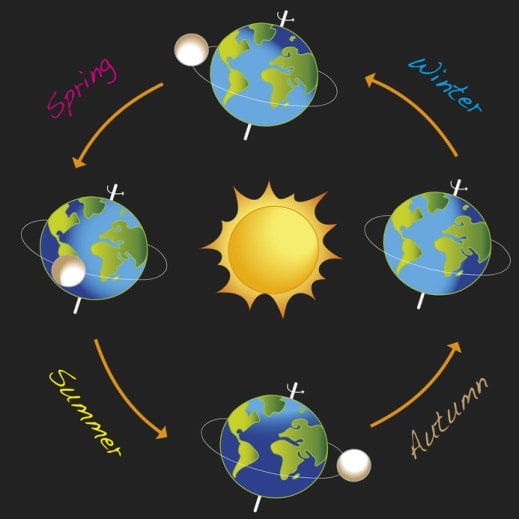
At New York’s latitude, the more nearly-direct rays at the summer solstice of June 21st, bring about three times as much heat as the more slanting rays at the Winter Solstice on December 21. Heat received by any region is dependent upon the length of daylight and the angle of the Sun above the horizon. Hence the noticeable differences in temperatures that are registered over different parts of the world.
A Climatological Fallacy
When I attended Henry Bruckner Junior High School in The Bronx, my ninth grade earth science teacher, Mr. Shenberg, told all of us that because we were farthest from the Sun in the July and closest in January, that such a difference would tend to warm the winters and cool the summers, at least in the Northern Hemisphere.
And yet the truth of the matter is that the preponderance of large land masses in the Northern Hemisphere works the other way and actually tends to make the winters colder and the summers hotter.
So, while you’re shivering and scraping the ice off of your car’s windshield during the winter, try to remember that the Sun is actually three million miles closer than it was in July. Maybe that will help you feel a little warmer!
Join the Discussion
Did you know that the Earth is closer to the Sun during winter in the Northern Hemisphere?
What questions do you have about aphelion and perihelion?
Share your thoughts in the comments!

For international visitors, note that dates are in US format, months and days are the other way round than conventional in the rest of the world.
Fair point, rowan, thank you. The site’s default is US mm/dd format, which does trip up international readers. We will pass this along to the editorial team as a request to add the month name (e.g. “July 4” rather than “7/4”) on tables that get international traffic, this page included. Until then, every date on the perihelion and aphelion table is month/day/year.
I live in the State of Maine U.S.A, It has been very dry for here where we usually get rain during the spring and summer are warmer.As a child I remember a lot more snow.And if it was real warm it only lasted a few days them we would get storms. I do not miss the storms. They took down many trees which we are famous for. If you have read the Hidden Life of Trees. You might feel as I do about the loss of them which is sad.weather plays such a important part in the progress of forest
amazing
Need to receive lessons from your source
Why is this happening
I’m from India – the South Asian Continent and we have very hot summers from March to May, and somewhere around June it starts raining, and the rain gets heavier by each month leading up to August. Then it’s moderate climate till October and from November till the beginning of February, it’s kind of cold depending on which part of India you’re living in.
Hi Ekan,
Thank you for stopping by!
So educative and informing
Interesting
sun flares astronomical changes
The effect