
Why Do Cats’ Eyes Glow in the Dark? The Science Behind That Spooky Stare

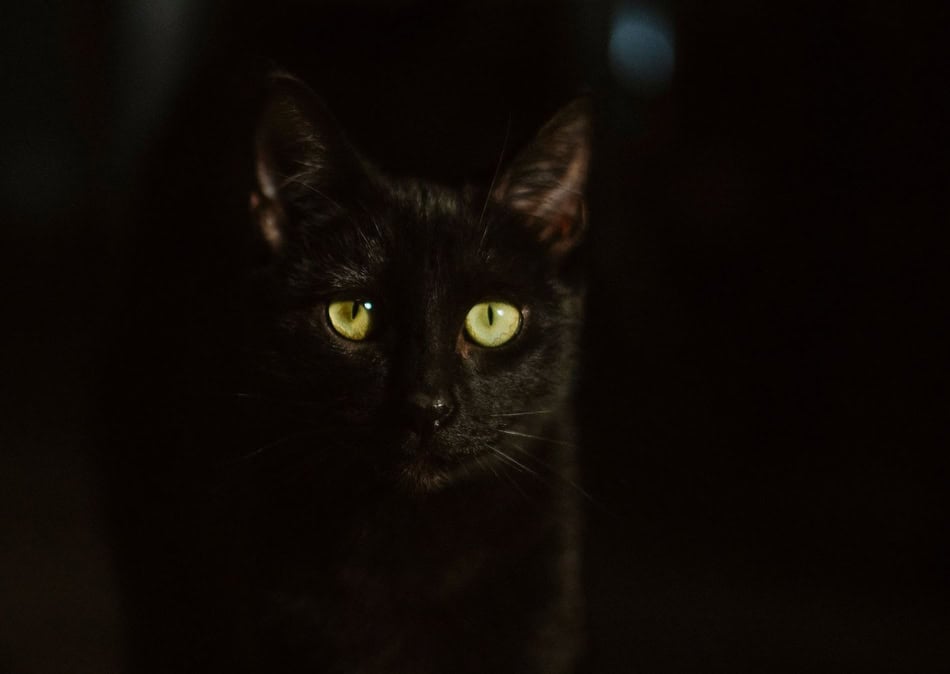
You’re walking through the house at night when two glowing green eyes suddenly appear at the end of the hallway. For a split second, your imagination runs wild. Then the mysterious creature lets out a familiar meow, and you realize it’s just your cat wondering why you haven’t gone to bed yet.
There’s something undeniably eerie about the way a cat’s eyes can shine in the darkness. It’s easy to see why cats, especially black ones, have been associated with Halloween and spooky stories for centuries.
But that strange glow isn’t supernatural, and cats don’t have tiny lights hidden behind their eyes. They’re equipped with something far more interesting: a remarkable reflective layer that helps them make the most of whatever light is available.
It’s one of the reasons your cat can navigate a dim room while you’re still fumbling for the light switch.
What Makes a Cat’s Eyes Glow in the Dark?
The secret is a specialized layer of tissue called the tapetum lucidum, located behind the retina at the back of a cat’s eye.
The name comes from Latin and means something like “shining layer,” which is a pretty good description of what it does.
When light enters the eye, it passes through the retina, where light-sensitive cells help turn it into signals the brain can interpret. But not all the incoming light gets absorbed on that first pass.
That’s where the tapetum lucidum comes in. It acts somewhat like a mirror, reflecting some of the light that wasn’t absorbed back through the retina. This gives the eye another opportunity to detect it.
According to the Cornell University College of Veterinary Medicine, this adaptation helps make cats much more sensitive to low levels of light than humans.
Some of the reflected light escapes back out through the pupil. When it reaches your eyes, you see that familiar greenish, yellow, or sometimes orange glow.
So your cat’s eyes aren’t actually generating light. They’re reflecting it.
And that little trick serves a very useful purpose.
Why Do Cats Need Reflective Eyes?
Think about when your cat is most likely to become lively. You may notice a burst of energy around dawn or dusk, even if the rest of the day has been devoted to serious napping.
Cats are naturally crepuscular, meaning they’re particularly adapted to activity during twilight hours. Their wild ancestors often hunted when light was fading or just beginning to return.
Being able to see in those dim conditions was a tremendous advantage. A small movement in the grass might mean the difference between catching dinner and going hungry.
The tapetum lucidum helps, but it isn’t the only feature that gives cats excellent low-light vision.
Their eyes also contain large numbers of rod cells, which are especially sensitive to dim light. And their pupils can open much wider relative to their size than ours, allowing more light to enter.
You’ve probably noticed how your cat’s pupils change throughout the day. In bright sunlight, they may shrink into narrow vertical slits. In dim light, they widen dramatically, sometimes appearing almost perfectly round.
All of these features work together to help cats see when the light is low.
The Merck Veterinary Manual reports that cats can see about six times better than people under dim lighting conditions.
For an animal built to notice the slightest movement of a mouse, that’s a particularly handy ability.
Can Cats See in Complete Darkness?
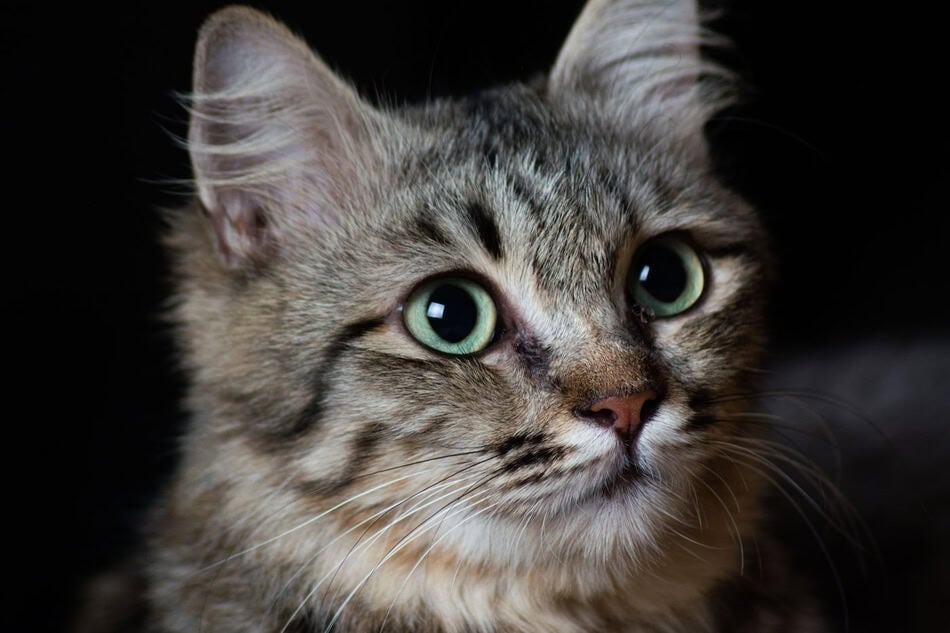
Despite what you may have heard, cats can’t see in total darkness.
Their eyes are remarkably good at using small amounts of available light, but they still need some light to see.
A little moonlight coming through a window, the glow from a streetlamp, or faint light from another room may be enough for a cat to see things that are nearly invisible to you.
But put a cat in a room with absolutely no light, and its remarkable night vision won’t help. The tapetum lucidum has nothing to reflect.
Cats can still rely on their other senses, of course. Their sensitive hearing and whiskers help them gather information about their surroundings, particularly when visibility is poor.
So while your cat might seem capable of seeing in the dark, it isn’t working with some sort of supernatural vision. It’s simply much better equipped than we are to use the light that’s already there.
Why Do Some Cats’ Eyes Glow Green and Others Yellow?
If you’ve spent time around different cats, you may have noticed that their eyes don’t all shine the same color.
Some reflect a brilliant green. Others appear yellow, gold, or orange. Occasionally, the reflected light may look bluish or reddish.
The color depends on several factors, including the composition of the reflective tissue, pigmentation, age, and the light entering the eye.
The animal’s normal eye color doesn’t necessarily determine the color of the reflected glow.
According to VCA Animal Hospitals, the color of eyeshine can vary among individual cats and dogs, and it may change as young animals mature.
The angle matters, too. Sometimes a cat’s eyes will appear to glow brightly when you’re looking almost directly toward a light source, then seem perfectly ordinary when you move to the side.
That’s because the reflected light is traveling in a particular direction. Change your position, and the effect can disappear.
It’s also why a camera flash can occasionally make a pet’s eyes look startlingly bright in photographs.
Do Other Animals Have Glowing Eyes?
Cats certainly aren’t alone in this department.
Dogs, deer, raccoons, and many other mammals also have a tapetum lucidum. It’s especially useful for animals that need to see well in low-light conditions.
If you’ve ever driven along a rural road after dark, you may have noticed a pair of shining eyes near the woods. That glow can come from the same basic reflective mechanism found in your cat.
But don’t assume that every pair of glowing eyes belongs to the same species. Different animals can produce similar-looking reflections, and color alone isn’t a reliable way to identify them.
Humans, incidentally, don’t have a tapetum lucidum.
You might remember the old problem of red eyes in flash photographs. That’s a different effect, caused by light reflecting from structures and blood-rich tissues at the back of the human eye.
It’s another example of how light can produce unexpected effects inside the eye, but it isn’t the specialized night-vision adaptation found in cats.
Is It Normal for a Cat’s Eyes to Glow Differently?
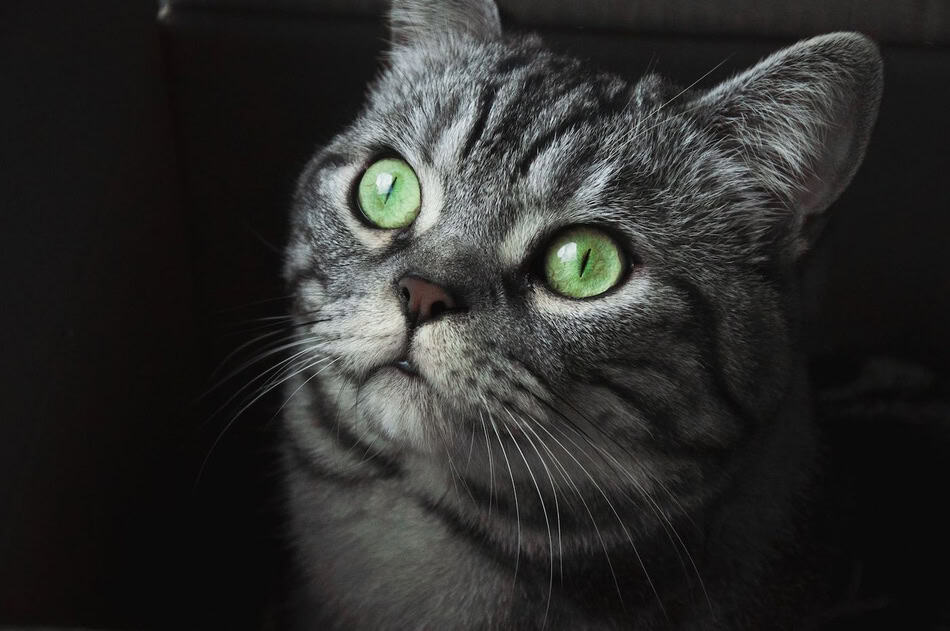
Ordinary eyeshine is a normal feature of feline vision. But an unusual change in the appearance of your cat’s eyes deserves attention.
If one eye suddenly looks noticeably different from the other, or you notice persistent cloudiness, unusual pupil size, redness, or signs of discomfort, it’s worth contacting your veterinarian.
Changes in the way an eye reflects light can sometimes be associated with eye disease, although appearance alone isn’t enough to diagnose a problem.
Cornell’s veterinary specialists emphasize that early attention to feline eye problems can make an important difference in protecting vision.
There’s no need to test your cat’s eyes by shining a bright flashlight directly into them. The reflection may be interesting, but your pet probably won’t appreciate being dazzled.
The Real Secret Behind That Spooky Stare
Cats have been linked with mystery and superstition for generations, and their glowing eyes have undoubtedly helped fuel some of those stories.
It’s easy to imagine how unsettling the sight must have been before people understood the anatomy of the eye. A pair of green lights suddenly appearing from a dark barn or shadowy corner could give almost anyone a fright.
Today, we know that the explanation is far more practical than paranormal.
Those shining eyes are part of a beautifully adapted visual system that helps cats hunt, explore, and move through the world when light is scarce.
So the next time you catch that eerie glow from beneath the couch or across the darkened hallway, there’s no reason to be alarmed.
Unless, of course, it’s accompanied by the unmistakable sound of your cat knocking something expensive off a shelf.

- Maggie Konrad

- Maggie Konrad
- Maggie Konrad
- Maggie Konrad