How can a bat sleep upside down for hours without falling?

Imagine trying to sleep while hanging upside down from your toes. Your muscles would be working overtime, your head would feel like it was about to burst, and you’d probably end up on the floor before you managed a wink of sleep.
For bats, though, it’s a perfectly comfortable way to spend the day.
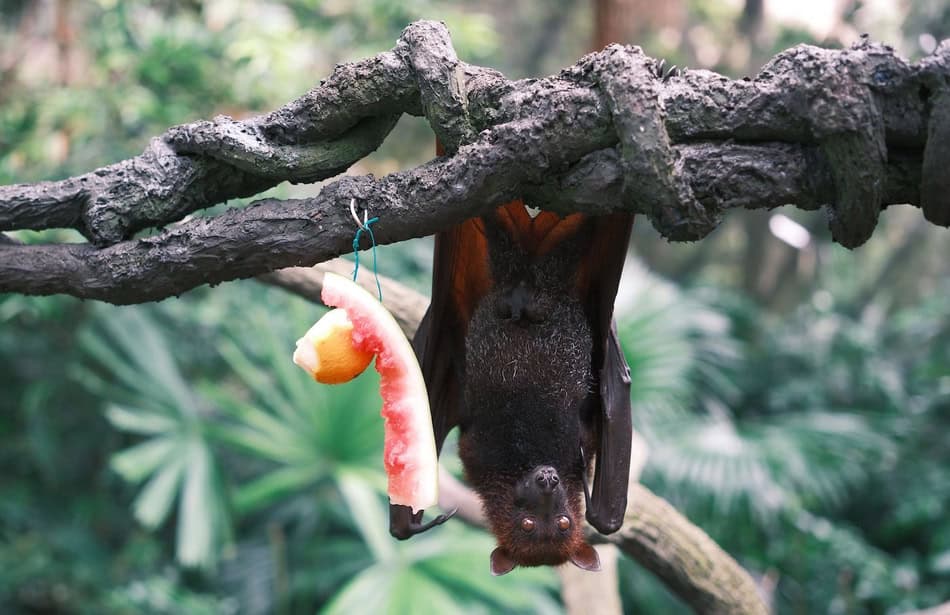
Many bats rest hanging headfirst from cave ceilings, tree branches, and other sheltered spots. Some tuck themselves into their wings, while others gather in colonies of hundreds or even thousands. They can remain suspended for hours, sleeping soundly without falling.
You might assume they have an exceptionally strong grip. But the real explanation is much more interesting. Bats have a remarkable mechanism in their feet that allows them to hang almost effortlessly, even when their muscles are relaxed.
And there’s a good reason they choose such an unusual sleeping position.
How Can Bats Hang Upside Down Without Falling?
If you were hanging from a bar, you’d have to keep your hand muscles working to maintain your grip. As soon as you relaxed, you’d fall. Bats have a clever way around that problem.
Many species possess a specialized tendon-locking mechanism in their feet. When a bat lands on a branch or other suitable surface, it curls its toes around the perch. Tendons running through its feet help hold the claws in position, allowing the bat to remain attached without continually contracting its muscles.
The most surprising part is that the bat’s own weight helps keep the grip secure. As its body hangs downward, tension in the tendons helps maintain the curled position of its toes.
According to Bat Conservation International, this arrangement allows bats to hang for long periods while using very little energy. Rather than fighting gravity, they’re putting it to work.
To let go, the bat actively releases its grip by engaging the appropriate muscles. It’s a little like having a built-in locking system that stays secure until you’re ready to open it.
That ability is especially valuable for an animal that spends much of its life resting between periods of flight.
Why Do Bats Sleep Upside Down Instead of Sitting on a Branch?
The answer has a lot to do with how bats fly.
Bats are the only mammals capable of true, sustained powered flight. Their wings are made of thin, flexible membranes stretched between elongated finger bones, creating an impressive flying apparatus. But that specialization comes with trade-offs.
Unlike most birds, many bats aren’t well equipped to stand upright, run along a branch, and spring into flight. Their hind legs are relatively small and positioned differently from those of most walking mammals.
Hanging from an elevated perch gives them an easier way to get airborne. When it’s time to fly, a bat can release its grip, drop into the open air, and spread its wings. That brief fall gives it room to begin flying without needing to launch itself from the ground.
The Iowa Department of Natural Resources identifies this convenient takeoff position as one advantage of hanging upside down.
Of course, not every bat is helpless on the ground. Vampire bats, for example, have developed an unusual ability to move on all fours. But for many of the bats people commonly encounter, an elevated roost is a much better place to begin a flight.
Hanging also allows bats to rest in places that other animals would find difficult to use. A rough cave ceiling or the underside of a branch provides a secure foothold without requiring a nest or broad surface to sit on.
Doesn’t All the Blood Rush to Their Heads?
Spend a minute upside down on the playground, and you’ll probably notice the pressure building in your face. It doesn’t take long before you want to sit upright again.
So why can a bat hang headfirst for hours?
Size makes a considerable difference. Most bats have relatively small bodies, so the distance between their hearts and heads is much shorter than it is in a human. Their circulation is also adapted to their normal resting position.
Because of their small size and physiology, hanging head-down doesn’t produce the same circulatory difficulties that a much larger animal might experience.
That doesn’t mean bats are immune to gravity or that blood flow somehow stops mattering. Their bodies are simply adapted to conditions that would be uncomfortable for us.
It’s one of those reminders that what feels perfectly natural to another animal may seem downright impossible from a human perspective.
Hanging Upside Down Has Another Advantage
Picture a bat tucked high beneath a rocky overhang or hanging from the ceiling of a cave. It’s not exactly an inviting place for most ground-dwelling predators to reach.
Roosting above the ground can provide some protection from predators, although bats are certainly not beyond their reach. Snakes, birds of prey, and other animals can still hunt bats, depending on the habitat.
Different species also have their own preferences when it comes to finding a place to rest. Some gather in enormous cave colonies, while others shelter beneath loose bark, inside hollow trees, or in the protected spaces of buildings.
Many fruit bats hang from branches in trees, sometimes in large, noisy groups that are impossible to miss. Other bats prefer secluded spaces where they can remain relatively undisturbed during daylight hours.
The Smithsonian Institution’s bat resources describe the remarkable variety of habitats and roosting behaviors found among bat species.
For many of these animals, upside-down hanging is an efficient way to make use of their surroundings while conserving energy and remaining ready to fly when necessary.
Do All Bats Sleep Upside Down?
Here’s another surprise: Not every bat follows the familiar head-down routine.
Most bats do hang upside down when resting, but a few have evolved rather unusual alternatives.
Some small tropical bats, known as disk-winged bats, have specialized adhesive structures on their wrists and ankles. These allow them to cling to smooth surfaces, including the insides of rolled leaves.
Rather than dangling by their claws, they can attach themselves to those surfaces and rest in positions that would be difficult for other bats.
It’s an interesting exception in a group of mammals that includes more than 1,400 species worldwide. Bats have evolved an astonishing variety of shapes, diets, habitats, and behaviors.
The familiar silhouette of a bat hanging upside down represents only part of that diversity.
What Happens If a Bat Is Disturbed While Sleeping?
A resting bat may appear motionless, but that doesn’t mean it’s unaware of its surroundings. Depending on the species, temperature, and time of year, it may be sleeping normally or conserving energy in a state called torpor, during which body temperature and metabolic activity decrease.
If disturbed, an active bat may shift its position, crawl along its roost, or fly away. A bat in torpor may respond more slowly, and repeated disturbances can waste valuable energy reserves.
That’s one reason it’s important to leave roosting bats alone, especially during winter when some species are hibernating.
If you discover bats in a tree, outbuilding, or another sheltered location, enjoy observing them from a respectful distance. Don’t attempt to handle or disturb them. Bats are wild animals, and like other mammals, they can carry diseases, including rabies.
For homeowners dealing with bats inside a building, professional wildlife guidance is a better choice than trying to remove them by hand.
Nature’s Cleverest Way to Put Your Feet Up
Bats have acquired a rather spooky reputation, especially around Halloween. Their dark wings, nighttime habits, and upside-down resting positions have made them familiar characters in everything from haunted-house decorations to vampire stories.
But the real animals are considerably more fascinating than their fictional counterparts.
Their feet are designed to grip securely with little muscular effort. Their resting position gives many species a convenient starting point for flight, and their bodies are well adapted to spending long periods suspended above the ground.
So the next time you see a bat dangling peacefully from a branch or cave ceiling, don’t imagine it’s struggling to hang on.
It’s probably quite comfortable. In fact, there’s a good chance it’s getting a better day’s sleep than you did last night.

- Maggie Konrad

- Maggie Konrad
- Maggie Konrad
- Maggie Konrad