Why the Pleiades Are Called the Seven Sisters, Even Though Most People See Six

Look closely at the little cluster of stars known as the Seven Sisters, and you may notice something strange: There appear to be only six.
The Pleiades, one of the most recognizable star clusters in the night sky, have carried the name Seven Sisters for centuries. Ancient Greek storytellers even gave each sister a name. Yet most people can pick out only five or six stars without binoculars.
So where did the seventh sister go? The question has puzzled skywatchers since ancient times, and astronomers have an intriguing possible explanation.
The Ancient Legend of the Seven Sisters
In Greek mythology, the Pleiades were seven daughters of the Titan Atlas and the sea nymph Pleione. Their names were Maia, Electra, Taygete, Alcyone, Celaeno, Sterope (also called Asterope), and Merope.
According to one version of the legend, the great hunter Orion pursued the sisters until Zeus placed them among the stars for their protection.
But the Greeks also recognized that one sister seemed to be missing.
In one telling, Merope became dim because she was ashamed of marrying a mortal man rather than a god. Other traditions identify Electra as the missing sister, grieving over the destruction of Troy and the fate of her descendants.
These stories attempted to explain something people could observe with their own eyes: Seven stars were named, but only six stood out.
The mystery wasn’t unique to Greece. Stories involving seven sisters also appear in several Aboriginal Australian traditions, sometimes with a missing or hidden sister.
Did the Seventh Star Actually Disappear?
Thousands of years ago, two stars in the Pleiades called Atlas and Pleione may have been easier to distinguish from one another. Over time, their positions in the sky gradually shifted, bringing them so close together that most people today see them as a single point of light.
This could explain why ancient cultures told stories about seven sisters, even though most people can now identify only six stars in the cluster.
In a study titled Why Are There Seven Sisters?, astronomers Ray Norris and Barnaby Norris examined how the stars’ positions have changed over thousands of years. They proposed that Atlas and Pleione were once far enough apart to be more easily seen as two separate stars without a telescope.
As the stars appeared to move closer together, people may have begun seeing six stars where earlier generations had seen seven. Stories about a missing or hidden sister could have developed to explain the change.
It’s an intriguing theory, although it remains unproven. Atlas and Pleione are both still there, and under excellent viewing conditions, some observers can distinguish seven or more stars in the Pleiades. The difference lies in how many stars our eyes can separate, not in a star actually disappearing.
How to Find the Seven Sisters in November
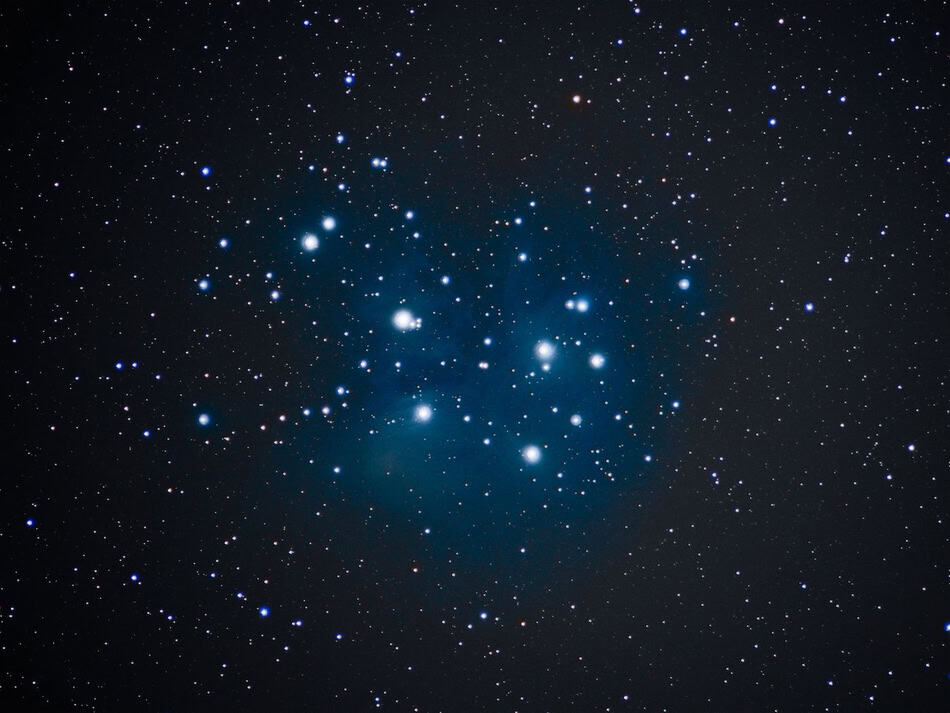
November is an excellent month to look for the Pleiades from the Northern Hemisphere.
By mid-to-late evening, the cluster is visible in the eastern sky, climbing higher as the night progresses.
Look for a small, tightly grouped collection of stars resembling a miniature dipper. They’re located in the constellation Taurus, the Bull.
If you can find Orion’s Belt, follow the line of its three bright stars toward the reddish star Aldebaran and continue in the same general direction. You’ll come to the Pleiades.
For help identifying other stars and constellations, consult the Farmers’ Almanac Night Sky Guide.
Try counting the stars before reaching for binoculars. Choose a clear, dark night, away from bright outdoor lighting, and give your eyes time to adjust.
Then look through binoculars. The small handful of stars visible to the naked eye becomes a much richer cluster, with numerous fainter stars appearing between the brightest members.
You probably won’t identify one particular star as the missing sister. There is no single confirmed seventh star that disappeared from view. But you can see the same little gathering of stars that inspired one of the sky’s oldest and most enduring mysteries.

- Maggie Konrad

- Maggie Konrad
- Maggie Konrad
- Maggie Konrad