

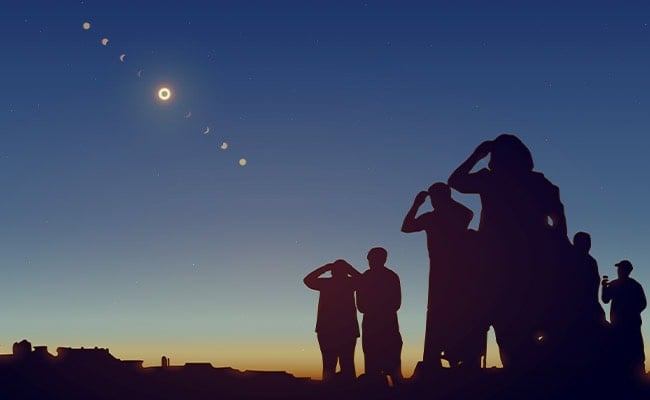
Eclipses do not arrive on a tidy schedule. They come in seasons, which is why one year can hold four and the next can go most of a year without any. 2026 has already had all of its, so the next one is the annular solar eclipse of Saturday 6 February 2027. The one to circle, though, is Monday 2 August 2027, a total solar eclipse with one of the longest stretches of totality this century. Below is every eclipse through 2028, along with the folklore the Almanac has carried for generations, including why banging a drum during an eclipse was thought to help.
Quick Reference: The Next Eclipses
- Next eclipse: Saturday 6 February 2027, an annular solar eclipse
- Next lunar eclipse: Saturday 20 February 2027, penumbral
- The one to circle: Monday 2 August 2027, a total solar eclipse with one of the longest totalities of the century
- Left in 2026: none. The last was the partial lunar eclipse of 28 August
- From the United States: no 2027 eclipse crosses the mainland. The next total solar eclipse over the lower 48 is 23 August 2044
The Farmers’ Almanac Eclipse Calendar
Eclipses arrive in pairs and seasons rather than at even intervals, which is why a year can hold four of them and then the next ten months hold none. The table below lists every solar and lunar eclipse through the end of 2028, with the moment of greatest eclipse in Universal Time. Subtract five hours for Eastern Standard Time and eight for Pacific.
| Date | Type | Greatest eclipse (UTC) | Broadly visible from |
|---|---|---|---|
| Sat 6 Feb 2027 | Annular solar | 16:00 UTC | Southern South America, the Atlantic and west Africa |
| Sat 20 Feb 2027 | Penumbral lunar | 23:13 UTC | The Americas, Europe and Africa |
| Sun 18 Jul 2027 | Penumbral lunar | 16:03 UTC | Africa, Asia and Australia |
| Mon 2 Aug 2027 | Total solar | 10:07 UTC | Southern Spain, north Africa and the Middle East |
| Tue 17 Aug 2027 | Penumbral lunar | 07:14 UTC | The Pacific and the Americas |
| Wed 12 Jan 2028 | Partial lunar | 04:13 UTC | The Americas, Europe and Africa |
| Wed 26 Jan 2028 | Annular solar | 15:08 UTC | South America, the Atlantic and Europe |
| Thu 6 Jul 2028 | Partial lunar | 18:20 UTC | Africa, Asia and Australia |
| Sat 22 Jul 2028 | Total solar | 02:56 UTC | Australia and New Zealand |
| Sun 31 Dec 2028 | Total lunar | 16:52 UTC | Europe, Africa, Asia and Australia |
There Are No More Eclipses in 2026
2026 had its full share early. The annular solar eclipse of 17 February, the total lunar eclipse of 3 March, the total solar eclipse of 12 August across Greenland, Iceland and northern Spain, and the partial lunar eclipse of 28 August. Nothing further falls in this calendar year, so the next one to watch for is in February.
Eclipses in 2027
Annular Solar Eclipse, Saturday 6 February 2027
An annular eclipse happens when the Moon sits far enough away that it cannot quite cover the Sun, leaving a thin ring of light around a black disc. The old name for it is the ring of fire. Greatest eclipse falls at 16:00 UTC, and the track runs across southern South America and out over the Atlantic towards west Africa.
Penumbral Lunar Eclipse, Saturday 20 February 2027
A penumbral eclipse is the gentlest kind. The Moon passes through the outer, softer part of Earth’s shadow and dims slightly rather than turning red. Greatest eclipse is at 23:13 UTC. If you are watching casually you may not notice it at all, which is part of why the old records make so much more of total eclipses than of these.
Total Solar Eclipse, Monday 2 August 2027
This is the one worth planning around. The Moon will be close to Earth and the Sun near its furthest, a combination that stretches totality out to well over six minutes near the centre of the track, far longer than the two to four minutes a total eclipse usually offers. Greatest eclipse is at 10:07 UTC, and the shadow crosses southern Spain, north Africa and the Middle East. Nothing of this length is due again over land for decades.
Penumbral Lunar Eclipse, Tuesday 17 August 2027
Two weeks after the great solar eclipse the Moon passes through Earth’s outer shadow again, greatest eclipse at 07:14 UTC. Pairs like this are the normal pattern: a solar eclipse at new Moon and a lunar one at the full Moon either side of it, because both require the Sun, Earth and Moon to line up near the same point in the Moon’s orbit.
If you want the long view on the season rather than the sky, the Farmers’ Almanac long-range weather forecast covers your region, and the full Moon calendar lists every full Moon and its traditional name.
Eclipse FAQ
What is an eclipse?
When many people hear the term “eclipse,” they think of a solar eclipse. Solar eclipses occur when the Moon’s motion in the sky blocks the Sun’s light. But the Sun isn’t the only celestial object that may be eclipsed! Stars and planets can be eclipsed by the Moon as well, which is called an “occultation.” The Moon can also be eclipsed by the Earth, which is known as a lunar eclipse.
What happens during a lunar eclipse vs solar eclipse?
A solar eclipse occurs when the Moon is directly between Earth and the Sun, and the Moon casts a shadow over Earth, shown in this illustration:
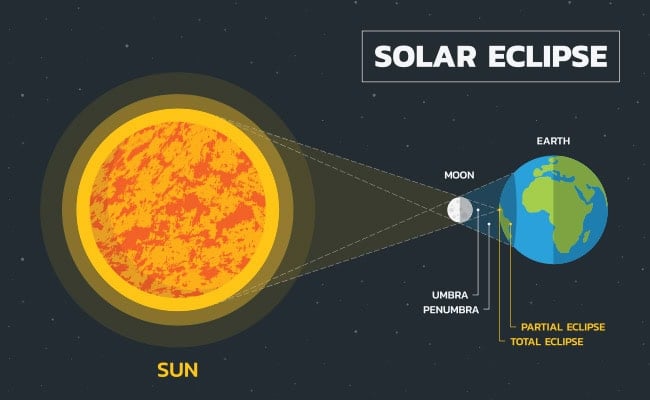
On the other hand, during a lunar eclipse the Earth and Moon trade places and therefore the Earth casts a shadow upon the Moon. Solar and lunar eclipses have specific names according to how much shadow coverage is involved.
Solar eclipses always happen during a new Moon phase, but lunar eclipses always occur during the full Moon phase. Whether there is an eclipse or not is based on the alignment of the three celestial bodies: Sun, Moon, and Earth.
How often do eclipses occur?
Eclipses typically happen four times each year: two solar eclipses and two lunar eclipses. Though there are sometimes five, six or seven eclipses in a single year. (The last time we saw a year with seven eclipses was 1982 and the next time will be in 2038.)
“Eclipse season” is a time when eclipses are more likely to happen, approximately every six months. During an eclipse season, the Sun, Moon, and Earth line up in a way that makes it possible for eclipses to occur. In this window of time—approximately 34 days—eclipses happen in pairs, two weeks apart. For example, the total solar eclipse of 2 August 2027 is followed by a penumbral lunar eclipse on 17 August 2027.
Can there be three eclipses in one month?
Yes, it is possible to have three eclipses in one month, but it is very rare. The last time there were three eclipses in a single calendar month was in 2000, but it won’t happen again until 2206!
Do eclipses happen earlier and earlier as time goes on?
The time between eclipse seasons is about a week short of six months, so eclipse seasons migrate backward through our calendar, occurring slightly earlier each year.
How many types of solar eclipses are there?
There are four types of solar eclipses: three main types and one that is a combination:
- Total Solar Eclipse: This occurs when the Moon completely covers the Sun, blocking out its light. During a total solar eclipse, the sky becomes dark as if it were nighttime, and the Sun’s corona, or outer atmosphere, becomes visible as a glowing ring around the darkened Moon.
- Annular Solar Eclipse: An annular solar eclipse happens when the Moon is farther away from the Earth, so it appears smaller in the sky. As a result, it doesn’t completely cover the Sun, leaving a ring of sunlight visible around the edges of the Moon. This creates what’s often referred to as a “ring of fire” effect.
- Partial Solar Eclipse: In a partial solar eclipse, the Moon only covers part of the Sun’s disk. This creates a crescent shape in the sky, with a portion of the Sun still visible. The degree of coverage varies depending on the observer’s location.
- Hybrid Solar Eclipse: Also known as an annular-total eclipse, this rare type of eclipse transitions between a total and annular eclipse along its path. It begins as an annular eclipse and then transforms into a total eclipse or vice versa, depending on your location along the eclipse path.
Note: Hybrid solar eclipses are particularly rare celestial events, occurring when the alignment of the Earth, Moon, and Sun is so precise that the eclipse transitions between total and annular phases along its path. This phenomenon adds an extra layer of intrigue for astronomers and skywatchers alike, making hybrid eclipses highly anticipated and sought-after events.
How many types of lunar eclipses are there?
There are three types of lunar eclipses:
- Total Lunar Eclipse: This happens when the Earth passes between the Sun and the Moon, casting its shadow on the Moon. During a total lunar eclipse, the Earth’s shadow completely covers the Moon, turning it a deep red or copper color. This occurs because some sunlight refracts through the Earth’s atmosphere and illuminates the Moon. It is as if all of the sunsets of Earth are being cast upon the face of the Moon. The term “Blood Moon” is often used colloquially to refer to this striking phenomenon. (This is the kind most people mean when they talk about a Blood Moon.)
- Partial Lunar Eclipse: In a partial lunar eclipse, only a portion of the Moon passes through the Earth’s shadow. This results in a section of the Moon appearing darker than usual, but it doesn’t fully disappear as in a total lunar eclipse.
- Penumbral Lunar Eclipse: This type of lunar eclipse occurs when the Moon passes through the faint outer part of the Earth’s shadow, known as the penumbra. During a penumbral lunar eclipse, the Moon may appear slightly dimmer than usual, but the change is subtle and may not be noticeable to the casual observer.
Any questions? Contact [email protected]
Would you like to keep learning? We recommend watching this informative video:
When Is The Next Total Solar Eclipse In North America?
- March 30, 2033: We should also note that a swath of our vast 49th state of Alaska will be darkened by the Moon’s shadow on this date. The northern and western part of the “Great Land State” will be inside the totality path. Nome will see 2 minutes 30 seconds of total eclipse. Alaska also played host to the total eclipses of 1963 and 1972, both occurring in the month of July.
- August 23, 2044: this solar eclipse will envelop much of northeastern Montana and a slice of westernmost North Dakota near local sunset. Totality will last only around 100 seconds, but the width of the shadow path is immense: in excess of 300 miles.
- August 12, 2045: A truly great eclipse will visit the United States, stretching east-southeast along a broad arc from northern California, through Kansas/Oklahoma and then down into Florida. Totality will last unusually long, ranging from 4 minutes 22 seconds along the Pacific coast to 6 minutes 06 seconds at Port St. Lucie, Florida.
- March 30, 2052: will see the Moon’s shadow clip the southern tip of southern Texas (Brownsville will see 1 minute 48 seconds of totality). The shadow then continues northeast across the Gulf of Mexico, grazing the Louisiana Parishes that border Barataria Bay, the Mississippi Delta and Breton Sound, before streaking across the Florida Panhandle, clipping the southeast corner of Alabama, rolling through the lower third of Georgia before heading out to sea at the South Carolina coast. And yes, as was the case in 2017, Charleston, South Carolina will be in the totality path!
- May 1, 2079: Nine minutes after sunrise, the Moon will totally eclipse the Sun for just over 2 minutes as seen from the Tri-State Area; New York’s first total solar eclipse since 1925.
Solar Eclipse Myths And Superstitions
In our technological age, relatively rare occurrences like total solar eclipses are well understood by scientists. But in the days when life was harder and accurate information scarcer, eclipses were often seen as a mysterious and unwelcome disruption of the natural order.
Many cultures viewed a solar eclipse as if some mythic creature devouring the Sun. In ancient China, it was a celestial dragon, and in southeast Asia, they imagined it to be a giant turtle, frog, or toad. In Korea, “fire dogs” were believed to steal the Sun and when they bit it, an eclipse resulted.
For the Vikings, a hungry wolf named Sköll (whose name means “Treachery”) raced across the sky, hunting down and eating the Sun. Even cultures like Greece and Rome—which had the mathematical and observational knowledge to be able to predict eclipses—viewed eclipses as bad omens, portents of evil, and fearsome astronomical events.
In Hindu mythology, it was believed that the demon Rahu stole an elixir of immortality, called amrita, but was beheaded by the god Vishnu before he could fully swallow it. Consequently, the demon’s severed head, forever alive, floats around and occasionally devours the Sun. To this day, in India, people make noise by banging pots and pans and setting off fireworks during a solar eclipse to scare Rahu away and make him cough up the Sun.
A northwestern Native American tribe has a legend that a solar eclipse is the result of a quarrel between a great bear and the Sun, ending with the bear taking a huge bite out of it. In fact, the tribe’s name for a solar eclipse translates to Sun got bit by a bear.
Emperors, Kings, and rulers throughout history have been particularly nervous about eclipses. Their court astrologers interpreted them as bad omens that the monarch’s power was in danger. In ancient Babylon, there was the practice of hiring “stand-in” kings to sit on the throne during an eclipse, so any harm would come to them rather than the real king.
In 1133 King Henry I died shortly after a solar eclipse, and some in his court had, in fact, assumed that it was tied to the astronomical event.
Can solar eclipses be good omens too?
Not all of the tales associated with eclipses are negative!
- Herodotus, an ancient Greek scholar, and a battle in the 6th Century B.C. between the Medes and the Lydians, which was raging until a solar eclipse began. It is said the soldiers threw down their arms and stopped fighting, believing that the gods disapproved of the war.
- And in Italy, it is believed that if you plant flowers during a total solar eclipse, they will bloom with more vibrant colors than those planted at any other time.
Lunar Eclipse Superstitions
Here’s a look at some of the stories, beliefs, myths, and superstitions about lunar eclipses from around the world. Keep these in mind the next time you watch a total lunar eclipse:
Changes Are Coming: American Indian tribes say lunar eclipses are a sign of transformation (based on the belief that the Moon controls and regulates the Earth).
Time To Forgive: According to South African mythology, the Sun and Moon fight during an eclipse. It was thought that the people must come together to encourage the celestial bodies to resolve their feud.
Pay It Forward: Tibetan Buddhists believe the effect of good deeds (and bad) are multiplied tenfold during a lunar eclipse.
Relax, Moms: In several cultures, expectant mothers are advised to stay indoors when the Moon turns dark for fear it may curse their unborn child. They should also avoid doing housework, since using a knife or other sharp object during these times is believed to cause birthmarks.
Make Some Noise: Incan civilizations believed that lunar eclipses occurred when a mythological jaguar attacked and ate the Moon. To drive it away, people would shake spears at the night sky and make their dogs bark.
Today, many eclipse watchers give a nod to this ritual with noisemakers in hand to “scare off” whatever is swallowing the Moon. Whether you believe lunar eclipses are spooky or spectacular, you can’t deny they’re fascinating sights to see!
What are some modern-day beliefs?
To this day, superstitions persist about eclipses. Many cultures still believe that eclipses are evil omens that bring death and destruction. One of the most pervasive is that eclipses are dangerous to young children and pregnant women. Many people, even in our modern times, won’t venture outside during a solar eclipse because of the belief that they will be harmed (be sure to wear protective eclipse viewing eyewear).
Fortunately, most of us know that solar eclipses are nothing to fear, and we will enjoy them for what they are—a rare and beautiful celestial event!
Join The Discussion
Do you believe that eclipses bring good or bad luck?
Where will you be for the next eclipse?
Share thoughts with your community in the comments below!
