

Quick Reference: The Spring Equinox
- Spring Equinox 2026: Friday, March 20, 2026 at 10:46 a.m. EDT (14:46 UTC). Already passed.
- Next Spring Equinox (2027): Saturday, March 20, 2027 at 4:25 p.m. EDT (20:25 UTC)
- What it is: The moment the Sun crosses the celestial equator heading north
- Old name: Vernal equinox or “First Point of Aries”
- Folk rule: “Equinox” is Latin for “equal night,” but daylight actually wins by several minutes
- Equal-day day: The true 12-hour day, the equilux, falls a few days before the equinox
The Spring Equinox 2026 has already come and gone, arriving on Friday, March 20, 2026 at 10:46 a.m. EDT (14:46 UTC). The next one is Saturday, March 20, 2027 at 4:25 p.m. EDT (20:25 UTC). For those of us in the Northern Hemisphere, the equinox marks the official start of spring, when the Sun crosses the celestial equator heading north. It is the moment astronomers call the vernal equinox, or the “First Point of Aries.” Below, we lay out the exact times for the next five years, why the date wobbles, why “equal night” is not quite true, and how cultures from Persia to the Yucatan have marked the turn of the season for thousands of years. If you love the lore, jump down to the spring equinox myths and folklore companion piece.
When Is the Spring Equinox 2027?
From our vantage point in May 2026, the next spring equinox lands on Saturday, March 20, 2027 at 4:25 p.m. EDT. In other time zones that is 3:25 p.m. CDT, 2:25 p.m. MDT, 1:25 p.m. PDT, and 20:25 UTC. For those in the Northern Hemisphere, this is the official start of spring. For readers in the Southern Hemisphere, the same instant marks the start of autumn. The equinox happens at the same moment for everyone, everywhere on Earth.
At that instant, the Sun sits directly above the equator, and its rays cross from the southern half of the sky into the northern half. The exact timestamp comes from astronomers tracking the Sun’s ecliptic longitude. The U.S. Naval Observatory’s Earth’s Seasons and Apsides table is the authoritative reference; NASA’s solar science group publishes the same figures.
When Was the First Day of Spring 2026?
The first day of spring 2026 was Friday, March 20, 2026 at 10:46 a.m. EDT. For those of us in the Northern Hemisphere, this was marked by the arrival of the spring equinox (otherwise known as the “First Point of Aries”). Traditionally, we celebrate the first day of spring on March 21, but astronomers and calendar manufacturers alike now say that the spring season starts on March 20 in all time zones in North America. Yet the spring equinox marks the official start of the spring season. Fun fact: in 2024, spring fell on March 19, the earliest first day of spring in 128 years.
How long will winter hold on next year, and when will the weather warm up? Our Members have access to twelve months of long-range forecasts.
Spring Equinox Dates: The Next Five Years
Plan ahead with the exact moments of the spring equinox through 2030. Times below are drawn from the U.S. Naval Observatory’s seasonal tables.
| Year | Date | Eastern Time | UTC |
|---|---|---|---|
| 2027 | Saturday, March 20 | 4:25 p.m. EDT | 20:25 |
| 2028 | Sunday, March 19 / Monday, March 20 | 10:18 p.m. EDT (Mar 19) | 02:18 (Mar 20) |
| 2029 | Tuesday, March 20 | 4:02 a.m. EDT | 08:02 |
| 2030 | Wednesday, March 20 | 9:52 a.m. EDT | 13:52 |
| 2031 | Thursday, March 20 | 3:41 p.m. EDT | 19:41 |
Notice 2028. Because of leap year and the slow drift of the calendar against the Sun, that year’s equinox slips just barely back to March 19 in Eastern Time, the second time in five years that spring will start on the nineteenth in North America. By the end of this century, March 19 starts will be the rule rather than the exception, until the year 2100, when the calendar resets through the no-leap-year rule.
What Does Spring Equinox Mean?
The word vernal translates to “new” and “fresh,” and equinox derives from the Latin aequus (equal) and nox (night). Put plainly, “equal night” is the old name for the day the Sun’s path balances the dark hours and the light ones.
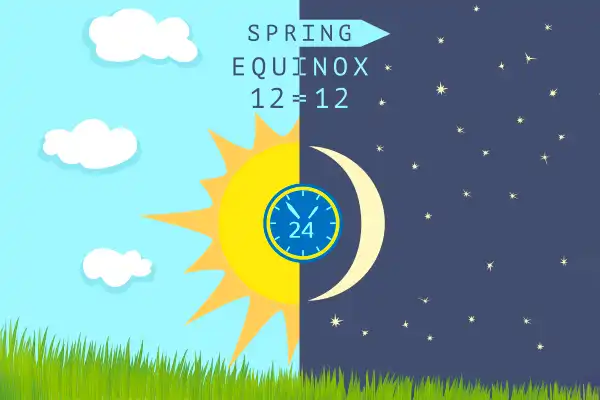
So what does that actually mean? Essentially, our hours of daylight, the period of time each day between sunrise and sunset, have been growing slightly longer since the winter solstice in December, which is the shortest day of the year in terms of light. Even though we know that after December 21 the days start getting steadily longer, we still see more darkness than light over the course of a day in those three months leading up to spring. The vernal equinox marks the turning point when daylight begins to win out over darkness.
At this moment, the direct rays of the Sun shine down on the equator, producing the effect of (nearly) equal day and night. After the vernal equinox, those direct rays migrate north of the equator, with the hours of daylight steadily growing longer, until they finally arrive at the Tropic of Cancer at latitude 23.5 degrees north. The migration of the Sun’s rays comes to a halt on that day; this is as far north as they will go. We call that moment the summer solstice, where solstice means a suspension of the migration of the Sun’s direct rays. It is the longest day of the year in terms of hours of daylight.
After the summer solstice, the direct rays proceed to head south and the days begin to grow shorter. It will take another three months, until the autumnal equinox, for the periods of daylight and darkness to reach equilibrium once again. The rays ultimately reach the Tropic of Capricorn at latitude 23.5 degrees south on the day of the winter solstice, and the whole cycle begins again.
Equilux vs. Equinox: When Day and Night Actually Equal Out
A question revolving around the spring equinox concerns the length of day versus night. We have been taught that on the first days of spring and autumn, the day and night are equal to exactly 12 hours all over the world. Yet, if you check the calendar pages in our Almanac, you will find that this is not so. In fact, our tables show that on the days of the spring and fall equinox, the length of daylight is actually longer than darkness by several minutes.
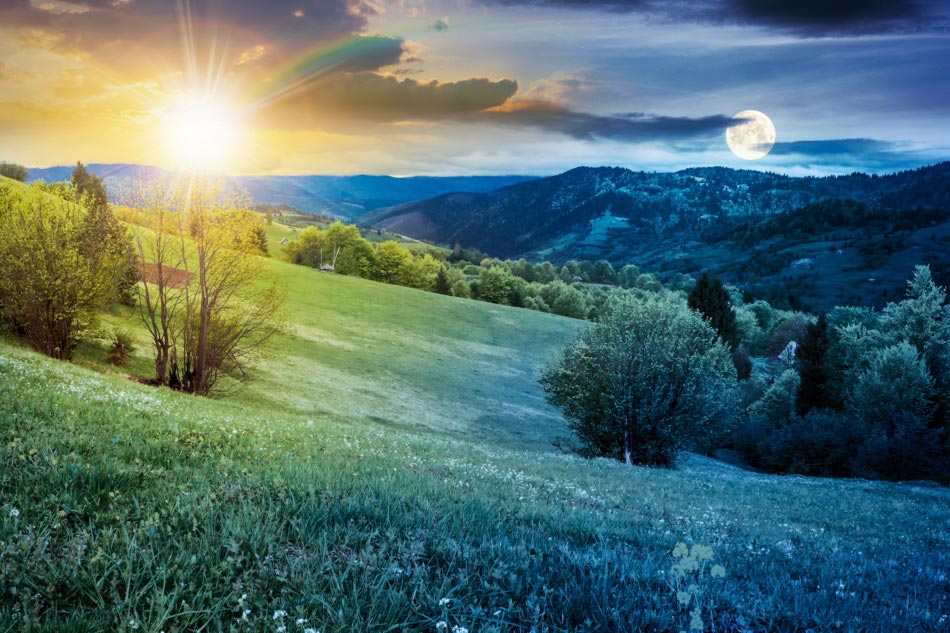
The reason can be attributed to our atmosphere. If Earth were a planet that did not have an atmosphere, then yes, on the equinox days the length of day and night would be exactly even. However, our atmosphere acts like a lens and refracts (bends) the Sun’s light above the edge of the horizon. When you watch the Sun coming up at sunrise, or going down at sunset, you are looking at an illusion. The Sun is not really there; it is already below the horizon. As a result, we actually end up seeing the Sun for a few minutes before its disc rises and for a few minutes after it has set. Thanks to that atmospheric refraction, the length of daylight on any given day is increased by roughly six or seven minutes.
The day with exactly 12 hours of daylight is called the equilux, from the Latin for “equal light.” For most of the United States and Canada, the equilux falls a few days before the spring equinox: around March 16 or 17 in the northern tier (think Minneapolis, Toronto, Anchorage), closer to March 17 or 18 in the middle latitudes (Denver, St. Louis, New York), and as late as March 18 or 19 in the south (Miami, Houston, Phoenix). The closer you live to the equator, the closer your equilux sits to the equinox itself. The closer you live to the poles, the wider the gap.
Why Does the First Day of Spring Change?
There are a few reasons why the equinox can fall on March 19, March 20, or (very rarely) March 21:
- A year is not an even number of days, and neither are the seasons. The calendar year is 365 days; the tropical year (one trip around the Sun) is roughly 365.2422 days. The leftover quarter-day accumulates until a leap day resets it.
- Leap year days may factor in. The February 29 that arrives every four years pushes the next year’s equinox back about six hours on the clock.
- Earth’s elliptical orbit is changing its orientation (skew), which causes its axis to constantly point in a slightly different direction, called precession (via NASA).
Since the seasons are defined as beginning at strict 90-degree intervals, these positional changes affect the time the Earth reaches each 90-degree location in its orbit around the Sun. Second, the pull of gravity from the other planets also affects the location of Earth in its orbit. Add it all up, and the equinox can wobble by nearly a day from year to year.
Is Spring Getting Shorter?
The current seasonal lengths for the Northern Hemisphere are (approximately):
- Summer: 93.641 days
- Autumn: 89.834 days
- Winter: 88.994 days
- Spring: 92.771 days
As you can see, the warm seasons (spring and summer) combined are 7.584 days longer than the cold seasons (fall and winter). Good news for warm-weather lovers. However, spring is currently being reduced by approximately one minute per year, and winter by about one-half a minute per year. Summer is gaining the minute lost from spring, and autumn is gaining the half-minute lost from winter. Winter is the shortest astronomical season, and with its seasonal duration continuing to decrease, it is expected to attain its minimum value, 88.71 days, by about the year 3500.
Why the Changes?
So why are the “warm seasons” (spring and summer) longer than the “cold seasons” (autumn and winter)? It goes back to Earth’s elliptical orbit. We are 3.1 million miles closer to the Sun (called perihelion) in early January than we are in early July, when we are farthest from it (called aphelion). The closer a celestial body is to the Sun, the faster it must move in its orbit. Gravity insists upon that. It is a fundamental, natural law that was demonstrated 400 years ago by the astronomer Johannes Kepler. That means during the cold months, when we are closest to the Sun, we are sweeping fastest through our orbit in space. In July, when we are farther from the Sun, we move more slowly. The colder seasons clock through faster because we are racing past the Sun; the warmer seasons drag out a little because we are loafing along on the far side.
The Astronomy: Axial Tilt and the Vernal Point
Earth is tilted 23.5 degrees on its axis, and that tilt is what gives us seasons. As the planet orbits the Sun, the angle the Sun’s rays strike any one spot changes over the year. At the spring equinox, that tilt is perpendicular to the Earth-Sun line; the planet is leaning neither toward the Sun nor away from it. Six months later, at the autumnal equinox, the geometry is the same again. In between, at the solstices, the tilt points its furthest toward or away from the Sun.
The exact spot on the sky where the Sun sits at the moment of the spring equinox is called the vernal point, or in older astronomy texts, the “First Point of Aries.” Two thousand years ago, that point really did fall in the constellation Aries. Because of precession, it has since drifted into Pisces, and in a few hundred more years it will drift on into Aquarius (yes, the same “dawning of the Age of Aquarius” the song was about). The Almanac treats this as a piece of sky-watching history, not a fortune. The point is that the calendar of the heavens is slow and steady, but it is not perfectly still.
Spring Equinox Traditions Around the World
The arrival of longer days has been worth celebrating for as long as people have kept calendars. A handful of the best-known spring equinox traditions:
- Nowruz (Persian New Year). Across Iran, Afghanistan, Central Asia, and parts of the Kurdish world, Nowruz begins on the spring equinox and runs for thirteen days. Families set a haft-sin table with seven symbolic items, leap over bonfires on the eve, and visit elders. The tradition is more than 3,000 years old and is recognized by UNESCO as Intangible Cultural Heritage.
- Higan (Buddhist tradition, Japan). For one week around the spring (and fall) equinox, Japanese families clean ancestral graves, offer flowers, and gather for ohagi, a sweet rice and red bean cake. Higan means “the other shore,” a reference to the Buddhist crossing from worldly suffering to peace, made symbolic by the day of equal balance.
- Easter. The Christian holiday is dated by the equinox. By the rule set at the Council of Nicaea in 325 AD, Easter falls on the first Sunday after the first full Moon on or after the spring equinox. That is why Easter wanders from late March to late April, never landing on the same Sunday twice in a row. The Almanac’s full Moon calendar is the simplest way to see the date pin down each year.
- Chichen Itza and the serpent of shadow. At the great Mayan pyramid of Kukulkan in the Yucatan, the late-afternoon sun on the spring (and fall) equinox throws a series of triangular shadows down the northern staircase. From the right angle, the shadows form the body of a descending serpent, joining the carved stone head at the base. The Mayan engineers built this nearly a thousand years ago and we still watch tens of thousands of visitors gather to see it.
- European folklore. In old European weather lore, the spring equinox is the dividing line between the dark half of the year and the light half. Farmers watched the sky on equinox eve for clues to the planting season. For more on those signs, dragons, and old country sayings, see our companion piece on spring equinox myths and folklore.
Spring Equinox and Daylight Saving Time
Most readers ask us whether daylight saving time is “the reason” spring feels brighter. The answer is partly yes and partly no. In the United States and Canada (most provinces), the clocks spring forward on the second Sunday of March, which in 2027 will be March 14, a full week before the equinox. By the time the spring equinox arrives, our evenings are already an hour later than they were at the end of February. The daylight is also genuinely longer by then, by about an hour and forty minutes since the winter solstice. So the brighter-evening feeling you notice is both the clock change and the real, slow swing of the Earth toward the Sun. The two effects stack.
Looking ahead to the 2027 equinox week, expect a sunset around 7:15 to 7:25 p.m. for most of the lower 48 states on March 20, give or take a few minutes for your longitude inside your time zone. By June, when the summer solstice arrives, you will pick up roughly two more hours of evening light on top of that.
Spring Equinox Folk Weather Lore
The Farmers’ Almanac has collected weather lore tied to the first day of spring for more than two centuries. These are signs to watch, not forecasts to bet the farm on. We pair them here with the science where there is any.
- “A wet spring, a dry harvest.” A rainy stretch in late March often signals an active jet stream that will track north and dry the Plains by August. Sometimes true, sometimes not. Worth noting.
- “If it thunders on the first day of spring, expect a cold spring.” An old European sign, brought to North America by colonial farmers. The science is thin, but the saying still circulates in the country papers.
- “As March goes, so goes May.” A warm, wet March often (not always) leads into a warm, wet May. The pattern is loose, but the Almanac’s long-range forecasters do see it more years than not.
- The Equinox Dragon. Some old European tales say the equinox is the day a dragon swallows the night to make the day longer. The story shows up in different forms from Wales to Romania. For the full collection, see spring equinox myths.
A Note from the Editor
The spring equinox is a small, quiet event by clock-time. It happens once. Six and a half minutes past four on a Saturday afternoon in 2027, the Sun crosses the line and the season turns. Step outside. Notice that the daylight is now winning. Mark the date on the wall calendar. Then go put seeds in the ground. The Almanac’s first job, for two hundred and eight years and counting, has been to tell country readers when to plant. The spring equinox is the starting gun.

Frequently Asked Questions
When is the spring equinox in 2027?
The spring equinox 2027 is Saturday, March 20, 2027 at 4:25 p.m. EDT (20:25 UTC). That is the moment the Sun crosses the celestial equator heading north, and the official start of spring in the Northern Hemisphere.
When was the spring equinox in 2026?
The 2026 spring equinox arrived on Friday, March 20, 2026 at 10:46 a.m. EDT (14:46 UTC). It has already passed; the next one is March 20, 2027.
Are day and night really equal on the spring equinox?
Not quite. Because of atmospheric refraction (which makes the Sun appear above the horizon when it is geometrically below) and the fact that the Sun is a disc rather than a point, daylight is about six or seven minutes longer than night on the equinox itself. The day with exactly twelve hours of daylight, called the equilux, falls a few days before the spring equinox for most of the United States and Canada.
What is the difference between equinox and solstice?
An equinox is the moment the Sun crosses the celestial equator. A solstice is the moment the Sun reaches its greatest distance north or south of the equator. Equinoxes give us roughly equal day and night; solstices give us the longest day (summer) or the longest night (winter) of the year. There are two of each, six months apart. See our summer solstice guide for the matching pair.
Why does the date of the spring equinox change year to year?
Three reasons. First, the calendar year (365 days) does not divide evenly into the tropical year (about 365.2422 days), so the equinox slips by about six hours each year. Second, leap days reset that drift. Third, the slow wobble of Earth’s axis, called precession, and the gravitational pull of the other planets nudge the date as well. The spring equinox can fall on March 19, March 20, or (very rarely) March 21.
What does “First Point of Aries” mean?
It is the older astronomical name for the spot on the sky where the Sun sits at the moment of the spring equinox. Two thousand years ago that point fell in the constellation Aries; because of precession it has since drifted into Pisces. Astronomers still call the spot the First Point of Aries, even though the Sun is no longer in that constellation on the day in question.
How is Easter’s date connected to the spring equinox?
By the rule fixed at the Council of Nicaea in 325 AD, Easter falls on the first Sunday after the first full Moon that occurs on or after the spring equinox. That is why the holiday wanders between late March and late April. Our full Moon calendar is the simplest way to see how the date settles each year.
Is spring really getting shorter?
Yes, very slightly. Spring is currently being reduced by about one minute per year, with that minute being gained by summer. Winter is also shrinking, by about half a minute per year, with autumn gaining the difference. Winter is expected to reach its minimum length, 88.71 days, by about the year 3500.

Adorei conhecer seu blog, tem muito artigos bem interessantes. webwhats
Gostei do seu poste, existe muitos artigos em seu blog relacionado a este que acebei de ler gostei de seu blog.
Muito obrigado!
March 20, 2026. You wrote 2025.
Why is it hotter in July? We are farther from the Sun. Why is it cold in January? We are closest to the sun.
The northern hemisphere is tilted up to 23.5 degrees toward the sun in late June and tilted away from the sun in late December. During Spring and Fall Equinox the earth is not tilted.
Let me put it another way; since this is more about time than distance, heat and light. Whether standing on the equator or on either pole; Earth’s full rotation takes 24 hours. The equatorial circumferential “spin” will cover many thousands of miles while the exact point of the poles will cover no distance at all; yet the same 24 hour period has elapsed.
… disapproval? Seriously? The poles are always increasing or decreasing in circumferential path in relation to the hub or axis of it’s orbit…the sun; hence the gradual increase or decrease in light and heat. The earth, as a whole, is not getting closer or further from the sun or speeding or slowing it’s orbit around the sun or it’s own rotation. And by the year “3500”…riddle me this y’all…how many of you are going to live another 1500 years and how are you going to change the naturally occurring process…for what and perhaps millions of years?
…from Autumn equinox to Spring equinox, when the northern hemisphere and pole begin a shorter circumferential path; giving the appearance of velocity change with subsequent elongation of day “light” and heat.
If I may, the Earth’s orbit is exactly the same and has not changed. The “tilt” is what makes the north and south poles, respectively, spin or orbit the sun “faster” or “slower” than the equatorial line; which always, always, remains the same distance from the sun. It’s an illusion that seems to have eluded most if not all. The earth spins on its axis 1 rotation every day; but it takes 365 days for 1 solar orbit. The sun doesn’t move and the Earth’s “tilt” doesn’t change. The axle or hub on a bicycle tire; based solely on it’s circumference will take many more revolutions to cover the same distance as the tire with it’s much larger circumference. The appearance is illusory as the same point on the tire matches the same point on the axle without variance. So it is in the “winter” months in the northern hemisphere. The orbit of a given point, the “pole” being “tilted” away from the sun, has a larger circumferential path in relation to the axis of the orbit…the sun.
If the “equatorial line – remains the same distance from the sun” the orbit would be circular. It is not.
Regarding day lengths, “True”sunrise, as well as “True” sunset is when the solar disc is exactly half way above/below the horizon; which is about 4 minutes different on each side of the day, thus 8 minutes longer than 12 hours,on the equinoxes!!! That is the REAL reason that daylight on the equinoxes is longer than 12 hours!!!
But the distance to the Sun in winter and summer are reversed in the Southern Hemisphere. So for their winter they are closer to the Sun.