
The Push to “Lock the Clock”: What It Would Mean for Your State
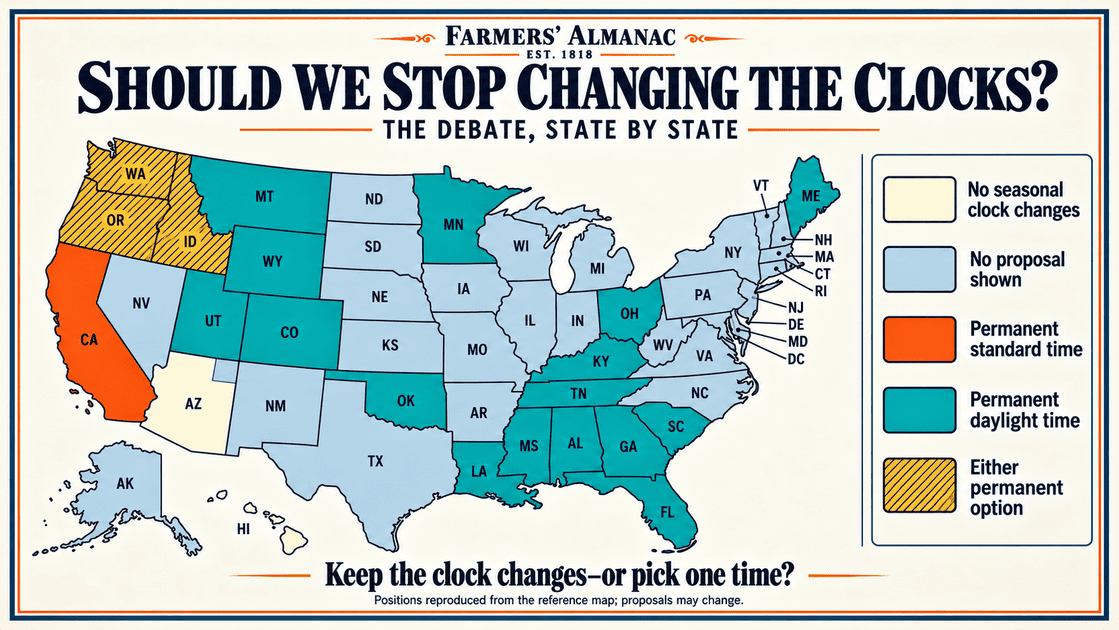
States have taken steps to stop the twice-yearly clock change. But choosing which time to keep—and getting permission to keep it—are different questions.
You can reset the kitchen clock in a few seconds. Convincing the country to stop resetting it has proved considerably harder.
As another “fall back” approaches, the same question returns: If states have already voted to stop changing the clocks, why are we still doing it?
The catch is federal law. States can choose year-round standard time, but they cannot put themselves on permanent daylight saving time under the rules currently in effect. That leaves many state measures waiting for a change in Washington. US Department of Transportation
For now, most Americans are still scheduled to turn their clocks back on Sunday, November 1, 2026, at 2 a.m. local time. Here’s how the state-by-state debate breaks down. NIST
Permanent Daylight Saving Time and Permanent Standard Time Are Different
“Stop changing the clocks” can mean two different things.
Permanent standard time keeps the clock setting we use after falling back in November. Permanent daylight saving time keeps the setting we use after springing forward in March.
Compared with standard time on the same date, daylight time puts both sunrise and sunset one hour later on the clock. It does not add an hour of sunlight.
| Option | What it means | Allowed under current federal law? |
|---|---|---|
| Permanent standard time | Keep the November clock setting throughout the year. | Yes, through state legislation opting out of daylight saving time. |
| Permanent daylight saving time | Keep the March clock setting throughout the year. | No. Federal law would have to change. |
| Seasonal clock changes | Continue springing forward and falling back. | Yes, following the federally prescribed schedule. |
The U.S. Department of Transportation explains those limits under the Uniform Time Act. A state vote favoring permanent daylight time does not, by itself, authorize the switch. US Department of Transportation
Which States Have Backed Permanent Daylight Saving Time?
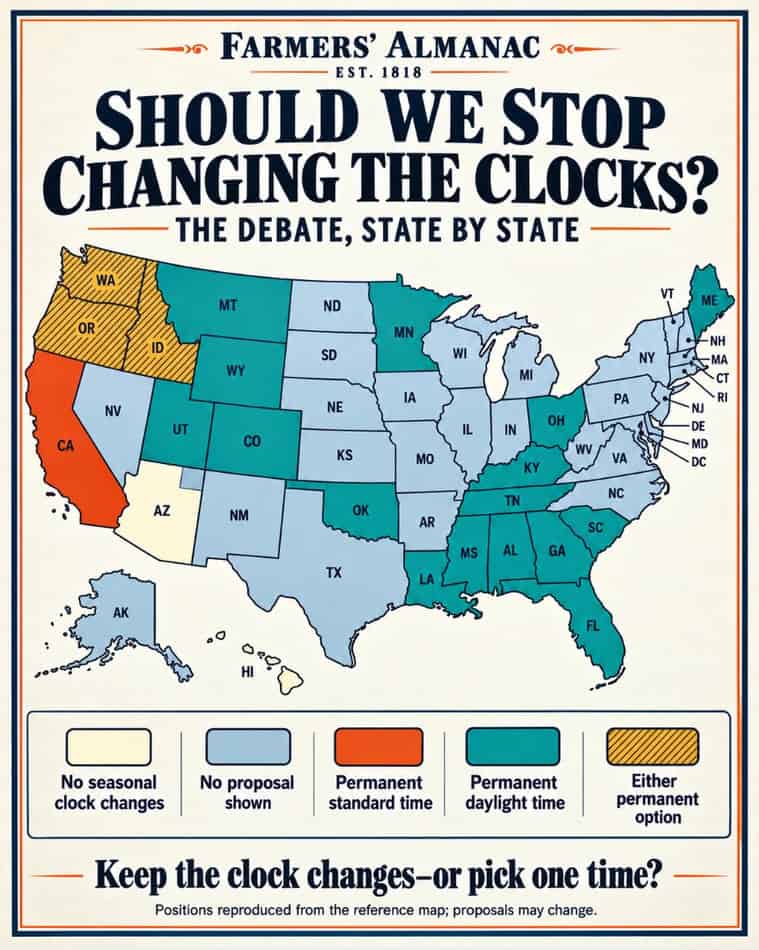
The National Conference of State Legislatures’ October 12, 2026, update identifies 19 states with enacted measures supporting year-round daylight saving time, contingent on federal authorization and, in some cases, additional conditions.
| Year listed by NCSL | States |
|---|---|
| 2018 | Florida |
| 2019 | Delaware, Maine, Oregon*, Tennessee, Washington |
| 2020 | Idaho*, Louisiana, South Carolina, Utah, Wyoming |
| 2021 | Alabama, Georgia, Minnesota, Mississippi, Montana |
| 2022 | Colorado |
| 2024 | Oklahoma |
| 2025 | Texas |
The Idaho and Oregon measures apply to their Pacific Time portions.
These measures are not permission to stop changing clocks now. Some also depend on neighboring states making the same choice. State Legislation
Texas offers a clear example. Its 2025 legislation, House Bill 1393, calls for year-round daylight saving time, referred to as “Texas Time.” But the law expressly makes the change dependent on federal legislation authorizing it. Bill Text
That distinction matters when reading a map: supporting a change, passing a conditional measure and actually observing a new time schedule are three different things.
Which States Already Skip the Clock Change?
Hawaii and most of Arizona already stay on standard time throughout the year. The Navajo Nation is an important exception in Arizona: it observes daylight saving time.
Several U.S. territories also skip the seasonal change, including Puerto Rico, the U.S. Virgin Islands, Guam, American Samoa and the Northern Mariana Islands, according to the Department of Transportation’s daylight saving time overview. US Department of Transportation
Those places demonstrate the option states already have: opt out of daylight saving time and keep standard time.
Didn’t Congress Already Vote to End the Time Change?
The U.S. House passed the Sunshine Protection Act on July 14, 2026, by 308–117, according to the official House roll call. clerk.house.gov
House passage alone does not change federal law. The measure must complete the remaining steps needed to become law before it can change the timekeeping rules.
As of October 24, 2026, the existing seasonal schedule remains in effect. The Sunshine Protection Act’s official bill page is one place to follow the proposal.
For the upcoming change, see our 2026 daylight saving time guide.
What Would Permanent Daylight Saving Time Feel Like?
For anyone tired of watching daylight disappear before dinner, keeping daylight saving time through winter can sound appealing.
But the morning changes, too.
Consider a winter day when sunrise is at 7:30 a.m. and sunset is at 4:30 p.m. under standard time. With permanent daylight time, those same events would read 8:30 a.m. and 5:30 p.m.
That is an illustration, rather than a forecast for a particular town. The trade-off is the same: later evening light comes with later morning light.
The American Academy of Sleep Medicine favors permanent standard time, saying it better aligns with human circadian biology. Its position is a reminder that eliminating clock changes and choosing the best permanent setting are separate decisions. Sleep Education by the AASM
We explore the broader debate in How Much Daylight Are We Really Saving?
Changing the Clock Cannot Stop the Days From Getting Shorter
Whether the clock says 4:30 or 5:30, a winter afternoon still has the same amount of daylight.
Seasonal changes in daylight continue under either system. The Northern Hemisphere’s shortest day arrives at the winter solstice; changing our clocks shifts the labels on those daylight hours.
So the choice is about how sunlight lines up with school, work, chores and time outdoors. It cannot preserve a long June evening in December.
Do We Still Turn the Clocks Back in November 2026?
Yes—under the law currently in effect.
The National Institute of Standards and Technology lists the end of daylight saving time as November 1, 2026, at 2 a.m. local time. In places observing the change, 2 a.m. becomes 1 a.m. NIST
If you have clocks that need manual adjustment, turn them back before bed on Saturday, October 31.
What would you choose: brighter winter mornings, later winter sunsets, or the system we have now? Tell us in the comments—and include your state.

- Tim Konrad

- Tim Konrad
- Tim Konrad
- Tim Konrad