Those Brown Leaves Still Hanging on Your Tree Have a Name—and a Purpose Worth Exploring

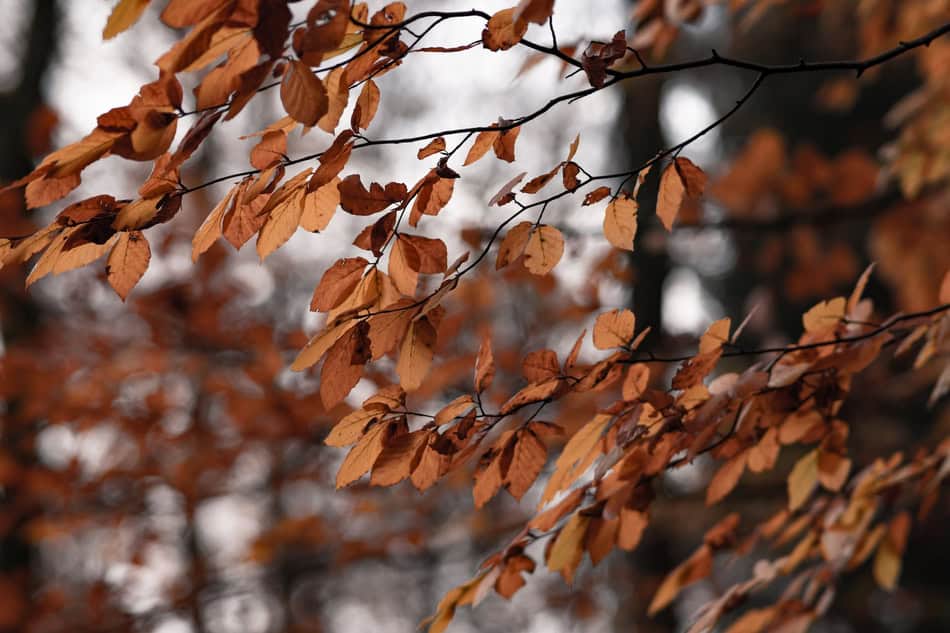
Walk through the woods after most of the fall leaves have dropped, and you may notice a small tree still wearing a coat of pale tan leaves. The surrounding branches are bare, but its dry foliage rattles in the breeze.
Those lingering leaves have a name: marcescence, pronounced mar-SESS-enss.
It describes the retention of dead plant parts, including leaves that remain attached after the growing season ends. On certain trees, those papery leaves can hang on through winter and into spring. Why they stay is a question scientists are still exploring. University of Maryland Extension
Why Some Leaves Stay Attached
Most deciduous trees have a built-in release mechanism. At the base of each leaf stalk is an area called the abscission zone, where cells separate so the leaf can detach.
In marcescent leaves, that separation is delayed. The leaf withers, but its connection to the branch remains.
As Harvard’s Arnold Arboretum explains, the usual autumn release does not occur in these leaves. Holding onto brown foliage does not make a tree evergreen: the retained leaves are dead. Arnold Arboretum
For more on the changes that happen before leaf drop, read what makes fall foliage bright.
Which Trees Hold Their Leaves Through Winter?
According to University of Maryland Extension, marcescence occurs in familiar trees and shrubs including:
- Oaks
- American beech
- American hornbeam
- Eastern hophornbeam
- Witch hazels
It is particularly noticeable on young trees and the lower branches of older ones. A tree may have bare upper branches while retaining a skirt of brown leaves closer to the ground. University of Maryland Extension
The pattern varies, so neighboring trees—even of the same species—may not look alike.
What Purpose Could Those Brown Leaves Serve?
The tempting answer is that the leaves must be doing something useful. But scientists have proposed several explanations, and no single one accounts for every case.
A 2023 review published in Ecosphere examined the leading hypotheses. Here are three:
They may discourage hungry deer. Deer browse on twigs and buds in winter. Dry leaves could make those nutritious bites harder to reach or less appealing. Some experimental evidence supports this idea, but its importance may differ among tree species and settings.
They may change when nutrients return to the soil. Leaves that remain overhead through winter reach the ground later. That delay could alter decomposition and the timing of nutrient release. Researchers are investigating whether this benefits trees as spring growth begins.
They may shelter developing buds. Another possibility is that retained leaves buffer buds against frost or drying. This remains a proposed explanation rather than an established benefit for deciduous trees generally.
There is also a less intuitive possibility: marcescence may sometimes be an inherited trait without a current advantage. A feature does not necessarily have one useful purpose simply because it persists. Wiley Online Library
Scientists Are Still Investigating
This familiar woodland sight remains an active research topic.
In a 2026 account from the University of Hamburg, researchers described an international project involving 18 botanical gardens studying marcescence in woody plants. Comparing plants across gardens and climates can help reveal patterns that a single woodland cannot. uni-hamburg.de
One question is whether the same outward behavior has different explanations in different plants.
When Will the Brown Leaves Finally Fall?
You may see some shed during winter, followed by more as spring approaches. University of Missouri Extension describes this late retention and eventual shedding around the return of new growth. ipm.missouri.edu
That means a tree can contribute to the leaf pile long after autumn cleanup seems finished.
On your next late-fall or winter walk, look for a small beech or oak holding its pale leaves against the darker woods. Then pause and listen.
Long after autumn’s brightest colors have faded, those dry leaves still have a sound of their own.
Have you noticed a tree that keeps its brown leaves through winter? Tell us what kind—and where you spotted it.


- Farmers' Almanac Staff

- Farmers' Almanac Staff
- Farmers' Almanac Staff
- Farmers' Almanac Staff