National Fossil Day 2026: Where to See Real Fossils Near You

A beach where shark teeth wash out of ancient cliffs. A Connecticut floor covered with dinosaur footprints. A 150-million-year-old wall with some 1,500 dinosaur bones still embedded in the rock.
You don’t have to be a paleontologist (or live anywhere near a famous dinosaur quarry!) to get surprisingly close to the fossil record.
National Fossil Day is Wednesday, October 14, 2026, and museums, parks, universities, and fossil sites around the country are marking the occasion. The National Park Service created the annual celebration to highlight paleontology and the importance of preserving fossils for future generations.
So where can you see some?
First, Find a Fossil Site Near You
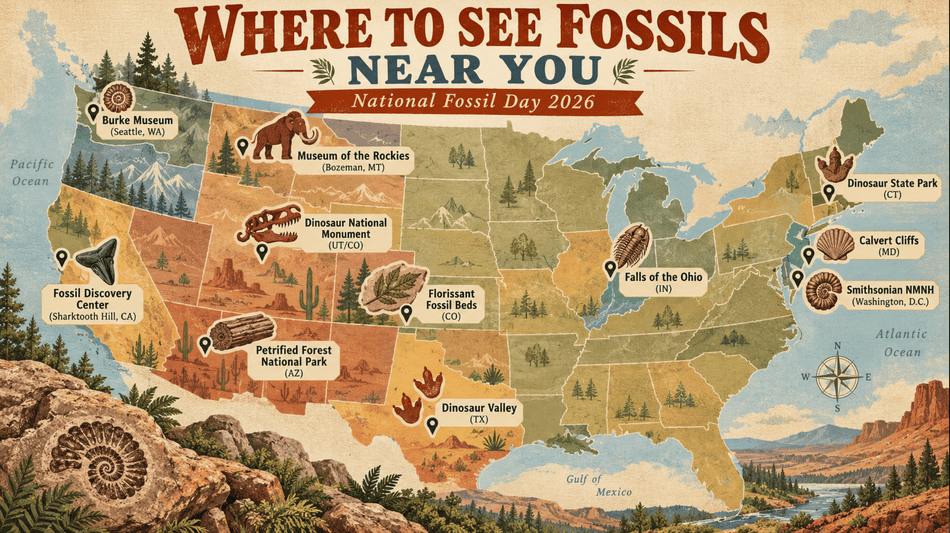
Before planning a cross-country dinosaur pilgrimage, check what’s close to home.
The National Park Service’s National Fossil Day events page includes an event calendar and a partner lookup for museums, universities, fossil sites, geological groups, and other participating organizations around the country. The NPS currently lists 420 National Fossil Day partner organizations.
There’s an even bigger list if you’re simply looking for somewhere to see fossils. The National Park Service’s fossil master list includes 288 park areas with documented fossil resources, spread across much of the country.
Not sure where to start? Here are some especially good choices, arranged roughly by region.
Northeast: Walk Where Dinosaurs Walked
Dinosaur State Park in Rocky Hill, Connecticut
If you want to see dinosaur evidence exactly where it was left, Dinosaur State Park is hard to beat. More than 750 early Jurassic dinosaur footprints are preserved inside the park’s exhibit center. They’re about 200 million years old and remain in place in the original trackway rather than being mounted behind glass somewhere else. Trails and an arboretum surround the museum if you want to make a day of it.
Yale Peabody Museum in New Haven, Connecticut
At the Yale Peabody Museum, enormous Brontosaurus and Stegosaurus skeletons get plenty of attention, but look around the edges of the dinosaur hall, too. The museum also displays fossils found in Connecticut, including evidence from the ancient rift valleys where dinosaur footprints and other remains were preserved. It’s a good reminder that you don’t necessarily have to travel west to find dinosaur country.
Academy of Natural Sciences in Philadelphia, Pennsylvania
Philadelphia has its own claim to dinosaur history. The Academy of Natural Sciences’ Dinosaur Hall displays more than 30 species of dinosaurs and other Mesozoic animals, including Hadrosaurus foulkii, discovered across the Delaware River in New Jersey in 1858. The Academy became the first institution in the world to publicly display an articulated dinosaur mount in 1868.
Mid-Atlantic: Hunt for Shark Teeth or Meet the Nation’s T. rex
Calvert Cliffs State Park in Lusby, Maryland
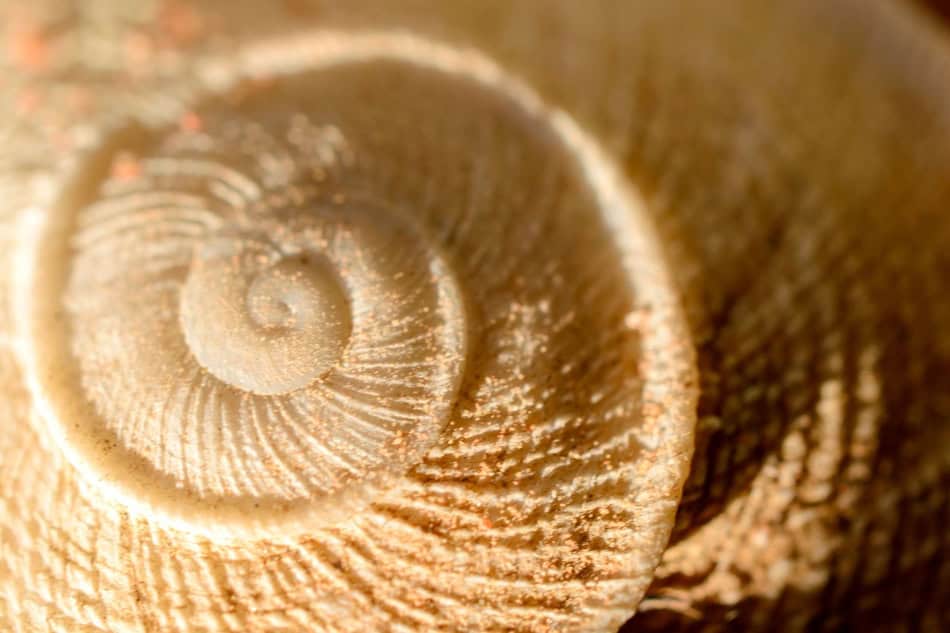
Here’s one where you can actually go fossil hunting yourself. At Calvert Cliffs State Park, fossils from an ancient Miocene sea continue to turn up along the Chesapeake Bay. More than 600 fossil species have been identified from the cliffs, and visitors commonly search the designated beach for shark teeth and shells.
Getting there requires a little walking: the public fossil-hunting area is about 1.8 miles from the parking lot at the end of the Red Trail. One important warning: stay off and away from the cliffs themselves. They are unstable, and Maryland prohibits walking beneath them and collecting fossils there.
Smithsonian National Museum of Natural History in Washington, D.C.
National Fossil Day itself is a particularly good time to visit the Smithsonian.
On Wednesday, October 14, the Smithsonian’s National Fossil Day celebration runs from 10 a.m. to 2 p.m. in the Hall of Fossils – Deep Time. Visitors can handle real fossils, watch experts working in the FossiLab, and get close to the Nation’s T. rex. The event is free and no registration is required.
Southeast: See Fossils While the Science Is Still Happening
North Carolina Museum of Natural Sciences in Raleigh, North Carolina
Some fossil museums show you the finished product. Raleigh lets you peek at the work behind it.
The North Carolina Museum of Natural Sciences has a glass-walled paleontology research lab where visitors can see active research. Its fossil collection is especially strong in material from North Carolina, and the museum’s public DinoLab has been home to the remarkable Dueling Dinosaurs specimen: a Triceratops preserved with a small tyrannosaur.
Gray Fossil Site & Museum in Gray, Tennessee
The fossils at the Gray Fossil Site & Museum are much younger than the dinosaurs—but that’s exactly what makes the site different.
They preserve a roughly 5-million-year-old ecosystem from northeastern Tennessee. Visitors can explore the fossil hall, look into paleontology labs, and take a tour of the fossil site itself. Scientists are still studying material excavated there.
Midwest: Ancient Seas Beneath Today’s Heartland
Field Museum in Chicago, Illinois
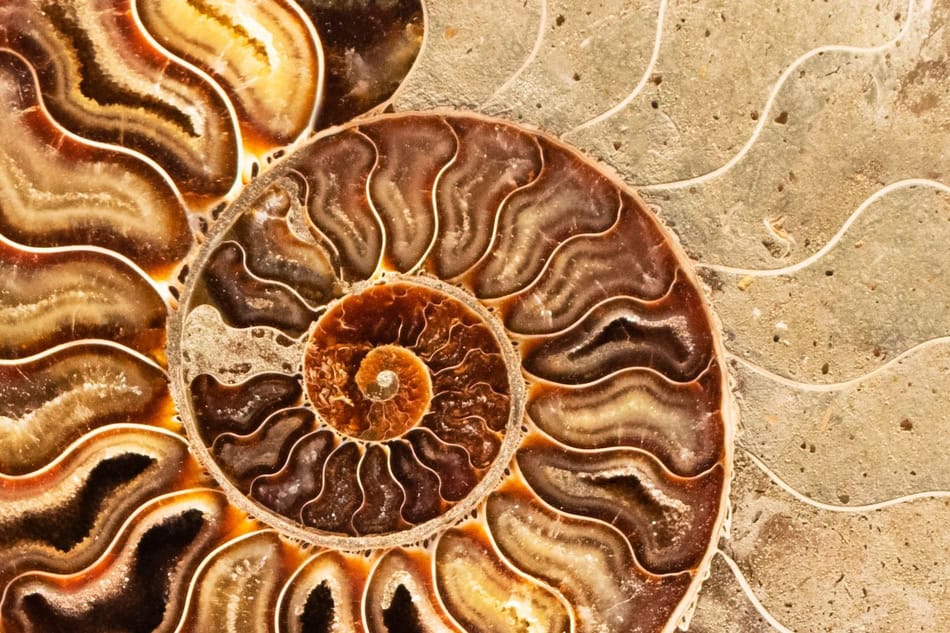
Chicago’s famous SUE the T. rex is only part of the fossil story at the Field Museum’s Evolving Planet exhibit.
The hall traces billions of years of life on Earth through fossils and other evidence, with more than a dozen major dinosaurs along the way. SUE is a 40-foot-long, roughly 90-percent-complete T. rex, but Illinois gets a local moment, too: the exhibit includes the strange Tully Monster, the state’s official fossil.
Falls of the Ohio State Park in Clarksville, Indiana
One of the country’s best fossil experiences sits right along the Ohio River.
Falls of the Ohio State Park protects 390-million-year-old Devonian fossil beds, among the largest exposed beds of their kind in the world. More than 600 fossil species have been described there.
October is particularly good timing: Indiana says August through October generally offers the best access because river levels tend to be lower.
You may explore the fossil beds, but don’t pocket specimens from them. Fossil collecting there is prohibited except in designated collecting piles near the interpretive center.
Texas and the Southwest: Put Your Foot Next to a Dinosaur’s
Dinosaur Valley State Park in Glen Rose, Texas
At Dinosaur Valley State Park, the attraction isn’t behind glass.
Dinosaur tracks are preserved in the limestone bed of the Paluxy River. Some were made by huge sauropods; others by meat-eating theropods. Depending on conditions, visitors can walk along track sites in and beside the river.
Check park alerts before making a special trip. Because many tracks lie in the riverbed, water levels can dramatically affect what you’ll be able to see.
Petrified Forest National Park in Arizona
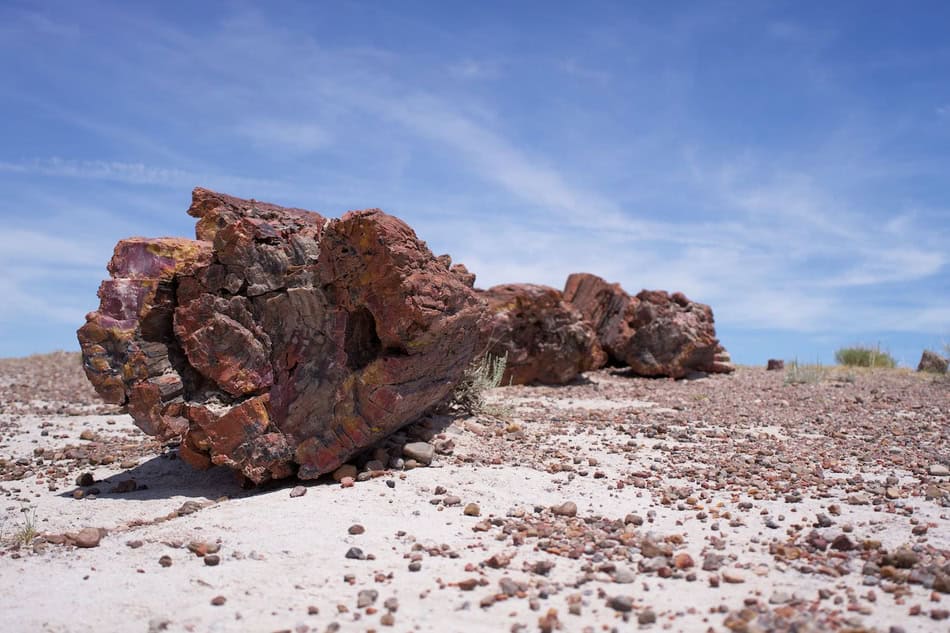
A tree can become a fossil, too. And Arizona proves it on an enormous scale.
The rocks at Petrified Forest National Park preserve a landscape formed by ancient river systems roughly 208 million to 225 million years ago. Fallen trees were buried in sediment and gradually replaced by minerals, leaving the brilliantly colored petrified wood scattered through the park today.
Look all you like. Leave every piece where it is.
Rocky Mountain West: Some of America’s Biggest Fossil Experiences
Florissant Fossil Beds National Monument in Colorado
Thirty-four million years ago, giant redwoods grew in Colorado.
You can still see their remains at Florissant Fossil Beds National Monument, where massive petrified stumps stand along trails. The site also preserves extraordinarily delicate fossils of insects, plants, spiders, fish, and other organisms from an ancient lake ecosystem.
More than 1,800 fossil species have been described from Florissant.
Dinosaur National Monument in Utah and Colorado
Few places make the fossil record feel as immediate as Dinosaur National Monument’s Quarry Exhibit Hall.
The building encloses a rock face containing approximately 1,500 dinosaur bones from the Late Jurassic. Instead of excavating the entire quarry and moving the fossils elsewhere, part of the hillside was preserved so visitors could see the bones still embedded in the rock.
There are even a few places where visitors can touch real dinosaur fossils roughly 150 million years old.
Museum of the Rockies in Bozeman, Montana
If your idea of National Fossil Day involves a lot of dinosaurs, Bozeman delivers.
The Museum of the Rockies’ Siebel Dinosaur Complex houses one of the largest collections of North American dinosaur fossils, including Montana’s T. rex, a large Triceratops collection, dinosaur eggs and babies, and “Big Al,” a nearly complete Allosaurus.
Visitors can also watch fossil preparators working in the museum’s viewing lab.
Wyoming Dinosaur Center in Thermopolis, Wyoming
Want to move beyond looking at fossils and see where they’re actually being excavated?
The Wyoming Dinosaur Center combines a museum, fossil-preparation lab, and active dig sites. Its museum contains more than 70 mounted skeletons, while guided dig-site tours give visitors a look at the fossil-bearing ground nearby.
West Coast: Ice Age Giants and a T. rex Skull
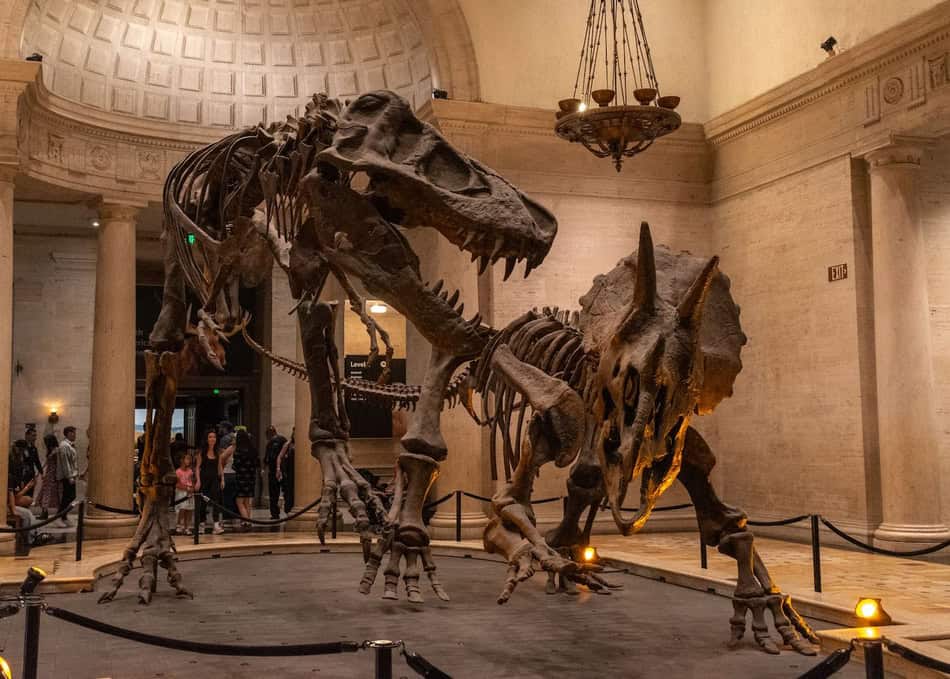
Fossil Discovery Center in Madera County, California
California’s Central Valley has its own remarkable fossil story.
The Fossil Discovery Center of Madera County sits beside the Fairmead fossil site, one of the significant middle-Pleistocene fossil localities in western North America. About 15,000 fossils have been found there, including remains of Columbian mammoths, saber-toothed cats, ground sloths, camels, and horses.
Burke Museum in Seattle, Washington
The Burke Museum’s Fossils Uncovered gallery gives Pacific Northwest readers a fossil destination much closer to home.
Its displays include the only real dinosaur fossils currently on public display in Washington state, along with Ice Age mammals and plant fossils. Among the stars is an exceptionally well-preserved T. rex skull.
Can You Take a Fossil Home?
Sometimes. But never assume you can.
Rules vary dramatically by location. Some designated fossil-hunting sites allow limited collecting. Others allow you to search but not remove anything.
In all units of the National Park System, recreational fossil collecting is prohibited. If you discover something interesting in a national park, the NPS recommends photographing it, recording the location, leaving it where it is, and telling a ranger.
That rule isn’t just about protecting a nice-looking rock. Where a fossil was found, and the rock surrounding it, can contain information scientists need to understand its age, environment, and history.
You May Be Closer to Fossils Than You Think
The most surprising thing about National Fossil Day may be how unnecessary a trip to the dinosaur-rich West really is.
Connecticut has dinosaur tracks. Indiana has an ancient coral seafloor. Maryland has shark teeth. Tennessee has a five-million-year-old ecosystem. California has mammoths beneath the Central Valley. Major museums from Philadelphia to Seattle hold fossils found practically in their own backyards.
And those are only a sampling.
If none of these is close enough, start with the National Park Service’s National Fossil Day partner and event finder or its master list of national parks with fossils and search by state.
You may not have a T. rex around the corner.
But there’s a good chance the distant past is closer than you think.

- Maggie Konrad

- Maggie Konrad
- Maggie Konrad
- Maggie Konrad