

Rainbow Facts: How They Form, Why They Bend, and What Makes Doubles
Check out these fun and fascinating facts about one of nature's most magical phenomena, rainbows.
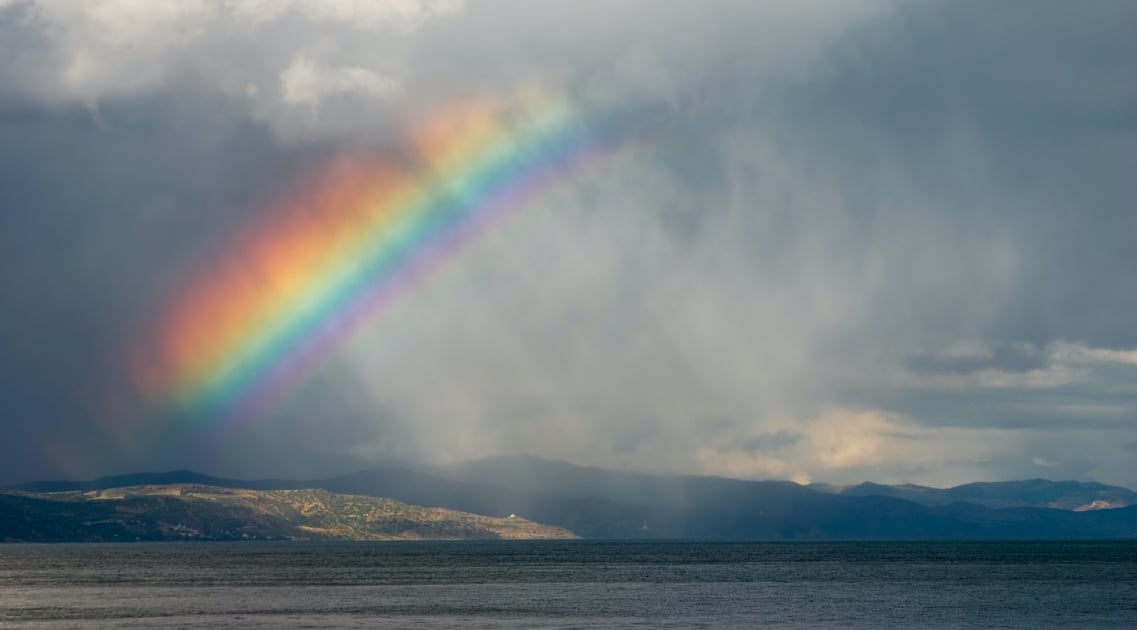
Quick Reference
- How rainbows form: sunlight refracts and reflects inside falling water droplets and exits at a fixed angle of about 42 degrees from the original ray.
- Position: always opposite the sun. Best seen with the sun low (early morning or late afternoon) and rain in front of you.
- Colors: red, orange, yellow, green, blue, indigo, violet (ROY G BIV), in order by wavelength.
- Double rainbow: a fainter second bow at 51 degrees, with colors reversed. The dark band between the two is called Alexander’s band.
- Full-circle: rainbows are actually circles. You can only see the full ring from above (from a plane), and the plane’s shadow appears in the centre.
A rainbow is the most familiar piece of sky optics on the planet, and most readers can name two facts about how it works. Here are seven, plus the geometry, the folklore, and the lesser-known cousins (double rainbow, fogbow, moonbow, supernumerary). Once you know what to look for, the next bow you spot will be three times as interesting.
How a Rainbow Actually Forms
A rainbow is an optical effect produced when sunlight enters a falling water droplet, bends (refracts), bounces off the back inside surface, and exits the droplet bent again on its way out. White sunlight is made of all the colors of the visible spectrum mixed together. Each color refracts by a slightly different amount because of its wavelength, so the white light separates into its component colors as it bends. The droplet acts as a tiny prism, and millions of droplets together produce the visible bow.
The geometry forces all of that bent light to leave the droplet at the same angle, around 42 degrees from the original sunlight direction. That fixed angle is what makes the rainbow a circle (or, when the horizon cuts it off, an arc). Every droplet that sits 42 degrees from the line connecting your eye to the sun’s anti-solar point contributes light to the rainbow you see. Move two steps to the left, and a slightly different set of droplets does the work; the rainbow you now see is technically a different rainbow.
The Seven Facts Worth Knowing
1. Rainbows Always Sit Opposite the Sun
Where you see a rainbow depends on where the sun is and where you are. The bow forms in a circle around the anti-solar point, the spot in the sky directly opposite the sun. If the sun is low in the western sky behind you, the rainbow appears in the eastern sky in front of you. The top of the arc is always centred on the line that runs from the sun through your head to the ground. Two people standing 100 feet apart see two slightly different rainbows, because their lines of sight produce different geometric paths.
2. The Colors Run in a Fixed Order: ROY G BIV
Every rainbow shows the same color sequence in the same order, from red on the outside to violet on the inside: red, orange, yellow, green, blue, indigo, violet. The standard mnemonic for remembering the order is the imaginary man’s name ROY G BIV. The order comes from wavelength: red is the longest visible wavelength and bends the least, violet is the shortest and bends the most.
3. A Double Rainbow Is Not Twice the Reflection, It Is Twice the Bounce
A double rainbow appears when sunlight reflects twice inside the water droplet before exiting, instead of just once. The second internal reflection sends the light out at a wider angle (about 51 degrees instead of 42), so the secondary bow sits outside the primary bow. It is fainter because each internal reflection loses some light, and the colors run in reverse order: violet on the outside, red on the inside. If you see a double rainbow, look for the color flip; that confirms the second bow is real and not just a thicker version of the first.
4. The Sky Inside the Bow Is Brighter
Look closely at any rainbow and the sky inside the arc is noticeably brighter than the sky outside it. The droplets inside the rainbow’s arc reflect a small amount of light at every angle less than 42 degrees, so the sky inside the bow gets an extra boost of scattered light. Outside the bow, no such reflection reaches your eye, and the contrast makes the outer sky look dim by comparison. In a double rainbow, the dark gap between the primary and secondary bows has a name: Alexander’s band, after Alexander of Aphrodisias, the Greek philosopher who described the phenomenon roughly 1,800 years ago.
5. Rainbows Are Actually Full Circles
The arc you usually see is the top half of a circle. The bottom half is hidden by the horizon because there are not enough water droplets at ground level to light up the lower half of the bow. From the ground you almost never see the full circle. From a plane in flight, you can: the rainbow appears as a complete ring around the plane’s shadow, which sits at the anti-solar point in the middle of the circle. Pilots and passengers regularly photograph circular rainbows from above storm cells.
6. There Is No End of the Rainbow
The rainbow is an optical effect, not a physical object. It has no fixed location in space. As you walk toward it, the geometry shifts and the rainbow moves with you. You will never reach the end of one. The Irish folklore of a pot of gold at the rainbow’s end is built on a piece of optics that makes the goal physically impossible. (The folklore is older than the science, of course; the pot of gold predates the geometry.)
7. Rainbows Need Sun in Front, Rain in Back
The basic ingredient list for a rainbow is short: sunlight from behind you, falling water droplets in front of you, and a sun angle of less than about 42 degrees above the horizon. That last condition is why rainbows are most common in early morning and late afternoon and almost never appear at noon in summer. When the sun is too high, the rainbow’s arc dips below the horizon and you cannot see it from the ground. The same rule applies to looking for one: stand with your back to the sun, look at the rain, and scan around the anti-solar point.
The Lesser-Known Cousins
The standard rainbow has a few rarely-seen relatives. Each is produced by the same basic refraction-and-reflection physics, but with different ingredients.
- Fogbow: a colorless or near-colorless arc that appears in fog or low cloud. The droplets are smaller than rain droplets, which smears the colors out into a white or pale band.
- Moonbow: a rainbow produced by moonlight, usually faint and ghostly. Most common around a full moon when there is rain or spray. Famous moonbows are documented at Cumberland Falls in Kentucky and Victoria Falls on the Zambia-Zimbabwe border.
- Supernumerary bow: faint bands of pink and green just inside the primary rainbow, caused by light-wave interference rather than simple refraction. They appear when the droplets are uniform in size.
- Reflection rainbow: a rainbow produced when sunlight reflects off a body of water before refracting through droplets. Looks like a normal rainbow but rooted in a different geometric origin.
- Brocken spectre: not a rainbow exactly, but a related phenomenon. A circular rainbow ring (called a glory) around the shadow of an observer cast on cloud or fog below. Most commonly seen on mountain summits or from aircraft.
For more on the variations, see our piece on the different types of rainbows.
Rainbows in Folklore and Tradition
Rainbows show up in nearly every culture’s mythology. The Old Testament places a rainbow as God’s covenant with Noah after the flood. Greek mythology made the rainbow into Iris, the messenger of the gods who connected heaven and earth. Norse tradition called it Bifrost, the bridge between Asgard and the realm of mortals. In Hawaiian tradition, rainbows mark sacred places and ancestral presence. The Irish leprechaun pot of gold dates from medieval Celtic folklore, when buried treasure was a popular motif and the unreachable end of the rainbow made for a fitting hiding place.
The science came much later. Aristotle wrote about rainbows in the 4th century BCE. Alexander of Aphrodisias described the dark band between primary and secondary bows in the 2nd century CE. Persian mathematicians worked on the geometry in the 13th century. René Descartes published the modern explanation of the 42-degree angle in 1637. Isaac Newton finished the picture in 1672 by demonstrating that white light is composed of all the colors of the spectrum and a prism can separate them.
How to Photograph a Rainbow Well
Rainbows are notoriously hard to photograph cleanly because the bow is much fainter than your eye perceives it. A few tricks help.
- Use a polarising filter on your lens. The light reflected back from the droplets is partially polarised, so a polariser can either intensify or wipe out the rainbow depending on the rotation. Rotate the filter until the bow is at its brightest.
- Underexpose by half a stop. The contrast between the bow and the bright sky behind it usually fools the camera’s auto-exposure into making the rainbow too pale.
- Include a foreground. A tree, a barn, a lighthouse anchored at the base of the bow gives the photograph scale.
- Move quickly. Rainbows usually last 5 to 15 minutes before the rain or the sun moves out of the right geometry.
When You Are Most Likely to See One
Rainbows are most common in spring and summer in the eastern half of the country, where afternoon thunderstorms drop rain ahead of westerly clearing skies. The Pacific Northwest produces rainbows almost daily in the wetter months because the same coastal storm cycle alternates rain and sun. The Plains see frequent rainbows around evening thunderstorm cells. Hawaii is famous for them; the islands’ volcanic peaks force trade-wind moisture into rain showers under nearly perpetual sun.
The Farmers’ Almanac long-range forecast covers seasonal precipitation patterns months ahead. The forecast does not predict the specific moment a rainbow will form, but it does flag the weeks where afternoon rain-and-sun cycles are most likely.
Watch the sky after the rain. The bow is usually there if you turn your back to the sun.
Frequently Asked Questions
What causes a rainbow?
Sunlight enters a falling water droplet, refracts into its component colors, reflects off the back of the droplet, and exits at a 42-degree angle from the original ray. Millions of droplets together produce the visible bow. Rainbows always sit opposite the sun in the sky.
How many colors are in a rainbow?
Seven by the standard ROY G BIV model: red, orange, yellow, green, blue, indigo, violet. The colors run in order from longest to shortest wavelength. The colors are actually a continuous spectrum, but seven is the number Newton settled on in 1672 and the convention has stuck.
Why is a double rainbow inverted?
In a double rainbow, the secondary bow is produced by light reflecting twice inside the droplet instead of once. The second reflection inverts the path of the light, so the colors of the secondary bow appear in reverse order: violet on the outside, red on the inside. The secondary is always fainter because each internal reflection loses some light.
Why is the sky inside the rainbow brighter than the sky outside?
Water droplets inside the bow’s arc reflect light at angles less than 42 degrees, so the sky inside the bow is lit by extra scattered light. Outside the bow, no such reflection reaches the eye. The dark band between primary and secondary bows is called Alexander’s band, after the Greek philosopher Alexander of Aphrodisias.
Can a rainbow form a complete circle?
Yes. Every rainbow is a circle; the horizon cuts off the bottom half from a ground-level view. From above, in a plane or on a high mountain summit, you can see the full circle. The plane’s shadow appears in the middle of the ring at the anti-solar point.
Why can’t you reach the end of a rainbow?
A rainbow has no fixed location in space. It is an optical effect that depends on the geometry between you, the sun, and the droplets. As you walk toward the bow, the geometry shifts and the rainbow moves with you. You will never reach the end of one. The Irish pot-of-gold legend is built on this physical impossibility.
What is a moonbow?
A moonbow is a rainbow produced by moonlight instead of sunlight. The same physics applies, but moonlight is much fainter than sunlight, so moonbows usually look pale or near-colorless. They are most common around a full moon with rain or spray nearby. Cumberland Falls in Kentucky and Victoria Falls in Africa are famous moonbow locations.


Jaime McLeod
Jaime McLeod is a longtime journalist who has written for a wide variety of newspapers, magazines, and websites, including MTV.com. She enjoys the outdoors, growing and eating organic food, and is interested in all aspects of natural wellness.
- Jaime McLeod

- Jaime McLeod
- Jaime McLeod
- Jaime McLeod





Today I saw a rainbow on THE SAME SIDE of the sun. How can this be possible?
Today I saw a rainbow on the SAME SIDE of the sun! How can this be possible?
Why is it that the colors of a “Sundog” are inverted? Please explain this.
i really like rainbows is it poosabell to see pink in the rainbow
I think so, sometimes I see a Magenta pink in a rainbow… and other people have done so, I think Rudolph Steiner also speaks of this ❤️🧡💛💚💙🩵💜💖💝🤍 I also question if you can get a bow shape without the full spectrum of Light, in good faith , Francess
Summer 2014 Sf Bay, I was sailing with three people 2-3 miles south of the Oakland bay Bridge on a south eastern heading. We happened to see a full circle rainbow over the entire southbay for the entire 4 hours of our race training. We got back to south beach yact club and many club members had witnessed the same thing. So therefore the full rainbow is seen when flying above or from the water below. All that I know saw this are expert sailors and live their lives on the water, and none had ever witnessed this before. It was beautiful and truly inspiring in my faith in GOD reminding me of the covenant of GOD the rainbow represents.
Hi Allen, thanks for sharing the story. It must have been an awesome sight!
You can grab your garden hose any time and stand in the yard when the sun is shining and make a mist and create a rainbow.. when you step back and learn about rainbows you might learn that even you can make such an amazing thing a reality. And nobody ever said it isnt a rainbow just because you make it. And I can start a sentence with “because” or “and” because theres no rules. I just thought I would share this little life hack.. if we all did it you could probably see it from space.. oh snap!
So sorry about your home, dog, and truck. There have been some beautiful experiences with rainbows in these comments. I always look for this sign God gave to Noah because it is also a sign that we can plant a garden and get a harvest that year.
I saw a rainbow once. And then i saw the hurricane make land fall and flooded my house in 15 feet of water completely ripping it off the foundation. Truck was in a tree 3 blocks away and never saw my dog again. But man that was a pretty rainbow.
Rainbows are caused by sunlight retracting through raindrops. They are not created by God because there is no such thing as a God. The idea of God was created by man so is therefore only fiction. If only people realized this there would be much less war.
Brian, I might have expressed your same thoughts about 30 years ago, in my lack of personal experience and within all the darkness that I walked. However, my lack of seeking Him, or my own denial, would not have made Him any less real. While you may not believe in God, He still believes in you. In fact, He knows the number of hairs on your head, and was in your mother’s womb when you were created. He even knew you before you were born. My hope and prayer for you is that in the coming days that He might make His presence known to you, for He is real and without Him, you wouldn’t even exist.
Ah, so God is a microbe-carrying astroid.
I heard a saying that went something like this: Reality can become absurdity when a man professes to know so much about creation that he no longer believes in the creator. For he need only look at his own two hands and ponder the creations which he has accomplished with them, and ask of himself that fundamental question with such regard. The ancient civilizations knew that knowledge was the key that unlocked the door to the human mind which is either a prison or a fortress depending on his own set of values and beliefs.
we would have less wars if there were fewer non-believers.
I always thought the rainbow was a sign? to Noah that God would never flood the earth again ?