

7 Songbirds That Star on Christmas Cards (and the Winter Folklore Behind Them)
Meet the songbirds that adorn many of our holiday decorations, from cards to ornaments.
Quick Reference
- Top seven holiday songbirds: black-capped chickadee, blue jay, Eurasian bullfinch, European robin, northern cardinal, snowy owl, and white-breasted nuthatch.
- Why they show up on cards: all seven hold their color through winter and stay in-range, so they are the birds people actually see when the tree goes up.
- Best card-star of the U.S.: the northern cardinal, whose male plumage stays scarlet all twelve months (Cornell Lab of Ornithology).
- British Christmas icon: the European robin, popularized on Victorian postcards because 19th-century postmen wore red coats.
- Feeder mix that draws all seven-ish: black-oil sunflower plus suet, per the National Audubon Society’s winter-feeding guidance.
- Best planting for a card-worthy backyard: holly, dogwood, and native pine (year-round cover and berries).
Open any stack of holiday cards and you will find a small aviary hiding inside. A cardinal on a snow-dusted pine, a chickadee tucked into a wreath, a robin perched on a mailbox lid. Songbirds are one of the most durable images of Christmas and midwinter, appearing on ornaments, wrapping paper, cookie tins, candles, and figurines. The question is why these particular species keep landing the December gig, when the woods hold dozens more.
The short answer, backed by the Cornell Lab of Ornithology and the National Audubon Society, is visibility. The birds featured on holiday cards are the ones that stay put through winter, hold onto bright plumage, and visit backyard feeders where illustrators and photographers can actually study them. Below are the seven species most likely to appear on your mantel, plus the folklore, science, and feeder details that put them there.

Most Popular Holiday Bird Species
These seven colorful songbirds show up on holiday decorations more than any other winter species. Each entry keeps its full original identity from the Almanac’s earlier post and adds the folklore, range facts, and Cornell-sourced range detail we did not have room for the first time.
1. Black-Capped Chickadee
Small, round, and permanently cheerful looking, the black-capped chickadee (Poecile atricapillus) is the tiny gray-and-white songbird you see swinging under sunflower feeders while the mercury sits at zero. Cornell Lab notes that chickadees can drop their body temperature by around 10 to 15 degrees Fahrenheit overnight to survive northern winters, then jolt back at dawn. That resilience is the holiday-card story in one bird.
On cards, they usually appear in profile on a pinecone or a hemlock twig, black cap tipped as if listening. Folklore in New England ties them to messages of good luck and news, which is why they turn up on stationery-style greeting cards.
2. Blue Jay
Blue jays (Cyanocitta cristata) bring the loud, unmistakable color note. They stay in their U.S. and Canadian range through the coldest months and often mob feeders in family flocks. On cards they usually appear against snow or holly, because the cobalt blue looks its most electric next to red or white.
Blue jay feathers are not actually blue; the color comes from light scattering in the feather structure, which is why photographers love them under bright winter light.
3. Eurasian Bullfinch
The Eurasian bullfinch (Pyrrhula pyrrhula) is the reason many European cards look different from American ones. The male’s chest is a soft rose-red that photographs beautifully against evergreen. In British and Central European folklore the bullfinch shows up in Advent posts and midwinter carols, and it is one of the classic subjects of German Christmas postcards from the early 1900s.
The Eurasian Bullfinch is often portrayed on Christmas cards.
4. European Robin
The European robin (Erithacus rubecula) is not the same species as the American robin; it is a much smaller flycatcher relative with a bright orange-red face. Britain’s Post Office ran red uniforms in the mid-1800s, and Victorian card designers began drawing robins delivering letters. That single design choice turned this bird into the unofficial Christmas card mascot of the U.K.
The Royal Society for the Protection of Birds notes the male robin defends winter territory aggressively, which is why you often see a lone robin, not a flock, on British cards.
5. Northern Cardinal
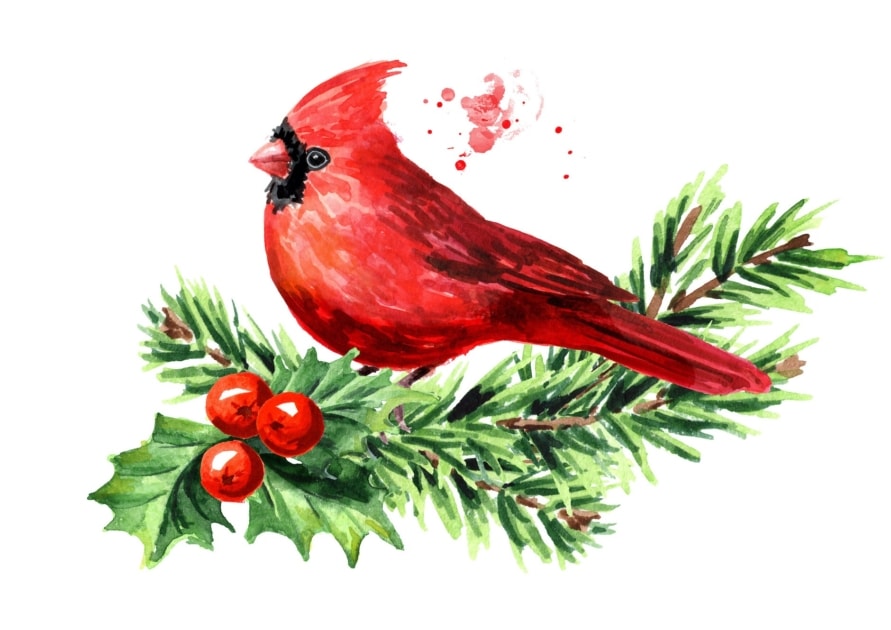
Cardinals are very popular in holiday decorations because of their vibrant red color. The northern cardinal (Cardinalis cardinalis) is the state bird of seven U.S. states, and the male keeps his scarlet plumage year-round. That single fact does most of the work: a cardinal in a snow-dusted spruce reads as a living Christmas ornament even before an artist adds a bow.
In many parts of the American South and Midwest, folklore holds that a cardinal at your feeder in winter is a visit from a loved one who has passed, which is why cardinal cards, ornaments, and figurines have a persistent memorial market. Attracting them to a feeder, per Audubon, is mostly about safflower and black-oil sunflower.
6. Snowy Owl
The snowy owl (Bubo scandiacus) is the outlier of the seven. It is not a songbird in the taxonomic sense, but decorators lump it in because nothing says winter card like a white owl on a bare branch. Snowy owls breed in the Arctic tundra and irrupt south into the northern U.S. and Canada in certain winters, following boom-and-bust cycles of lemming populations.
Snowy owls surged into pop-culture holiday imagery after the Harry Potter series in the late 1990s, but they had already been a fixture of Nordic and Inuit winter storytelling for centuries.
7. White-Breasted Nuthatch
The white-breasted nuthatch (Sitta carolinensis) often appears on Christmas-themed wrapping paper, cards, ornaments, and more. It is the small, gray-backed songbird you see walking head-first down a tree trunk, which is a pose no other backyard bird pulls off. That upside-down posture makes for a distinctive card silhouette against bark.
Nuthatches cache sunflower seeds in bark crevices all fall, which is why they still visit feeders in the deepest cold: they are checking on their stored pantry as much as picking up a fresh meal.
Other Bird Species Featured on Holiday Cards
In addition to the seven above, more generic birds are often part of holiday decoration flocks. Doves, owls, penguins, and stylized versions of popular holiday carol birds, such as a partridge in a pear tree or seven swans a-swimming, are common decorations. Themed holiday cards may highlight more unusual birds too, such as flamingos, toucans, and parrots on tropical greeting cards. Doves, a symbol of peace, are another type of bird seen at the holidays.
Why These Birds?
Birds featured on holiday cards offer a beautiful glimpse of nature when we are often stuck indoors because of harsh winter weather. When a species is identifiable, it is typically one that stays in its range year-round, so it can be seen in winter. Cardinals, chickadees, bullfinches, and other holiday songbirds hold onto their colorful plumage through the winter. They are bright, cheerful visitors to winter feeding stations.
These birds often travel in flocks, and when a flock alights in a bare winter tree or among the branches of a pine dusted with snow, they can seem like living, fluttering holiday ornaments straight from nature. Winter birds serve more symbolic purposes in holiday decorations as well. Because these birds survive through the most brutal winter weather, they offer hope that the season will improve and spring will return again. This sense of hope and renewal is common in many faiths during the Christmas season.
Nurturing Your Holiday Birds
If you want the birds on your cards to show up in your yard, feed them the way winter demands. Cornell’s Project FeederWatch data shows that black-oil sunflower seed pulls in cardinals, chickadees, nuthatches, and jays more reliably than any other single food, and suet fills the fat gap when insects are gone. Add a heated bird bath, or refresh a shallow dish twice a day, and you have solved the two hardest problems for a winter bird: calories and open water.
Native plantings do the rest. Holly and winterberry hold red berries into January, dogwood keeps its structure under snow, and native pines and spruces give small birds a place to sit out a storm. Plant these near a window and you will have the same picture on your kitchen sill that the card designers were painting from.
Which Holiday Songbird You See Depends on Where You Live
The card in your mailbox and the bird in your yard often line up, but not always. The Cornell Lab’s eBird winter range data makes the split obvious:
- Northeast and Great Lakes: chickadee, blue jay, cardinal, white-breasted nuthatch. Snowy owl in irruption winters.
- Midwest and Plains: cardinal, blue jay, chickadee. Downy and hairy woodpeckers replace nuthatches at many feeders.
- Southeast: cardinal is nearly universal; Carolina chickadee replaces the black-capped south of a line roughly through Pennsylvania.
- Pacific Northwest and West Coast: chestnut-backed chickadee, red-breasted nuthatch, Steller’s jay (the western cousin of the blue jay).
- U.K. and Ireland: European robin dominates. Bullfinches, coal tits, and long-tailed tits show up on higher-end cards.
- Central Europe: Eurasian bullfinch, great tit, and Eurasian blue tit are the most common Christmas card birds.
The Folklore Layer: Why a Robin on a Card Feels Christmassy
Long before Hallmark, midwinter cultures across the Northern Hemisphere told stories about small bright birds surviving the cold. The Anglo-Saxons treated the robin as a household guardian; Scandinavian folklore linked the bullfinch to hearth and family; Native American traditions across the eastern woodlands tie the cardinal to memory and the return of the sun after the solstice. Almanac readers who plant a holly hedge or leave the seed heads on their coneflowers are participating in that old contract: shelter through the darkest weeks, in exchange for a flash of color out the window.

Frequently Asked Questions
Why is the northern cardinal the most popular holiday songbird in the U.S.?
The male cardinal keeps its scarlet plumage all year, and it is a resident (non-migratory) species across most of the eastern and central United States. That means it is the bird people actually see on snowy branches in December, which is exactly what makes it a natural fit for holiday card art. It is also the state bird of seven U.S. states.
Is the European robin on British Christmas cards the same bird as the American robin?
No. The American robin (Turdus migratorius) is a large thrush. The European robin (Erithacus rubecula) is a much smaller flycatcher relative with an orange-red face and throat. They are unrelated. British cards feature the European robin, tied to the red coats worn by 19th-century postal workers.
Do snowy owls actually appear in most U.S. yards in winter?
Only in irruption years. Snowy owls breed in the Arctic and push south into the Great Lakes, New England, and the northern Plains when lemming populations crash on their breeding grounds. In an average winter, the snowy owl on your card is closer to a symbol than a likely backyard visitor.
What is the fastest way to attract holiday-card songbirds to my yard?
Set up one feeder with black-oil sunflower seed, a second suet cage, and a shallow water dish you refresh twice a day. Cornell’s Project FeederWatch consistently ranks that combination as the highest-diversity winter setup. Plant holly, dogwood, or a native conifer within sight of a window for cover and berries.
Why do so many holiday cards show birds in pine or holly?
Both plants keep foliage through winter, which is when the cards ship. Pines and spruces provide shelter and seed for chickadees and nuthatches; hollies hold red berries into January and feed thrushes and cedar waxwings. The pairing is more accurate than decorative.
Are cardinals really a sign of a departed loved one?
That is a folk belief, not a biological claim. It is common across the American South and Midwest and drives a large share of the memorial cardinal ornament and card market. The bird itself is present because it is a hardy year-round resident, but the meaning people attach to it is a cultural inheritance.
Do bird populations on holiday cards match today’s actual winter bird populations?
Roughly. eBird winter data from the Cornell Lab of Ornithology confirms that cardinal, chickadee, blue jay, and white-breasted nuthatch are still among the ten most-reported feeder birds in the eastern U.S. every December. What has shifted is the range: cardinals have expanded steadily north over the last half-century, and now show up on cards from Ontario households they would not have visited in 1950.


Melissa Mayntz
Melissa Mayntz is a writer who specializes in birds and birding, though her work spans a wide range—from folklore to healthy living. Her first book, Migration: Exploring the Remarkable Journeys of Birds was published in 2020. Mayntz also writes for National Wildlife Magazine and The Spruce. Find her at MelissaMayntz.com.
- Melissa Mayntz

- Melissa Mayntz
- Melissa Mayntz
- Melissa Mayntz



as for birds attacting windows i put vinal cling decal adout 3 inch colorfull butterfly on the window in the center about 8 inches down from the top seem to help a lot for me
We have beautiful Winter birds. I am concerned about the female cardinals and wish I could remedy the behavior. The females are hitting, flying at their reflection in the glass windows. They are aggressive, hitting the windows multiple times. They attack the screened windows as well. Any suggestions?