The Blaze Star: T Coronae Borealis Set to Explode and How to Watch
Quick Reference: T Coronae Borealis (the Blaze Star)
- What it is: a recurrent nova, a binary star system that erupts every 79 years.
- Last seen: 1946.
- Next eruption: imminent (predicted 2024-2027 window).
- Where to look: Corona Borealis constellation, between Bootes and Hercules.
- Peak brightness: jumps from magnitude +10 (telescope only) to +2 (as bright as the North Star) in hours.
- Visibility duration: roughly 1 week visible to naked eye.
T Coronae Borealis, nicknamed the Blaze Star, is one of only ten known recurrent novae in our galaxy and the most reliable. It erupts roughly every 79 years, the last time in 1946, and the next eruption is overdue. When it happens, the star will brighten from invisible-without-a-telescope to as bright as the North Star in a matter of hours, and stay visible for about a week. Here’s what the Blaze Star is, why it explodes, and how to be ready to see it.

What Causes the Eruption
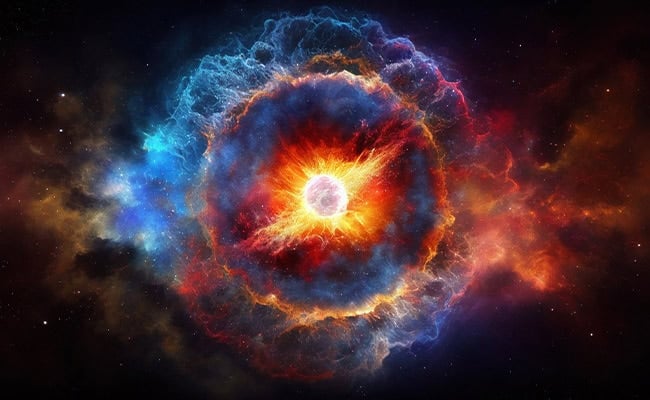
T Coronae Borealis is actually two stars locked in tight orbit: a white dwarf and a red giant. The red giant is slowly losing hydrogen to its more massive companion. Roughly every 79 years, enough hydrogen has accumulated on the white dwarf’s surface to trigger a runaway thermonuclear explosion, the surface ‘lights up’ brilliantly without destroying the star. The pattern resets, and the buildup begins again.
Only ten recurrent novae are known in the Milky Way. T Coronae Borealis is the most predictable, with documented eruptions in 1866 and 1946. NASA’s Goddard Space Flight Center estimates the next eruption is most likely in the 2024-2027 window.
How to Find It
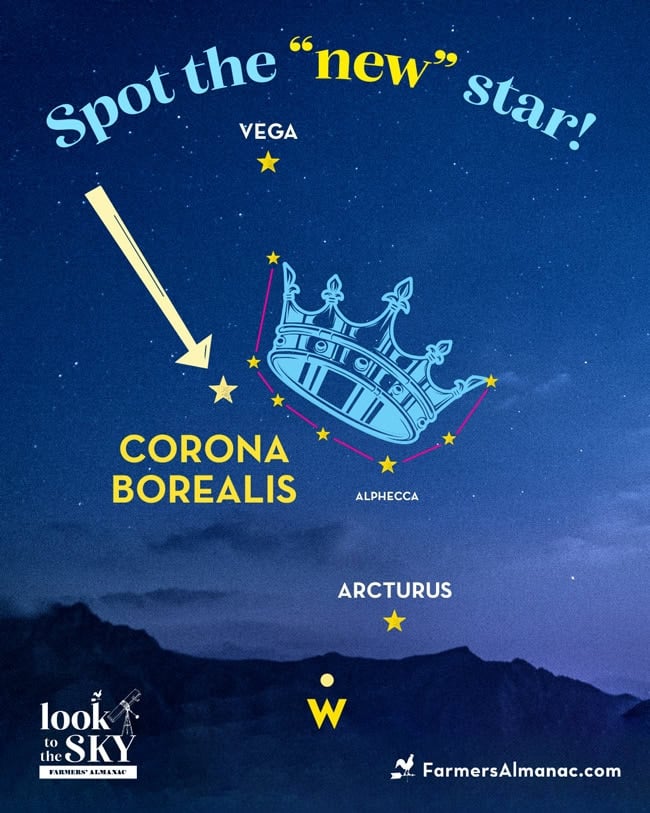
The Blaze Star sits in the constellation Corona Borealis, the Northern Crown, a small but distinct half-circle of 7 stars between the constellations Bootes (with bright Arcturus) and Hercules. The Northern Crown is visible in the northern sky from spring through fall.
When the Blaze Star erupts, it will appear inside the half-circle of the Crown, the size of which roughly fits inside an outstretched fist. The flare will brighten in hours and stay visible to the naked eye for about a week before fading.
When to Watch
Astronomers are watching T Coronae Borealis continuously, so news of the eruption will reach skywatchers within hours. The NASA and Royal Astronomical Society websites both publish real-time recurrent nova alerts.
- Step 1: bookmark a recurrent-nova alert page (NASA or AAVSO).
- Step 2: familiarize yourself with the Northern Crown so you can find it quickly.
- Step 3: when the alert comes, watch within 48 hours; the star is brightest in the first 2-3 days.
- Step 4: binoculars optional. Naked-eye is enough.

Frequently Asked Questions
When will the Blaze Star erupt?
Astronomers expect the eruption in the 2024-2027 window. As of mid-2026, it has not yet happened. Watch for real-time alerts.
How bright will it be?
About magnitude +2 at peak, roughly as bright as the North Star (Polaris) or the brightest stars in the Big Dipper. Easy naked-eye in light-polluted city skies.
How long will it be visible?
About a week visible to the naked eye, fading over another week. After two weeks it returns to telescope-only brightness.
Has it happened before?
Yes, documented eruptions in 1866 and 1946. Earlier eruptions in 1217 and 1787 are also recorded. The 79-year cycle has been remarkably consistent.



Dean Regas
Dean Regas is an astronomer and author of seven books including 100 Things to See in the Night Sky and How to Teach Grown-Ups About Pluto and host of the popular astronomy podcast Looking Up with Dean Regas. He can be reached at: www.astrodean.com
- Dean Regas

- Dean Regas
- Dean Regas
- Dean Regas