Animal Collective Nouns: Strange Names for Groups of Animals & Their Origins

Animal Collective Nouns: The Strange and Wonderful Names for Groups of Animals
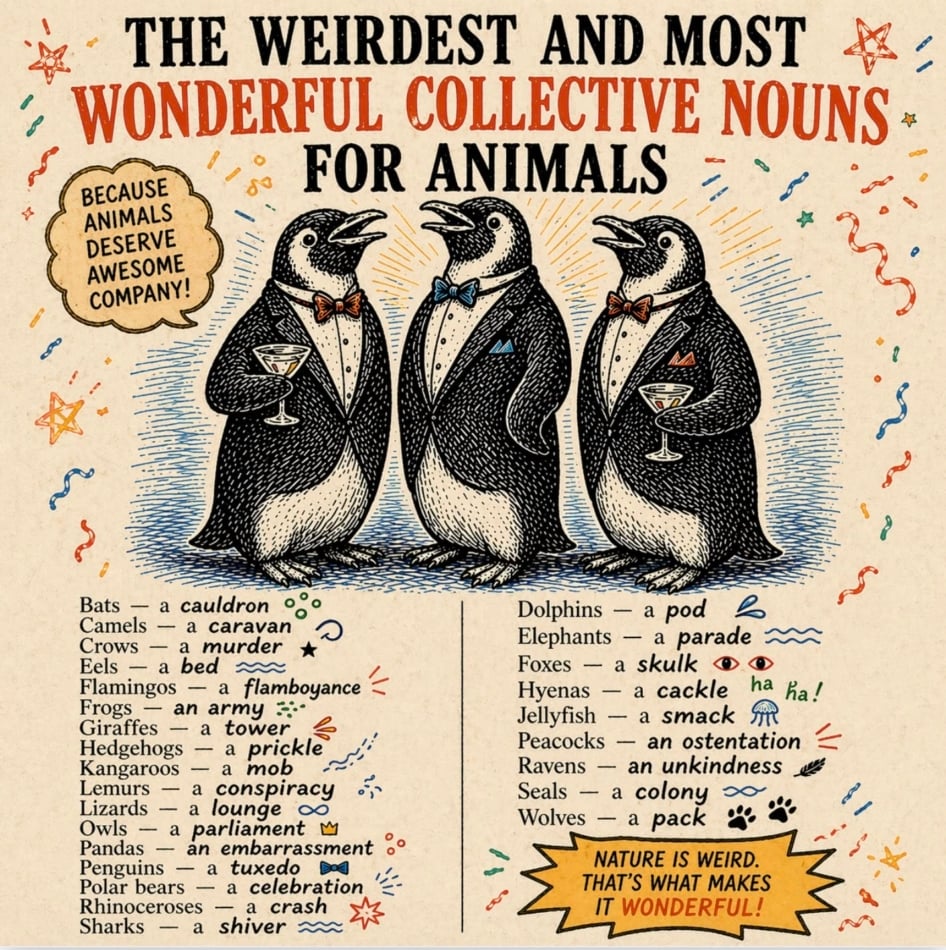
Have you ever wondered why we call a group of crows a murder? Or why leopards form a leap and owls gather in a parliament? These odd phrases are known as animal collective nouns (sometimes called terms of venery), and many of them have been part of the English language for more than 500 years.
Unlike ordinary words, collective nouns for animals often feel poetic, humorous, or slightly mysterious. They come from an old tradition of carefully naming groups of creatures, and many still capture something true about the animals themselves. Here’s a look at some of the most memorable ones and the stories behind them.
Where Did Animal Collective Nouns Come From?
Most of the classic collective nouns date back to medieval England. In 1486, a book called The Book of Saint Albans listed the “proper” terms hunters and nobility were expected to use. Some of those names stuck for centuries. Others were invented later but proved so fitting that they became standard.
These terms weren’t just decorative — they reflected how people observed animal behavior, appearance, and folklore. That careful attention to the natural world is something the Farmers’ Almanac has always valued.
Popular Animal Collective Nouns and Their Meanings
A murder of crows This is the most famous of all collective nouns. Crows have long been linked with death and misfortune in European folklore because they were often seen near battlefields and gallows. Calling a flock a “murder” plays on that dark reputation, even though modern science shows crows are highly intelligent and social birds.
A parliament of owls Owls have been symbols of wisdom for centuries. A gathering of them became known as a parliament — the place where serious discussion happens. The phrase feels especially fitting on quiet nights when you hear several owls calling to one another.
A leap of leopards Leopards are powerful, agile hunters famous for their ability to jump. The collective noun “leap” celebrates that athletic strength in a single, vivid word.
An exaltation of larks Larks are known for their joyful, upward-spiraling song. An “exaltation” captures the sense of rising and celebration that comes with hearing them on a spring or summer morning.
A pride of lions This one feels almost perfect. Lions live in close family groups, and “pride” has described them for centuries. It conveys both their social structure and their regal bearing.
An unkindness of ravens Ravens share some of the crow’s shadowy folklore. In older English, “unkindness” could mean something unnatural or harsh. The term stuck, even as we came to admire ravens for their remarkable intelligence.
A business of ferrets Ferrets were once widely used for hunting rabbits. A working group of them was called a “business,” likely because of their busy, determined underground activity. The name still suits their energetic nature.
A crash of rhinoceroses This more modern collective noun has earned its place. Anyone who has watched rhinos move through thick vegetation understands why “crash” feels so accurate — loud, sudden, and impossible to ignore.
A shrewdness of apes Apes are clever, observant, and sometimes cunning. “Shrewdness” acknowledges that intelligence in a respectful, understated way.
A gaggle of geese When geese are on the ground, they form a gaggle — a word that captures both their noisy chatter and their slightly disordered movement. (In the air, the same birds become a skein.)
Why These Names Still Matter
Collective nouns do more than make language interesting. They remind us that people have been watching animals closely for a very long time — noticing how they move, how they sound, and how they gather. A good collective noun is a small act of careful observation.
In a world that often moves too quickly, these old words invite us to slow down and look more closely at the creatures around us. Whether you’re watching a noisy murder of crows in a field or listening to a quiet parliament of owls at dusk, the traditional name still works.
What’s Your Favorite Animal Collective Noun?
Do you have a favorite group name — official or one you’ve made up yourself? Share it in the comments. The list of animal collective nouns has always had room for a little more imagination.
And the next time you’re outdoors, try using one of these terms. It still feels like the right way to speak about the natural world.

- Tim Konrad

- Tim Konrad
- Tim Konrad
- Tim Konrad