
Why Do Some Halloween Costumes Glow Under Blacklight? Here’s the Science.

Walk into a Halloween party with a blacklight, and you might notice something strange. A white skeleton costume suddenly shines bright blue, neon face paint seems to glow on its own, and someone’s ordinary white sneakers practically light up the room.
Meanwhile, another costume standing right beside them barely changes at all.
What’s going on? And why do some things glow under blacklight while others don’t?
The explanation involves invisible light, a little chemistry, and an ingredient that might already be hiding in your laundry detergent.
What Makes Things Glow Under Blacklight?
Despite its name, a blacklight isn’t completely dark. It produces ultraviolet light, or UV light, much of which is invisible to human eyes.
Some materials contain substances that absorb this ultraviolet energy and release part of it as visible light. That process is called fluorescence.
It’s what makes certain colors suddenly appear unusually bright under a blacklight. Instead of merely reflecting the visible light already in the room, a fluorescent material is producing additional visible light after absorbing ultraviolet radiation.
According to the University of California, Santa Barbara’s physics demonstrations, fluorescent materials can absorb ultraviolet light and emit visible light in different colors.
That’s why a fluorescent orange design may appear brilliantly orange, while another material glows blue or green.
But not everything reacts this way. Whether something fluoresces depends on the substances it contains, not simply how bright or colorful it looks in ordinary daylight.
Why Do White Clothes Sometimes Glow Blue?
Here’s the part that might surprise you: A plain white T-shirt can glow under blacklight even if it was never designed to be part of a Halloween costume.
The reason is often hiding in the laundry detergent.
Many detergents contain ingredients called optical brighteners. These compounds attach to fabric during washing and absorb ultraviolet light, then release some of that energy as visible blue light.
Under ordinary lighting, the effect can help white fabrics look brighter and less yellow. But under a blacklight, those same substances can make a shirt glow dramatically.
Researchers at Virginia Tech explain that optical brighteners absorb ultraviolet radiation and emit blue light, which is why they’re useful in laundry products.
It’s a clever bit of chemistry, and one you may have been carrying around on your clothes without ever noticing.
That doesn’t mean every white shirt will glow equally. Different fabrics and detergents contain different ingredients, and some clothing has been washed without optical brighteners.
The next time you’re at a Halloween gathering with a blacklight, take a look at the white clothing in the room. You may notice quite a difference from one person to another.
Why Does Neon Face Paint Glow So Brightly?
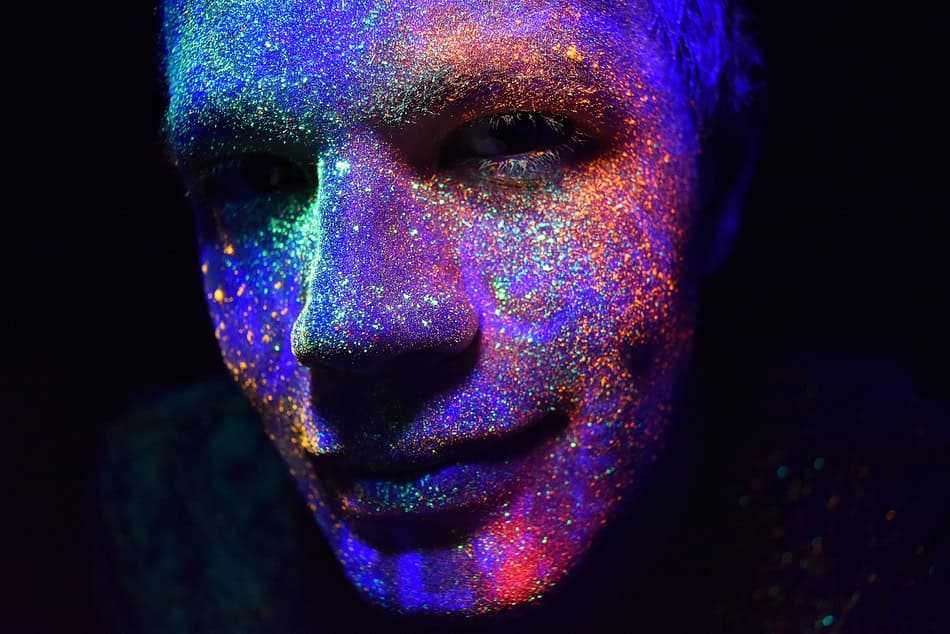
Halloween is a perfect occasion for fluorescent makeup, brightly colored decorations, and costumes designed to stand out in dim light.
Many of these products contain fluorescent pigments or dyes that react strongly to ultraviolet light.
A neon green design might be striking in daylight, but under a blacklight, a suitable fluorescent pigment can make it appear almost luminous.
Not every brightly colored product is fluorescent, though. A paint or fabric can look vivid in sunlight and still appear fairly ordinary under ultraviolet illumination.
If you’re buying face paint or costume makeup specifically for a blacklight party, look for products clearly labeled as UV-reactive or fluorescent and intended for use on skin. Ordinary craft paint isn’t a substitute for cosmetic products.
And remember that blacklight effects work best when there’s less competing visible light. In a brightly illuminated room, the glow may be difficult to notice.
Is Blacklight Glow the Same as Glow-in-the-Dark?
Not exactly, although the two effects are easy to confuse.
Fluorescent materials generally stop glowing almost immediately when the ultraviolet light is switched off.
Traditional glow-in-the-dark stars, stickers, and decorations work differently. Many use phosphorescent materials that absorb energy from light and then release it more slowly.
That’s why a glow-in-the-dark skeleton decoration may continue shining after you turn off the lights.
The University of Colorado Boulder’s physics department demonstrates the distinction: fluorescent objects glow while exposed to ultraviolet light, while phosphorescent ones can continue glowing afterward.
Glow sticks are different again. They produce light through a chemical reaction called chemiluminescence, rather than needing a blacklight to make them shine.
So although all three can look impressive at a Halloween party, they aren’t producing light in the same way.
A Little Halloween Magic, Explained
There’s something wonderful about watching an ordinary object change appearance the moment a blacklight switches on.
A white shirt becomes brilliant blue, fluorescent makeup seems to come alive, and familiar decorations suddenly look completely different.
But the effect isn’t magic. It’s invisible ultraviolet light interacting with substances that turn some of that energy into colors we can see.
And perhaps the funniest part is that you don’t need an elaborate costume to join in.
Sometimes all it takes is a freshly washed white shirt.

- Maggie Konrad

- Maggie Konrad
- Maggie Konrad
- Maggie Konrad