
Four Planets Will Line Up in November 2026: When and How to See This Celestial Show
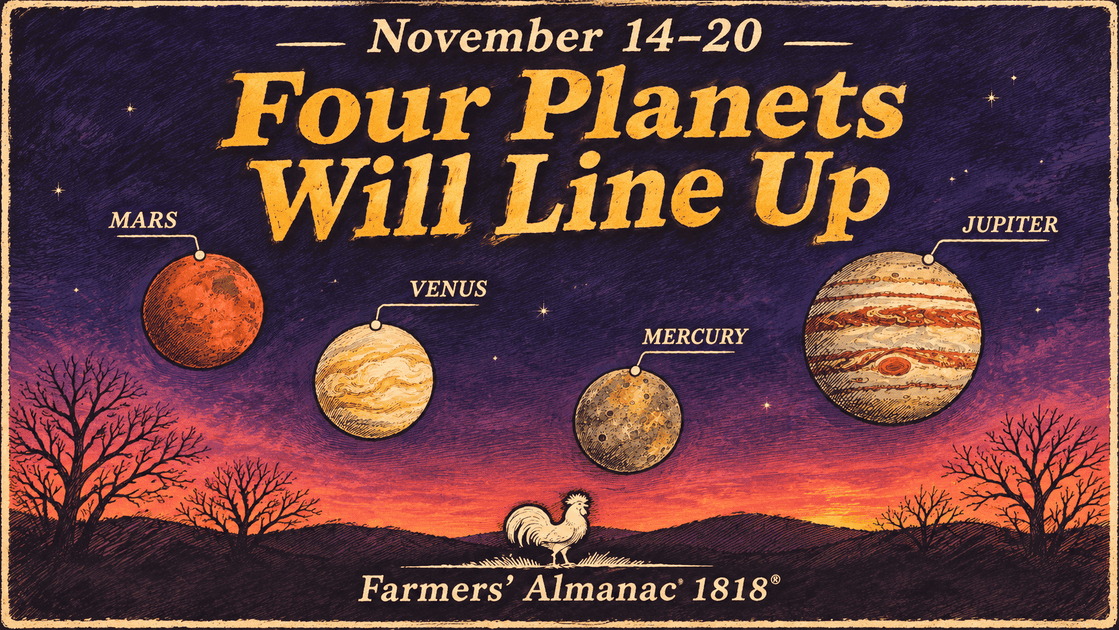
Mercury, Venus, Mars, and Jupiter will share the morning sky November 14–20. Here’s when to look up, where to look, and how to spot all four planets without a telescope.
If you enjoy looking up at the night sky, November has a special treat in store.
From November 14 through November 20, 2026, four planets—Mercury, Venus, Mars, and Jupiter—will be visible in the early morning sky. The celestial gathering, often called a planet parade or planetary alignment, will give early risers an opportunity to see four of our solar system’s planets during a single viewing session.
And here’s the best part: You won’t need a telescope to enjoy the show.
Under clear skies, all four planets can be seen with the naked eye, although Mercury may require a little patience and an unobstructed view of the eastern horizon.
Whether you’re an experienced skywatcher or simply someone who enjoys a beautiful sunrise, this is one November event worth getting out of bed for.
When Will the Four Planets Align in November 2026?
The four-planet gathering will be visible during much of the second half of November, with several particularly good mornings to watch.
Here are the dates to mark on your calendar:
- November 14: All four planets begin offering a favorable morning viewing opportunity, although Mercury remains low near the horizon.
- November 15–16: Mars and Jupiter appear exceptionally close together in the sky, separated by approximately 1.2 degrees.
- November 17–19: The planetary gathering continues, with Mercury becoming easier to find as the week progresses.
- November 20: Mercury reaches its greatest western elongation, making this one of the better mornings to spot the elusive planet.
- November 21–22: The four planets remain visible before sunrise under favorable conditions.
Unlike a solar eclipse, a planetary alignment isn’t confined to a few brief minutes. You’ll have multiple mornings to enjoy this event, provided the weather cooperates.
What Time Should You Look for the Planetary Alignment?
The best time to see the November 2026 planetary alignment is approximately 45 to 60 minutes before sunrise.
The exact viewing time will depend on your location, but the general advice is the same across much of the United States: find a place with a clear view of the eastern sky and arrive before the first light of dawn grows too bright.
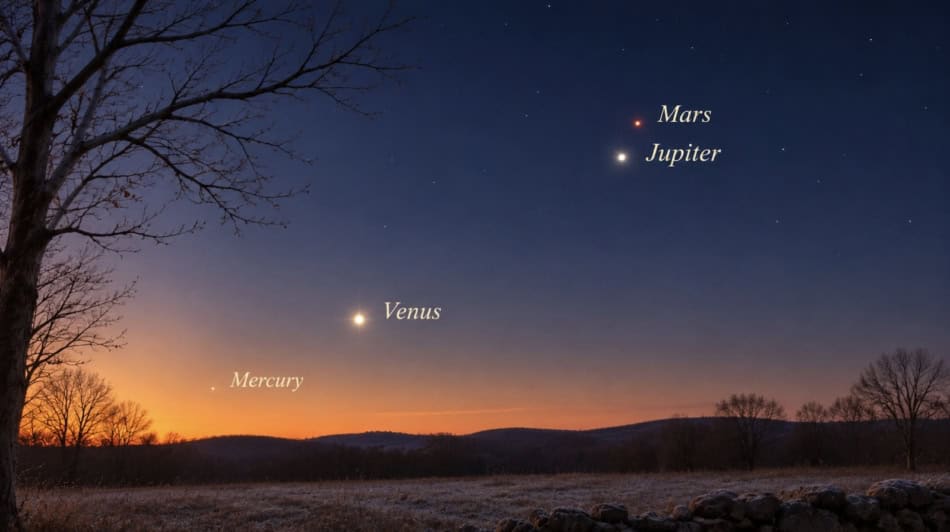
Look toward the east and southeast.
Mars and Jupiter will be higher in the sky, while brilliant Venus and much fainter Mercury will appear closer to the eastern horizon.
Because Mercury stays relatively close to the Sun from our perspective on Earth, it will be the most challenging of the four planets to spot.
If you have trouble finding Mercury on November 14 or 15, try again around November 20.
How to Identify All Four Planets
One of the pleasures of watching a planetary alignment is learning to recognize each planet by its appearance.
Here’s what to look for.
Jupiter: The Bright Giant
Jupiter will be one of the easiest planets to identify.
The largest planet in our solar system appears as a brilliant, whitish point of light in the predawn sky. During this November event, it will be located close to Mars.
Jupiter generally shines more steadily than the surrounding stars, making it a useful landmark for identifying the other planets.
Mars: The Red Planet
Look near Jupiter for a noticeably dimmer point of light with a warm, reddish-orange appearance.
That’s Mars.
On November 15 and 16, Mars and Jupiter will appear especially close together. According to NASA, the two planets will be separated by about 1.2 degrees—just a little more than the apparent width of two full Moons placed side by side.
Of course, the planets aren’t actually close together in space. They only appear near each other from our viewpoint on Earth.
Venus: The Brilliant Morning Star
Venus will be unmistakable.
Often called the Morning Star when it appears before sunrise, Venus is the brightest planet in Earth’s sky.
Look lower toward the eastern horizon for an exceptionally bright, steady point of light.
Venus can be so brilliant that people sometimes mistake it for an airplane or another unusual object in the sky.
But during this November alignment, it’s simply our neighboring planet putting on a spectacular morning display.
Mercury: The Trickiest Planet to Spot
Mercury will be the most difficult member of the four-planet gathering to find.
As the closest planet to the Sun, Mercury never ventures very far from the Sun in our sky. That means it often appears low on the horizon, shortly before sunrise or after sunset.
During the November 2026 alignment, Mercury will be visible below Venus in the eastern morning sky.
For your best opportunity, try looking around November 20, when Mercury reaches its greatest western elongation, appearing at its greatest angular separation west of the Sun for this morning apparition.
You’ll need a clear eastern horizon without trees, buildings, or hills blocking your view.
Will the Four Planets Form a Straight Line?
Not exactly.
Although the event is commonly described as a planetary alignment, the four planets won’t form a perfectly straight line in the sky.
Instead, they’ll appear spread along the same broad path across the heavens.
Astronomers call this apparent pathway the ecliptic, which marks the Sun’s apparent annual path through the sky.
Because the planets orbit the Sun in nearly the same plane, they generally appear along this familiar region of the sky.
A planetary alignment happens when several planets are visible along that path at approximately the same time.
And despite how the gathering looks from Earth, the planets aren’t lining up in a straight row out in space.
It’s a matter of perspective—and a beautiful one at that.
Is the November 2026 Planetary Alignment Rare?
Seeing several bright planets during the same morning isn’t unheard of, but finding four naked-eye planets visible together is still a special skywatching opportunity.
What’s particularly interesting about this November event is the combination of an unusually close apparent meeting between Mars and Jupiter and the return of Mercury to the morning sky.
Mercury’s favorable appearance around November 20 makes the second half of the month especially appealing for anyone hoping to identify all four planets.
You don’t need expensive equipment or specialized knowledge. Just a little curiosity and a willingness to get up early.
Five Tips for Seeing the Four-Planet Alignment
1. Set your alarm before sunrise. Aim to be outside 45–60 minutes before your local sunrise. The best viewing window may vary depending on your horizon and the date.
2. Find a clear eastern horizon. An open field, hilltop, shoreline, or other location without tall obstructions is ideal.
3. Start with the brightest planets. Locate Jupiter and brilliant Venus first. Then use their positions to help you find Mars and Mercury.
4. Check the weather forecast. Even thin clouds or haze near the horizon can make Mercury difficult to see.
5. Leave the telescope at home if you wish. All four planets are potentially visible with the naked eye. If you use binoculars to locate Mercury, be certain the Sun is still below the horizon, and never point binoculars toward the Sun.
For an easier viewing experience, a sky-mapping app can show the planets’ locations from your exact city.
What Else Is Happening in the November Night Sky?
The four-planet alignment isn’t the only astronomical event worth watching this month.
November 15–16: Mars and Jupiter Meet
These two planets will appear especially close together in the morning sky, offering one of November’s most attractive celestial pairings.
November 17–18: The Leonid Meteor Shower
The annual Leonid meteor shower reaches its peak, offering another reason to head outside before dawn.
Under ideal dark-sky conditions, observers may see around 10–15 meteors per hour, although actual counts will vary.
November 24: The Full Beaver Moon
November’s Full Beaver Moon arrives on November 24, and it will also be a supermoon.
This will be the first in a series of three consecutive supermoons, giving skywatchers even more to anticipate as the year draws to a close.
Don’t Miss November’s Morning Planet Parade
There’s something timeless about stepping outside on a chilly November morning, looking toward the eastern horizon, and watching the heavens come to life before sunrise.
For generations, farmers, sailors, and skywatchers have relied on the movements of the planets, stars, and Moon to mark the passing seasons.
This November, you can take part in that same tradition.
Mark your calendar for November 14–20, 2026, and remember that November 15–16 and November 20 offer especially interesting viewing opportunities.
Bundle up, find an open view of the eastern sky, and look up.
Sometimes the best show of the season happens before the day has even begun.
For more celestial events, Moon phases, and skywatching tips, visit the Farmers’ Almanac November 2026 Night Sky Guide and Visible Planets Guide.


- Farmers' Almanac Staff

- Farmers' Almanac Staff
- Farmers' Almanac Staff
- Farmers' Almanac Staff