Why Do Some Trees Hold Their Dead Leaves All Winter? The Surprising Science Behind This Winter Mystery
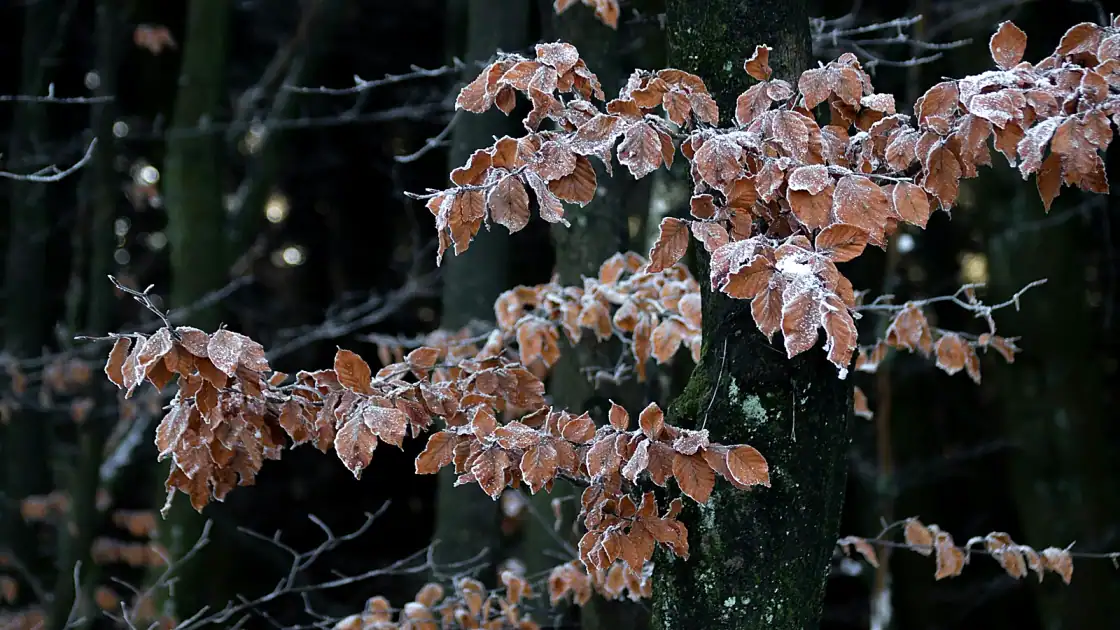
Ever notice an oak or beech tree still covered in brown leaves long after its neighbors have gone bare? Those stubborn leaves aren’t necessarily a sign of trouble. Scientists have a name for the phenomenon—and several fascinating theories about why it happens.
Walk through the woods on a cold December morning, and you’ll notice something curious.
Most of the trees have surrendered their leaves. Bare branches stretch into the winter sky, and the forest floor is covered with the remains of autumn.
But here and there, a tree seems determined to hold on.
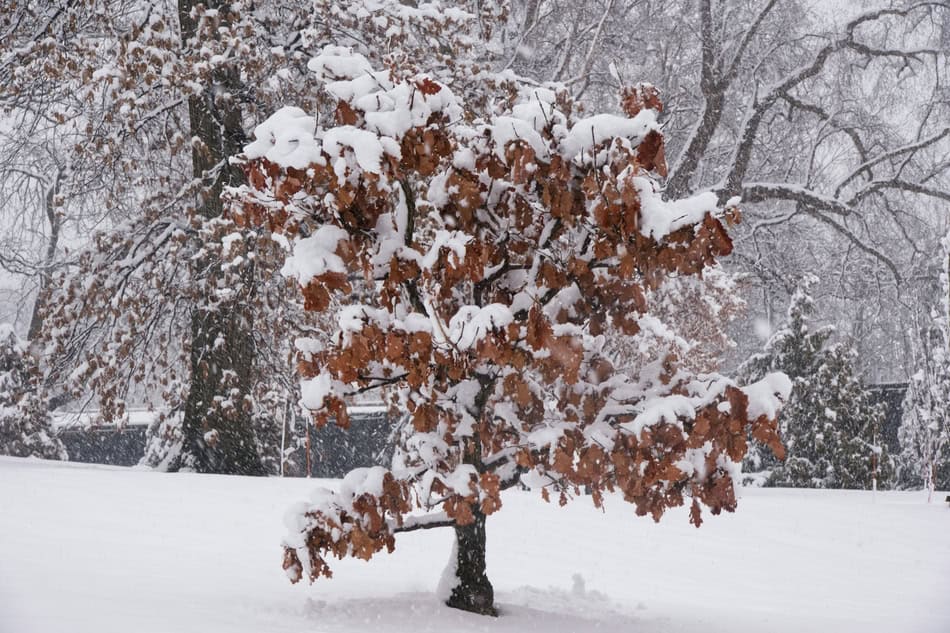
Its branches are still covered in dry, papery leaves, sometimes so thickly that the tree looks almost as though autumn never ended.
The leaves are clearly dead. They’ve turned brown, brittle, and dry. Yet they remain attached, rustling in the winter wind.
Why do some trees hold their dead leaves all winter while others drop them in the fall?
The phenomenon is called marcescence (pronounced mar-SESS-enss), and it’s especially common among oak and beech trees.
What makes it particularly interesting is that scientists still don’t fully understand why it happens.
Some researchers believe those dead leaves may help protect trees from hungry deer, freezing temperatures, or poor growing conditions. Others think the behavior may simply be a leftover characteristic of how certain trees evolved.
Whatever the explanation, those stubborn brown leaves are part of one of winter’s more overlooked natural wonders.
What Is Marcescence?
Marcescence is the term botanists use to describe dead plant material that remains attached rather than falling away.
In trees, it usually refers to the dry, brown leaves that stay on branches long after the growing season ends.
To understand why this happens, it helps to know how trees normally lose their leaves.
As autumn arrives and daylight decreases, deciduous trees begin preparing for winter.
Chlorophyll, the pigment that makes leaves green, breaks down. Yellow, orange, and red pigments become visible, creating the familiar colors of fall.
At the same time, trees begin forming a specialized layer of cells at the point where each leaf stalk attaches to its branch.
This is called the abscission layer.
Think of it as a natural release mechanism.
As the layer develops, the connection between leaf and branch weakens. Eventually, the leaf breaks free and falls to the ground.
But in trees that exhibit marcescence, this separation process is delayed or incomplete.
The leaves die, but their attachment remains strong enough to hold them in place.
They may stay there for weeks, months, or nearly the entire winter.
According to University of Illinois Extension, this behavior is particularly noticeable in oaks and beeches, although other trees can exhibit it as well.
Which Trees Keep Their Dead Leaves During Winter?
Not every tree develops marcescent leaves, and even among species that do, the behavior can vary considerably.
Some of the most familiar examples include:
1. Oak Trees
Oaks are among the most recognizable trees that retain brown leaves in winter.
Pin oaks, in particular, are known for hanging on to their foliage well after neighboring trees have become bare.
You may see a mature oak with bare upper branches but a thick covering of brown leaves near the bottom.
Young oak trees can retain even more foliage, sometimes keeping nearly all their dead leaves through much of the winter.
2. American Beech Trees
If you’ve ever walked through a northeastern forest in January, you may have noticed small trees covered in pale golden-brown leaves.
There’s a good chance they were American beeches.
Their thin, papery leaves can remain attached until spring, making the trees easy to spot against a backdrop of bare trunks and branches.
Beech leaves are especially striking in winter sunlight, when their coppery color seems to glow.
3. Hornbeam Trees
American hornbeam, sometimes called musclewood, can also retain dead leaves during winter.
These understory trees are often found in moist woodland environments.
Their distinctive smooth bark and lingering foliage make them interesting trees to identify during winter walks.
4. Eastern Hophornbeam
Eastern hophornbeam, also known as ironwood, is another species that may keep dried leaves through the colder months.
Although the tree is less familiar to many homeowners, it is native to much of eastern North America.
5. Witch Hazel
Some witch hazels also exhibit marcescence, retaining withered leaves after autumn.
Their lingering foliage can be particularly noticeable because certain witch hazels flower during fall or winter.
The interesting thing is that marcescence isn’t always consistent, even within the same species.
One tree may drop nearly all its leaves in November while another nearby retains a thick covering until March.
So why the difference?
Why Do Young Trees Hold More Dead Leaves Than Older Trees?
Here’s one of the most curious parts of the mystery.
Marcescence is often more pronounced in young trees.
A small beech tree might hold nearly every leaf throughout winter, while a towering mature beech standing just a few feet away loses most of its foliage in autumn.
Even on an older tree, the lower branches may retain leaves while the upper canopy becomes completely bare.
Researchers believe this pattern could offer clues about the possible advantages of marcescence.
One theory involves protection from animals.
Another concerns the development of the tree itself.
As trees mature, their patterns of growth and leaf shedding can change. The tendency to retain dead leaves may become less pronounced with age.
But why might keeping those leaves help a younger tree survive?
That brings us to one of the most interesting scientific explanations.
Theory #1: Dead Leaves May Protect Trees From Hungry Deer
Imagine you’re a deer looking for food in the middle of winter.
Green vegetation is scarce. Snow covers the forest floor, and many of your usual food sources have disappeared.
Young tree buds and tender twigs suddenly become appealing.
Now imagine approaching two small trees.
One has bare branches with exposed buds.
The other is covered in dry, stiff, brown leaves.
Which would be easier to browse?
Some scientists believe retained leaves may discourage deer and other browsing animals from feeding on young trees.
The dead foliage can make it more difficult for an animal to reach desirable buds and twigs.
The leaves may also be unpleasant to eat because they are dry, tough, and contain defensive compounds.
This hypothesis could help explain why marcescence is so common in young trees and lower branches—the parts most accessible to browsing animals.
However, this remains a scientific hypothesis, not a proven universal explanation.
Researchers have identified several possible benefits, and the reasons for marcescence may differ among species.
Theory #2: Dead Leaves May Protect New Buds From Winter Weather
Another possibility is that retained leaves offer a little protection from harsh winter conditions.
The buds that will produce next spring’s leaves are already present on many trees during winter.
They must survive months of freezing temperatures, drying winds, and changing weather.
Some researchers have proposed that dead leaves surrounding these buds may provide a measure of shelter.
They might reduce exposure to drying winds or offer limited protection from frost.
Think of the foliage as a loose winter covering.
It certainly isn’t the same as wrapping a tree in insulation, but even small changes in exposure might matter for vulnerable buds.
Scientists are still studying whether this protection provides a meaningful advantage.
Theory #3: Holding Leaves Until Spring May Help Feed the Tree
This explanation is especially interesting for gardeners.
When trees drop their leaves in autumn, those leaves begin breaking down on the forest floor.
Over time, decomposition returns nutrients and organic matter to the soil.
But what happens if a tree waits until spring to shed its leaves?
Some researchers believe delayed leaf drop might help time that nutrient return more closely to the start of the growing season.
Instead of dropping all its leaves in October or November, the tree releases them as temperatures warm and biological activity in the soil increases.
The leaves then contribute to the natural layer of organic matter around the tree.
This could be particularly useful in environments with nutrient-poor soils.
However, decomposition takes time, and researchers have not established that spring leaf drop consistently provides a nutritional advantage.
It’s one of several ideas scientists continue to investigate.
For a deeper look at the science, researchers published a review in the journal Ecosphere examining the possible explanations for leaf marcescence.
Does Keeping Dead Leaves Mean a Harsh Winter Is Coming?
According to an old weather saying:
“If in October many fall leaves wither and hang on the boughs, it betokens a frosty winter and much snow.”
For generations, people have looked at lingering autumn leaves as a possible warning of a severe winter.
The belief is easy to understand.
If a tree seems reluctant to shed its leaves, perhaps it knows something about the season ahead.
But does the folklore hold up?
Not reliably.
Leaf retention depends on tree species, age, genetics, and environmental conditions. Scientists have not established that unusually persistent leaves predict a colder or snowier winter.
A tree covered in brown leaves in December isn’t necessarily preparing for a blizzard.
It may simply be behaving exactly as its species normally does.
And although sudden autumn freezes can sometimes interrupt the normal leaf-shedding process in other trees, that tells us about weather that has already occurred—not what the entire winter will bring.
As with many traditional weather sayings, the observation is real even when the prediction is uncertain.
You can explore more fascinating beliefs in our collection of old-time October weather sayings.
When Do Those Dead Leaves Finally Fall Off?
If the leaves stay attached all winter, what eventually makes them drop?
Often, the answer is spring.
As temperatures warm and the tree begins preparing for new growth, swelling buds and changes at the base of the old leaf stalk can help release the remaining foliage.
On some trees, the old leaves fall shortly before new leaves emerge.
On others, wind, snow, or rain gradually knocks them loose during winter.
That’s why you might notice a pin oak dropping leaves in March or April, months after the traditional autumn leaf-raking season has ended.
The timing isn’t exactly the same for every species or individual tree.
But one thing is certain: those brown leaves won’t remain forever.
Eventually, the new growing season begins, and the old foliage makes way for spring.
Should You Remove Dead Leaves From a Tree in Winter?
If you have a young oak or beech in your yard that’s still covered in brown leaves, you might wonder whether something is wrong.
In most cases, there’s no reason to worry.
Marcescence is a normal characteristic of certain trees and does not, by itself, indicate that a tree is unhealthy.
You generally shouldn’t try to pull the leaves off.
They’re attached to the branches naturally, and forcing them loose could damage buds or small twigs.
Let the tree shed them on its own.
However, it’s important to distinguish normal marcescence from leaves that have died because of disease, drought, sudden freezing, or another form of stress.
Watch for additional warning signs, such as:
- Significant branch dieback
- Damaged or peeling bark
- Unusual growths or extensive cankers
- Brittle, dead twigs throughout the canopy
- Failure to produce healthy new growth in spring
If your tree shows these symptoms, especially after an unusually stressful growing season, consider consulting a certified arborist.
Otherwise, a healthy-looking oak holding its brown leaves through winter is usually nothing to be concerned about.
Can You Identify Trees by Their Winter Leaves?
Yes! In fact, winter can be a surprisingly good time to learn about trees.
Once most deciduous species lose their foliage, the trees that retain leaves stand out.
Try this simple nature activity on your next winter walk.
Step 1: Find a small tree that still has brown leaves.
Step 2: Examine the leaves without pulling them off. Are they rounded and lobed like oak leaves, or oval with pointed tips like beech leaves?
Step 3: Look at the bark and buds. American beeches often have smooth gray bark and long, slender, pointed buds.
Step 4: Notice where the leaves remain. Is the entire tree covered, or are the leaves concentrated on lower branches?
Step 5: Return in early spring and watch when the remaining leaves finally fall.
You may find that a tree you’ve walked past a hundred times becomes much more interesting once you know what to look for.
And if you’re curious about why leaves change color before winter arrives, read our guide to what temperature makes leaves change color.
Love Old Weather Folklore? Discover Our New Book, Red Sky at Night
Long before weather apps and satellite forecasts, people looked to the trees, sky, birds, and changing seasons for clues about the weather ahead.
Some of those observations turned out to have a scientific explanation. Others became beloved traditions passed down through generations.
At Farmers’ Almanac, we’ve been celebrating that kind of practical knowledge and country wisdom since 1818.
Now, we’ve gathered a treasury of those fascinating traditions into a new book.
Red Sky at Night: A Treasury of Old Weather Folklore and Sayings
Our new illustrated book explores the stories and science behind the weather sayings passed down through generations.
Have you ever wondered:
- Does a red sunset really mean fair weather tomorrow?
- Can a ring around the Moon predict rain or snow?
- Why do birds sometimes fly low before a storm?
- Can animals and plants really offer clues about changing weather?
- Which old-fashioned weather sayings have a basis in science?
Across 15 chapters, Red Sky at Night explores the fascinating connection between nature, weather, folklore, and generations of observation.
Filled with memorable rhymes, traditional sayings, charming illustrations, and plainspoken explanations, it’s a wonderful addition to any bookshelf.
It also makes a thoughtful gift for gardeners, weather watchers, nature lovers, and anyone who appreciates old-fashioned country wisdom.
Get Red Sky at Night on Amazon — Available Now
Frequently Asked Questions About Trees That Keep Their Leaves
Why does my oak tree still have brown leaves in winter?
Many oak trees naturally retain dead leaves because the separation layer that normally allows leaves to fall doesn’t fully develop in autumn. This condition, called marcescence, is especially common in young trees and lower branches.
Why do beech trees keep their leaves all winter?
American beech trees commonly exhibit marcescence. Their dead leaves can remain attached until late winter or spring. Scientists are still investigating whether this characteristic helps protect the tree or serves another purpose.
Do dead leaves on trees mean a cold winter is coming?
No reliable scientific evidence shows that dead leaves remaining on trees predict a harsh winter. Leaf retention is primarily influenced by species characteristics and environmental conditions.
Are trees with dead leaves still alive?
Yes. A deciduous tree can be completely healthy while retaining dead leaves in winter. The leaves are no longer functioning, but the tree itself may be dormant and ready to grow again in spring.
Should I remove brown leaves from my oak tree?
No. If the tree is healthy, leave the foliage alone. The leaves will usually fall naturally as winter progresses or new growth begins in spring.
What month do oak trees finally lose their old leaves?
It depends on the oak species, climate, and individual tree. Some lose their remaining leaves during winter, while others retain them until March, April, or the arrival of new spring growth.
A Final Thought: Sometimes Nature Isn’t Ready to Let Go
There’s something charming about a tree that refuses to surrender the last traces of autumn.
While the rest of the forest stands bare against the winter sky, young beeches and stubborn oaks continue to wear their rustling coats of brown and gold.
Scientists may not have settled every question about why those leaves remain, but the phenomenon reminds us that nature rarely follows a single, simple schedule.
The next time you see a tree holding its leaves in the middle of winter, pause for a moment and listen.
That soft rustling sound is one of the quiet pleasures of the colder months.
Have you noticed trees in your neighborhood holding onto their leaves all winter? Tell us where you live and what kinds of trees you’ve spotted in the comments!


- Farmers' Almanac Staff

- Farmers' Almanac Staff
- Farmers' Almanac Staff
- Farmers' Almanac Staff