Before Thursday, Try This One-Minute Earthquake Drill

If the room started shaking right now, what would you actually do?
Not what you vaguely remember from school. Not what you think you’re supposed to do. What would your body do in the first few seconds?
A lot of people would head for a doorway or try to get outside. That advice has hung around for years, but it’s not what earthquake experts recommend. In a modern home, a doorway usually offers no special protection, and trying to cross a shaking room can put you in the path of falling glass, furniture, or anything else that suddenly comes loose. The U.S. Geological Survey recommends something much simpler: Drop, Cover, and Hold On.
Thursday, October 15, is the Great ShakeOut, the annual earthquake drill held in communities around the world. You can join an organized drill, but you don’t need one. The useful part takes about a minute.
Pick the room you’re in most often and pretend the shaking has started.
Drop to your hands and knees so you’re less likely to be knocked over. If there’s a sturdy table or desk nearby, get underneath it and cover your head and neck. Hold on to the furniture in case it shifts. If there’s nothing sturdy within reach, stay low and protect your head and neck with your arms rather than trying to run across the room.
Then stay there for a minute.
That’s it.
But while you’re down there, look around.
The Drill Gets More Interesting From Floor Level
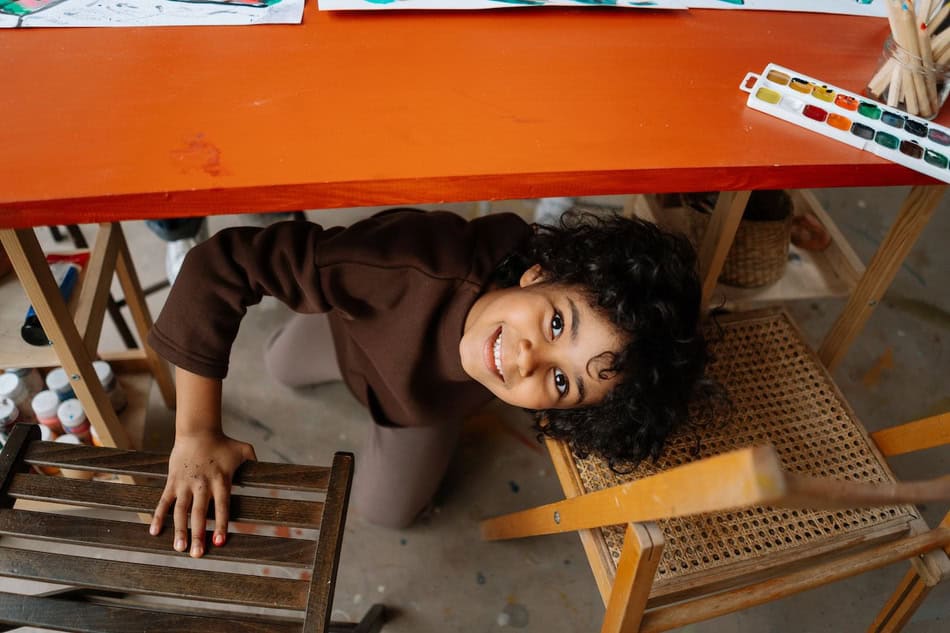
You may notice things you’ve stopped seeing because they’re part of the room.
A framed picture above the couch. A heavy lamp on a narrow table. Glassware stored on a high shelf. A bookcase that’s never been anchored to the wall. A television that could tip forward.
Those are the things that turn an ordinary room into a very different place once it starts moving.
That’s one reason the Great ShakeOut is more useful than simply memorizing three steps. The drill gives you a chance to see your home from the position you’d actually be in during strong shaking. Organizers suggest using the exercise to notice things that could fall, slide, break, or block an exit. FEMA earthquake guidance also recommends securing heavy furniture and wall-hung objects and keeping heavy or breakable items on lower shelves.
You don’t need to earthquake-proof the whole house in an afternoon. But if doing the drill makes one tall bookcase suddenly look questionable, that’s useful information.
And No, Don’t Run Outside
Trying to get outdoors can feel instinctive. During strong shaking, though, moving through a room or toward an exterior wall can expose you to falling objects and broken glass.
The doorway rule is another holdover from older construction. According to the USGS, doorways in modern homes are generally no safer than other parts of the structure.
The safest response depends somewhat on where you happen to be.
If you’re in bed, stay there and protect your head and neck with a pillow. If you’re outside, move to an open area away from buildings, signs, trees, and power lines. If you’re driving, pull over somewhere safe, set the parking brake, and stay in the vehicle until the shaking stops. Avoid stopping under bridges, overpasses, signs, or power lines.
People who use wheelchairs or walkers shouldn’t try to get onto the floor. The guidance is to Lock, Cover, and Hold On: lock the wheels, protect the head and neck, and hold on. The Earthquake Country Alliance has more detailed guidance for people with mobility and other access needs.
“We Don’t Really Get Earthquakes Here”
Maybe not often.
But earthquake country is a lot bigger than California. The ShakeOut includes regions across the United States, including the Northeast, Southeast, central states, Upper Midwest, Alaska, Hawaii, and Puerto Rico.
And preparedness has an annoying habit of becoming relevant somewhere other than home. You might be traveling. At work. In a hotel. Visiting family.
You don’t need to spend the week worrying about earthquakes. That’s not the point.
The point is to remove one tiny piece of uncertainty before you ever need the information.
Sometime before Thursday, take one minute. Get under the table. Cover your head. Hold on. Then look around from where you are.
You may be surprised by what suddenly looks different.

- Maggie Konrad

- Maggie Konrad
- Maggie Konrad
- Maggie Konrad