What Is a Water Devil? Waterspouts Explained, From Fair-Weather to Tornadic
Water devils and waterspouts are an impressive natural phenomenon. Learn more about these "sea serpents."
Quick Reference: Water Devils (Waterspouts)
- What it is: a “water devil” is the folk name for a waterspout, a column of rotating air over water.
- Two kinds: tornadic (storm-driven, dangerous) and fair-weather (cumulus-driven, usually short-lived).
- When they form: May to September in the Northern Hemisphere; peaks August in the Florida Keys.
- Height: typically a few hundred feet; the tallest fair-weather spouts can reach 3,000 feet.
- Where: any open water, fresh or salt. Florida Keys, the Great Lakes, the Mediterranean, and the Adriatic are global hotspots.
- What to do: waterspouts can move ashore as weak tornadoes. If you see one, head 90° away from its path.
Imagine this: it is the middle ages, and you are a fisherman with a small wooden boat. Every morning, you and your neighbors head out to sea to catch your livelihood. One morning, as you drop your nets, a serpentine column rises out of the water with an eerie groaning sound. It towers at least 1,000 feet above your boat as it weaves drunkenly across the surface. You watch in horror as it approaches another fisherman’s boat, reduces it to splinters in a matter of seconds, and drags your comrade into the roiling sea beneath it. Then, as quickly as it appeared, it slips back beneath the waves without a trace. Throughout your entire ordeal, the sun shone brightly and only a few small, fluffy clouds marked the sky. Whatever you saw, one thing is certain: you will be a popular man at the pub tonight.
This type of occurrence, along with sightings of whales and other impressive sea life, is likely responsible for many of the more colorful historical accounts of deadly monsters lurking in our oceans. What is described here, however, is not a sea serpent: it is a kind of tornado called a waterspout. At lower levels of intensity, usually not severe enough to destroy a boat, waterspouts are often referred to by the more poetic name “water devils.”
What Is a Water Devil?
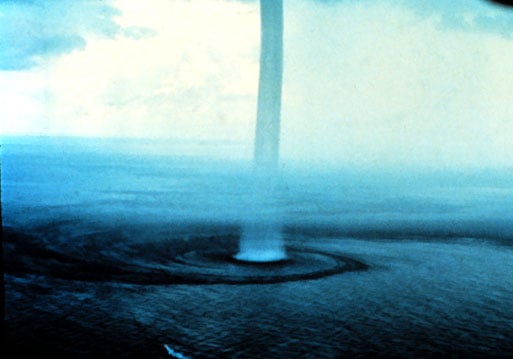
“Water devil” is the historic seafaring name for a waterspout: a rotating column of air that pulls up a visible funnel of mist and spray from the water below. The U.S. National Weather Service splits them into two categories. Tornadic waterspouts are true tornadoes that happen to form over water and travel onshore; they are rare, intense, and behave exactly like the Great Plains variety. Fair-weather waterspouts are the much more common kind: they spin up from the bottom of a developing cumulus cloud on a calm, warm day, last a few minutes, and dissipate when they hit cooler air or run out of moisture.
The pub story above almost certainly describes a fair-weather waterspout pushed past its usual size by an unusually warm sea surface. The “groaning sound” sailors reported is the funnel’s churn pulling air through the choppy water below it.
When and Where Waterspouts Happen
Waterspouts generally occur during warmer months, from May to September in the Northern Hemisphere. Like tornadoes, they are cyclonic disturbances that form when fronts of high and low pressure collide. Unlike tornadoes, waterspouts often occur when the weather is otherwise fair. They can form over any body of water, are usually short-lived, and are rarely as destructive as land tornadoes. Even so, they are impressive: a strong one can reach 3,000 feet from sea surface to cloud base.
| Region | Peak season | Conditions that favor them | Notes |
|---|---|---|---|
| Florida Keys (approx. 25 N) | May through September; June and May historically lead all months | Warm shallow water, high low-level humidity, weak wind shear, afternoon convective heating | More waterspouts reported here than anywhere else in the US; NWS Key West logged over 1,400 events from May 2006 through September 2024; annual average is 20-70 per year from the airport observation record |
| Gulf of Mexico and South Florida coast | Late spring through early fall (May-October) | Warm Gulf surface temperatures, sea-breeze convergence zones, outflow boundaries from afternoon thunderstorms | Fair-weather waterspouts form along convective lines and outflow boundaries; NWS Miami issues a separate waterspout forecast product for South Florida waters |
| Chesapeake Bay and Mid-Atlantic coast | Summer (July-September) | Warm bay and coastal waters, humid air mass, afternoon sea-breeze lifting | Less frequent than Florida; both fair-weather and tornadic types occur; tornadic events associated with tropical systems can be intense |
| Great Lakes (northern Michigan, Lake Michigan, Lake Superior) | August through October | Cold air masses moving over warm lake water, large air-water temperature contrast, light surface winds | NWS Northern Michigan notes this temperature contrast is the dominant local mechanism; events typically last 2-20 minutes; warm lake water extending into October prolongs the season |
| Pacific Northwest and Northern Pacific coast | Fall (September-November) | Cold air outbreaks over relatively warm near-shore ocean, strong atmospheric instability | Less common than Atlantic or Gulf locations; tornadic types associated with Pacific frontal systems predominate; occasional reports near Seattle in autumn |
| Mediterranean Sea (globally notable for context) | Late summer to early autumn (August-October) | Warm sea surface temperatures persisting from summer, cold air aloft from early fall troughs | Peer-reviewed climatology identifies the central and eastern Mediterranean (Adriatic, Ionian, south Aegean) as among the most waterspout-active regions on Earth, comparable in frequency to the Florida Keys on a per-area basis |
If you want to see one, the Florida Keys are the closest thing to a guaranteed sighting on the planet, especially during the last two weeks of August. For deeper background on the meteorology, the U.S. National Weather Service Key West office publishes a thorough waterspout primer with photos.
Tornadic vs Fair-Weather Waterspouts
The two kinds form by completely different mechanisms, and only one of them is dangerous to a boat.
- Tornadic waterspouts descend from a supercell thunderstorm, the same way Great Plains tornadoes do. They spin tighter, last longer, and can produce winds over 100 mph. If one moves onshore, the NWS will issue a tornado warning.
- Fair-weather waterspouts build upward from the water surface under a developing cumulus, before the cloud has matured into a thunderstorm. They are slower, weaker, and typically last under 20 minutes. Most fishing-boat sightings fall into this category.
What to Do If You See a Water Devil
- Take a bearing. Most fair-weather spouts move slowly (about 10 to 15 mph) and predictably.
- Move 90° to its track. Steering perpendicular is the fastest way out of the cone of risk.
- Reduce sail or speed. Even a weak spout can capsize a small craft if it sweeps directly across the deck.
- Listen to VHF Channel 16. The Coast Guard pushes special marine warnings the moment a waterspout is spotted near shipping lanes.
- On land? Treat an onshore-moving spout exactly like a tornado: get to a sturdy structure, lowest floor, interior wall.
Sea serpent or not, seeing a waterspout, or water devil, is definitely a tale worth sharing. For more strange-weather phenomena, browse our Best Days calendar and our piece on why March weather is so unpredictable.
Water Devil FAQ
What is a water devil?
“Water devil” is the historic seafaring name for a waterspout, a rotating column of air that lifts mist and spray from the water below. It is essentially a tornado that forms over water.
Are waterspouts dangerous?
Fair-weather waterspouts rarely destroy boats but can capsize small craft. Tornadic waterspouts, the rarer storm-driven kind, are as dangerous as Great Plains tornadoes and can produce winds over 100 mph.
When do water devils happen?
May through September in the Northern Hemisphere, with the strongest peak in August across the Florida Keys, the Great Lakes, and the central Mediterranean.
Where in the world do waterspouts form most often?
The Florida Keys average 400 to 500 waterspouts a year, the most of any place on Earth. Other hotspots include the Great Lakes, Tampa Bay, the Adriatic Sea, and the Mediterranean coast of Italy.
How tall can a waterspout get?
Most last only a few minutes and reach a few hundred feet. The strongest fair-weather waterspouts have been documented at up to 3,000 feet from sea surface to cloud base.
What should I do if I see a waterspout while boating?
Steer 90° away from the spout’s path, reduce speed or sail area, and monitor VHF Channel 16 for special marine warnings. Most spouts move slowly enough to avoid if you act early.


Jaime McLeod
Jaime McLeod is a longtime journalist who has written for a wide variety of newspapers, magazines, and websites, including MTV.com. She enjoys the outdoors, growing and eating organic food, and is interested in all aspects of natural wellness.
- Jaime McLeod

- Jaime McLeod
- Jaime McLeod
- Jaime McLeod