

Too Many Tomatoes? Three Easy Ways to Preserve Your Harvest
Learning how to preserve tomatoes when they are in season is a big money saver and prevents food waste. Try one method or all 3!
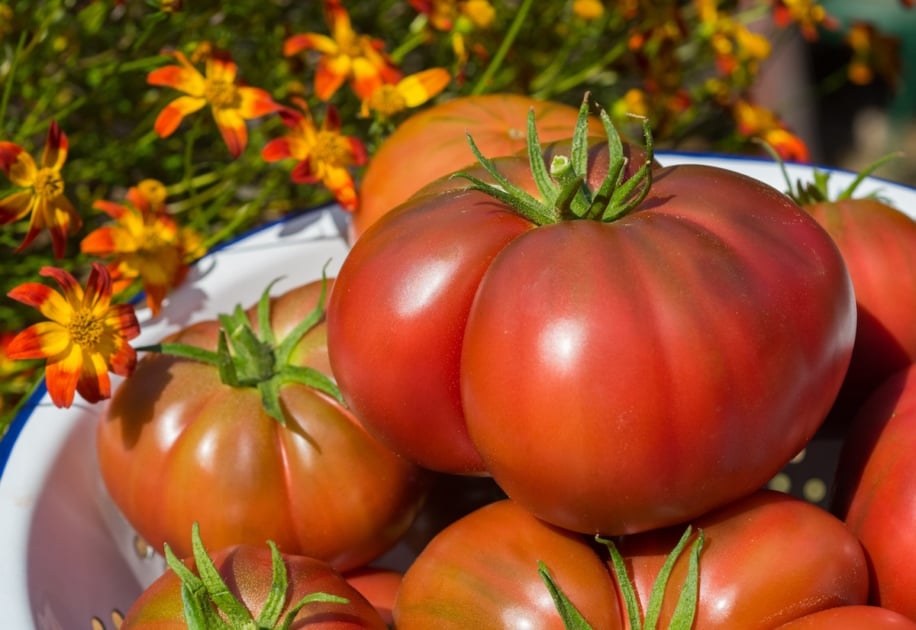
Every gardener who plants tomatoes faces the August glut. The vines that were polite in June are giving you ten pounds a week by mid-August, and the family has eaten so many BLTs they are starting to twitch. There are three reliable ways to preserve the harvest. Use one or use all three. By February you will be the most popular cook on the block.
Quick Reference
- Best for sauce all winter: water-bath canning.
- Best for soups, stews, and quick weeknight cooking: freezing whole or as puree.
- Best for pizza, pasta, and grain bowls: drying (oven or dehydrator).
- Quick freeze trick: wash whole tomatoes, freeze on a tray, transfer to bags. Skins slip off under warm water.
- Best for canning: paste varieties (Roma, San Marzano, Amish Paste). Lower moisture, thicker flesh.
- Storage life: frozen 6-12 months; canned 12-18 months; dried 6-12 months.
1. Convenience Preservation: Freezing
The fastest method. No special equipment, no special ingredients. Frozen tomatoes work for soups, stews, chili, sauces, and pretty much anything cooked. The texture suffers, so they are not for salads or fresh sandwiches, but for hot dishes they are nearly indistinguishable from fresh.
Whole frozen tomatoes:
- Wash tomatoes. Pat dry.
- Spread on a baking sheet in a single layer. Freeze 2 to 3 hours until solid.
- Transfer to freezer bags, label, and freeze up to a year.
- To use: run a frozen tomato under warm water for 10 seconds; the skin slips right off. Chop or use whole in cooking.
Tomato puree, frozen:
- Core and roughly chop tomatoes.
- Cook over medium heat 15 to 20 minutes until soft.
- Pass through a food mill or blender. Strain if you prefer no seeds.
- Cool. Pour into freezer bags (1 to 2 cups per bag). Freeze flat for easy storage.
2. Old Fashioned Water-Bath Canning
The classic. Sealed jars of whole or crushed tomatoes hold a year or more in the pantry and are ready for any sauce, soup, or chili you want to make. The tomato is acidic enough for water-bath canning (no pressure canner required), as long as you add a little extra acid (lemon juice or citric acid) for safety. The current USDA recommendation calls for 2 tablespoons of bottled lemon juice per quart of tomatoes.
Equipment: water-bath canner or large stock pot with rack, half-pint or pint or quart canning jars, two-piece canning lids, jar lifter, canning funnel.
Method:
- Wash jars and lids. Keep jars hot in the canner of simmering water.
- Blanch tomatoes 30 seconds in boiling water, then 30 seconds in ice water. Skins slip off.
- Core, peel, and roughly halve tomatoes.
- Pack into hot jars. Add 1 tablespoon bottled lemon juice per pint (2 tablespoons per quart). Add ½ teaspoon salt per pint (1 teaspoon per quart) if desired.
- Top with hot tomato juice or boiling water, leaving ½ inch of headspace.
- Wipe rims, seat lids, screw rings fingertip-tight.
- Process pints 40 minutes (quarts 45 minutes) in a rolling boil with jars covered by at least 1 inch of water.
- Cool 24 hours undisturbed. Check seals.
3. Drying
Dried tomatoes are concentrated flavor in a shelf-stable form. Use them in pasta, on pizza, in grain bowls, on cheese plates, or chopped into salad dressings. Oven or dehydrator both work.
Oven method:
- Slice tomatoes in half (Romas) or in ½-inch slices (slicers). Salt lightly.
- Spread on a parchment-lined baking sheet, cut side up.
- Bake at 200°F for 6 to 10 hours until leathery and dry to the touch but still pliable.
- Cool, store in airtight jars with a few sprigs of dried thyme or basil. For longer storage, cover with olive oil and refrigerate (use within 3 months).
Dehydrator method: 135°F for 6 to 10 hours, with slices on perforated trays.
Extra Time-Saving Tips:
Skip the peeling for sauce-style preservation. Run cooked, unpeeled tomatoes through a food mill; the mill catches skins and seeds in one pass. Roma and San Marzano tomatoes have thicker walls and lower water content; they are the right choice for canning and drying. Slicing tomatoes (Brandywine, Cherokee Purple) are better for freezing or fresh eating.
How Much to Put Up
A working pantry holds, per person, about 12 quarts of canned tomatoes (for sauces and stews), 6 to 8 pints of frozen puree or whole, and a pint of dried. For a family of four, that is roughly a bushel of tomatoes total. Plan to spend one Saturday in August on canning and a few smaller sessions on freezing and drying as the season runs.

Frequently Asked Questions
Is it safe to water-bath can tomatoes?
Yes, but you must add acid (2 tablespoons bottled lemon juice per quart, or 1 tablespoon per pint). Modern tomato varieties have been bred for lower acidity, and the extra acid ensures safe pH for water-bath canning.
Can I freeze tomatoes whole?
Yes. Wash whole tomatoes, freeze on a tray until solid, then bag. The skins slip off under warm water when you are ready to use them.
How long do home-canned tomatoes last?
Sealed jars are safe for years but flavor and texture are best within 12 to 18 months. Store in a cool, dark spot and rotate stock.
What is the best tomato for canning?
Paste varieties: Roma, San Marzano, Amish Paste. Thicker flesh, lower water content, and fewer seeds make for a cleaner pack and a richer sauce.
Can I freeze tomato sauce?
Yes. Cool the sauce completely, pour into freezer bags or rigid containers leaving 1 inch of headspace for expansion, freeze flat. Use within 6 months for best flavor.


Denise Dill
Denise Dill is a co-op livin', garden diggin', homegrown cookin' fool who creates soups of song out of local ingredients. She's currently working as a baker and soup maker while she completes culinary school. In the past, she worked as an urban gardener and community cooking educator. She has also toured the country as a folk musician, opening for such acts as Pamela Means and Hamell on Trial.

Haven’t had that happen.
What about the Water?
Salt?
Lemon Juice?
Just started using Lemon Juice because of all the new varieties. With all the great new versions of tomatoes, there seems to be tomatoes without as much acid.
I think the demand for less acidic tomatoes is because not a lot of people are canning to preserve. Many just eat tomatoes fresh.
I have canned tomatoes for years but this year my tomatoes have mold on them. Any help? I have no idea what happened and can’t find anyone locally who knows. They are still sealed.
If have Ex tomatoes let love to have my chop got hit bad by ..homework/and fungus /we use have some for winter ….so could me know ……
would like to know about frezing frest vegs since i just went and got a chest frezzer !!! thank you
Make ketchup salsa can them love to put up as much as posible mix veggies for soup
I am very interested in knowing other ways you can use cucumbers, besides pickling, Please Let Me Know!
We are almost done canning tomatoes for the year. So far, we have done 136 qts. and we have another 15-20 to do if we decide to continue doing them. We have been canning tomatoes for 30 years or better and there is nothing like tomato’s pureed and made into tomato sauce. Last year, we lost our entire tomato crop due to a hail storm in Central New York, so we had to do more then we normally do. We look forward to fresh tomato sauce during the cold winter months.
Hi, Don,
It had been awhile since I’d canned and decided to put up green beans. I did everything I’ve been taught to do, i.e. seals in hot water, got air out of jars after I packed them, wiped the lip of the jars off, etc. However…every jar had lost liquid in them. What did I do wrong? Are they safe to keep with the missing liquid? Also…I loaned my pressure cooker to a friend for her to put up potatoes. I’ve always kept the inside & out of canner spotless, never using it for anything but canning. When I got it back, the whole inside from the bottom, 1/3 of the way up was totally black! I used several SOS pads out and barely made a dent in it. What caused this? What can get it out?
Thank you so much for any advise, Pat
Don, Several years ago, we had large gardens and I canned. Recently, I bought green beans, got out canner and canned 8 qts. I got the air bubbles out, got seals out of the hot water & cleaned the lip of the jars before putting the seal & rings on. However…I lost liquid in every single jar. What did I do wrong? Will these green beans keep for a length of time without the top part in liquid??? Also, I loaned my canner to a friend. I kept it perfectly clean inside & out and never use it for anything but canning. When I got it back (she canned potatoes) the whole inside of my canner is black. I’ve scraped my fingers to the bone using SOS pads and could get only a little bit of it out. What caused that?
Thanks so much,
Pat
Hello Don,
Not everyone is fortunate enough to have a grandmother to learn old-time secrets from. So I really appreciated your comment! In fact, copied it to put in a book. I am compiling information in regarding preserving veggies from my garden this fall. Do you have any other “secrets” you would be willing to share to help insure my first (and hopefully not my last) canning experience? I sure would appreciate it! I am a firm believer in the old ways. Thanks!