

The Magic of Christmas: Reinvented Through Storytelling

Quick Reference: How Storytellers Invented Modern Christmas
- 1822: Clement Clarke Moore writes “A Visit from Saint Nicholas” (“The Night Before Christmas”) in New York City.
- 1843: Charles Dickens publishes A Christmas Carol in London, written in just 6 weeks.
- 1863 to 1886: Thomas Nast draws Santa Claus for Harper’s Weekly for 30 years, fixing the red-suit, white-beard image in American culture.
- Coined phrases: Dickens popularized “Merry Christmas” and “Bah! Humbug!” in the same book.
- The look of Santa: Nast added the North Pole workshop, Mrs. Claus, and the black boots.
- Why it stuck: Three works, one across the Atlantic from the other, gave the holiday its imagery and its greeting.
Almost every image you picture when you think of Christmas, the red suit, the reindeer on the roof, the snowy London street, the greeting itself, was written or drawn by three men in the nineteenth century. Two lived in New York. One lived in London. Between 1822 and 1886, they gave a modest religious holiday its modern face.
Here is the story of how a professor’s bedtime poem, a debtor’s son’s Christmas ghost story, and a political cartoonist’s pen invented the Christmas we celebrate today.
“The Night Before Christmas” Origins
In 1822, the Reverend Clement Clarke Moore, a literature professor at a theological seminary in New York City, wrote what many believe is the best-known poem in the English language, “A Visit from Saint Nicholas.” He wrote it for his own children. The poem, better known as “The Night Before Christmas” from its opening line, powerfully shaped the iconography of Santa Claus, his plump and jolly white-bearded look, his means of transportation, the names of his reindeer, and the tradition of delivering toys to boys and girls on Christmas Eve. On that night, families still read it aloud around the world.
The poem was first published anonymously on December 23, 1823, in the Troy Sentinel of Troy, New York. Moore did not publicly claim authorship until 1844, when he included it in a collection of his poems. According to the Library of Congress, the poem is one of the most reprinted works in American literature.
Listen to “The Night Before Christmas” in the following video:
Illustrations of a Jolly Old Elf
Later in the nineteenth century, another New Yorker, Thomas Nast, enlarged the image of Santa Claus with his artist’s pen and brush. Known as the Father of the American Cartoon, Nast remembered that when he was a little boy in southern Germany, every Christmas a fat old man handed out toys and cakes to the children. So when he sketched and painted Santa, his portraits looked like the kindly old man of his childhood.
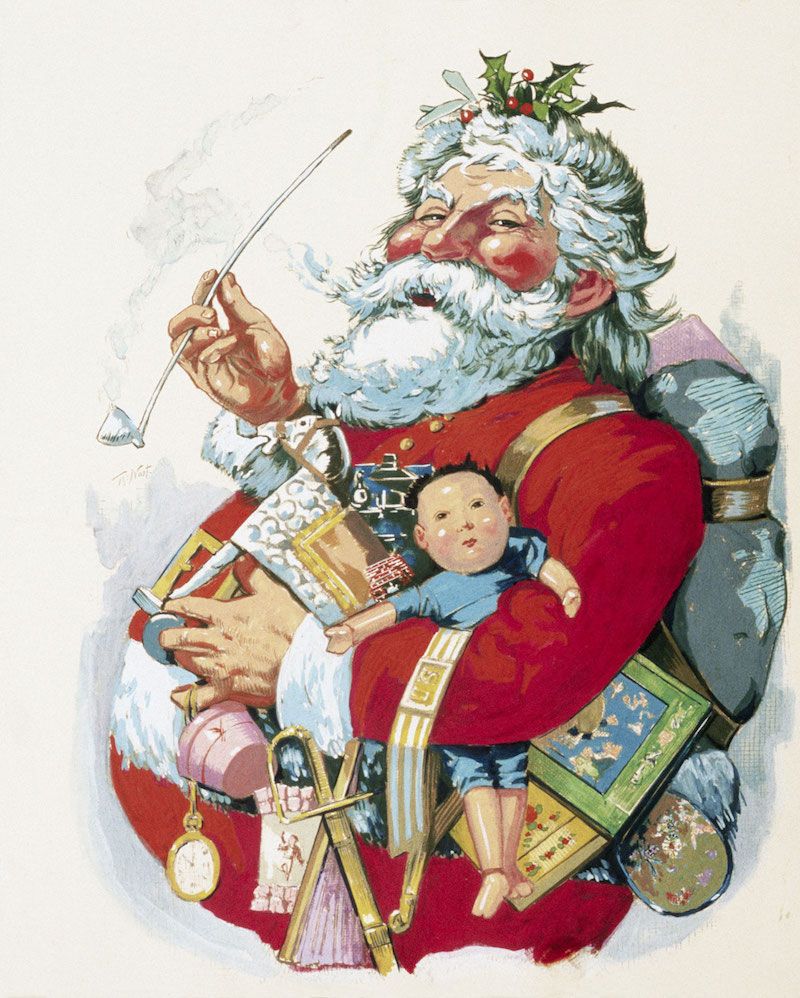
Santa Claus had been drawn many ways before Nast picked up his pen. Nast, influenced by the “right jolly old elf” of Moore’s poem, created the figure we know today. Over thirty years of drawing for Harper’s Weekly magazine, he baked into American culture his version of Santa: the jolly girth, the white beard and moustache, the bright red-and-white-trimmed coat, trousers, and hat, the black belt and boots, and the sack of toys. He also drew Mrs. Claus and set the Clauses’ workshop at the North Pole. Nast’s first Santa illustration appeared in Harper’s Weekly on January 3, 1863, during the Civil War, showing Santa distributing gifts to Union troops.
Charles Dickens and “A Christmas Carol”
Across the sea in England, Charles Dickens was born into an impoverished family. His father served a term in debtors’ prison, and Charles worked as a child laborer in a London boot-blacking factory. From unpromising origins, he rose to become the best-selling writer of his time and one of the most enduring and quotable writers of all time. The rags-to-riches life of Charles Dickens became more fantastic than any of his stories.
In 1843, in the brief compass of six weeks, Dickens gave the world A Christmas Carol. The influence of that Christmas present is towering. The story’s glowing message, the importance of charity and good will toward all humankind, struck a resonant chord in England and the United States and deepened the celebration of the holiday. Christmases in eastern England were rarely snowy, but Dickens’s backdrop of a blizzardy London in the Carol stuck with readers and helped shape our expectations of a “White Christmas.”
Today, we call anyone who is not in the Christmas spirit a Scrooge and toss out a sarcastic “Bah! Humbug!” Most of us know we owe those phrases to Charles Dickens, but hardly anyone realizes he also popularized the greeting “Merry Christmas.” Ebenezer Scrooge’s visiting nephew greets his uncle with it in the very first chapter. In all his curmudgeonly glory, Scrooge fires back: “‘Merry Christmas!’ What right have you to be merry? Every idiot who goes about with ‘Merry Christmas’ on his lips should be boiled with his own pudding and buried with a stake of holly through his heart!” After that scene, “Merry Christmas” lodged in readers’ minds and hearts. According to the British Library, the first print run of 6,000 copies sold out by Christmas Eve 1843.
Without Charles Dickens’s slim stack of messy manuscript pages that became A Christmas Carol, Christmas today might still be a relatively minor holiday with no snow, no carolers, and no large family gatherings for turkey dinners.
How the Three Stories Fit Together
Moore, Nast, and Dickens never worked together, but their contributions layer neatly. Moore gave Santa a personality and a job description. Nast gave him a face, a suit, and a home address at the North Pole. Dickens gave Christmas its emotional weight and its greeting. Take away any one and the modern holiday looks different.

Christmas Traditions the Storytellers Did Not Invent
For balance: Moore, Dickens, and Nast did not invent Christmas. The December 25 date, the tree, and the exchange of gifts predate all three by centuries. The Yule log came from pre-Christian northern Europe. The evergreen tree in the parlor is credited to sixteenth-century Germany, though its popularity in the English-speaking world took off after Queen Victoria and Prince Albert were sketched around one in the Illustrated London News in 1848. Christmas cards began the same decade, when Sir Henry Cole commissioned the first commercial Christmas card in London in 1843, the same year Dickens published the Carol.
What the three storytellers did was give an older, quieter holiday a common visual language and a warmer emotional register. They made it easier to picture, easier to celebrate together, and easier to greet a stranger with two words on a snowy street.
Related Articles
How to Pick a Christmas Tree: What to Look for on the Lot
Budget-Friendly Ways To Celebrate The Holidays This Year

Frequently Asked Questions About the Magic of Christmas
Who wrote “The Night Before Christmas”?
Clement Clarke Moore, a New York City literature professor, wrote it in 1822 for his own children. The poem was first published anonymously in the Troy Sentinel on December 23, 1823. Moore claimed authorship publicly in 1844.
Did Charles Dickens coin the phrase “Merry Christmas”?
Dickens did not literally invent the phrase, which had been used occasionally in earlier English writing, but he popularized it to the point that it became the standard Christmas greeting. In A Christmas Carol (1843), Scrooge’s nephew uses it in chapter one, and the greeting spread across England and America soon after.
Who drew Santa Claus in his red suit?
Thomas Nast, a German-born American political cartoonist, drew Santa for Harper’s Weekly from 1863 to 1886. He established the modern look: the jolly girth, the white beard, the red suit trimmed with white, the black belt and boots, and the sack of toys. He also added the North Pole workshop and Mrs. Claus.
How long did it take Charles Dickens to write “A Christmas Carol”?
Six weeks. Dickens wrote the entire novella in a burst between October and late November 1843, and it was published on December 19, 1843. The first print run of 6,000 copies sold out by Christmas Eve.
What are the names of Santa’s reindeer?
The eight reindeer named in “A Visit from Saint Nicholas” (1822) are Dasher, Dancer, Prancer, Vixen, Comet, Cupid, Dunder (later Donner), and Blixem (later Blitzen). Rudolph was added much later, in a 1939 booklet by Robert L. May for Montgomery Ward department stores.
Did Christmas trees start with these storytellers?
No. The evergreen tree in the parlor is credited to sixteenth-century Germany. Its popularity in the English-speaking world took off after Queen Victoria and Prince Albert were sketched around one in the Illustrated London News in 1848. That is a separate strand of the modern Christmas story.
Join the Discussion
Did you know that Charles Dickens coined the phrase Merry Christmas?
What did you learn from this article today?
Let us know in the comments below! We would love to hear from you.


Richard Lederer
Richard Lederer is a writer, speaker, and teacher best known for his books on word play and the English language and is a regular contributor to the Farmers' Almanac. You can visit his web site at Verbivore.
- Richard Lederer



Such an enjoyable and informative article. Thank you!
It’s interesting because I thought I knew more about the beginnings of Christmas, but I learned so much more after reading this! It’s also interesting to note that some of my friends and acquaintances do not like to say ‘Merry Christmas’ because they think it’s a religious sentiment, and not wanting to take part in a ‘religious festive’ experience. They would rather say Happy Holidays. But after reading this, ‘Merry Christmas’ and jolly old Saint Nick come from the imaginations of regular folk who had the gift of writing and giving joy. For me, Christmas was always about family gathering and delicious food. Yes, we always went to church, yet the sentiment of togetherness, and goodwill can be a shared experience no matter where a person comes from or what they believe. I really enjoyed this article, and the Michael Buble ‘Night Before Christmas’ video was beautiful ❤️
It’s deepened my respect that much more of the origins of Saint Nick and Merry Christmas. Thank you!
Thank you! Merry Christmas to you!
I second that!
Today, most of my British friends say “Happy Christmas” exclusively. Do we know when or how “Merry” became “Happy”?