

June Flower Lore: Rose and Honeysuckle Meanings
Quick Reference: June Flower Lore
- June birth flowers: the rose and the honeysuckle.
- Rose meaning: love overall, with each color carrying its own message, from red for true love to yellow for friendship.
- Honeysuckle meaning: affection, happiness, and the sweetness of new love, without the thorns.
- Folklore note: the rose is the flower of secrecy, the root of the Latin phrase sub rosa.
- Best for gifting: a bouquet of both blooms suits any June occasion, and June is the most popular month for weddings.
June flower lore runs deeper than almost any other month on the calendar. The month claims two birth flowers, the rose and the honeysuckle, and between them they carry centuries of mythology, color symbolism, and old garden superstition. Below we look at why the rose became the go-to symbol for love, how it is rooted in folklore around the globe, what the difference in meaning is between pink roses and the other color varieties, and where the sweet-scented honeysuckle fits in. Discover what lies beneath these traditional beauties, including the rose’s odd origin story and a few helpful growing tips. Jump to Rose Meaning
The Two June Birth Flowers at a Glance
Most months get one birth flower. June gets two. The rose takes the spotlight, but the honeysuckle stands right beside it as the recognized alternative. Here is how the pair compares before we get into the lore behind each one. If you want to plant your own, see our guide on how to grow a birth flower garden, and pair it with June’s birthstone, the moonstone.
| Rose | Honeysuckle | |
|---|---|---|
| Standing | The official June birth flower | The recognised alternate |
| What it means | Love, with each colour carrying its own message: red for true love, yellow for friendship | Affection, happiness and the sweetness of new love |
| Folklore note | The flower of secrecy, and the root of the Latin sub rosa | Sweetness without the thorns, which is much of its appeal as a gift |
| In the garden | Wants sun, airflow and yearly pruning | Vigorous and scrambling. Give it something to climb |
| Best for gifting | The safe choice for any June occasion | The quieter one, and a good pairing rather than a replacement |
About Rose
The word “rose” calls up glorious full blooms, rich deep fragrances, and passion, both for the flower itself and for its common symbolism. Today there are roughly 300 to 350 Rosa flower species, with more than 10,000 types, depending on how individual plants are classified.
All types are commonly called roses. Unlike many other flowers, there is no other overall name for these woody perennials beyond the “Queen of Flowers,” though there are many individual common names for distinct varieties.
Roses evolved 33 to 23 million years ago in the northern hemisphere, and they grow wild in North America, Europe, and Asia. All roses are typically colorful, highly fragrant, deciduous plants with oval-shaped serrated leaves. Many roses have thorns, which are actually “prickles” in botanical terminology, hard and sharply pointed outgrowths of the stem. Depending on the variety, roses can be shrubs or bushes, climbing or trailing vines, or even dwarf or miniature plants.
There are three types of roses generally recognized today:
- Wild (or species) roses: Naturally evolved plants that do not look too similar to florist shop roses, but they do come in classic pink shades and showcase 4 to 8 lovely petals.
- Old garden roses: Historically cultivated rose varieties first introduced prior to 1867, often more fragrant and hardier than newer roses.
- Modern garden roses: Introduced after 1867, these roses often showcase larger blooms but may sacrifice fragrance. These newer variations may not yet have developed the same resistance to diseases and pests as older rose varieties.
There is no one specific, exact type of rose formally known as the June birth flower, but during the month of June in the northern hemisphere, many different rose variations come into full, glorious bloom. That makes them an ideal symbol for the month and a fine way to celebrate the beauty of early summer.
Related Product: June Birthstone – Moonstone Necklace
Rose Symbolism
While the fossil record, the history of floriculture, and generations of rose lovers tell us the natural origin of these blooms, ancient legends offer a far more fantastical beginning.
According to Greek mythology, Chloris, the goddess of flowers, breathed life into a woodnymph and created the rose. Dionysus, the god of plant life, gave the bloom its heady scent, and Aphrodite, the goddess of beauty, named the flower after her son Eros, the god of love and desire. In Roman mythology the same origin story is told with the Roman variations of those gods and goddesses, Flora, Bacchus, Venus, and Cupid.
Another Greek origin of the rose ties the boldly red flower to the tears of Aphrodite and the blood of her lover Adonis, while some Christian origin legends link the red rose with the blood of Christ and white roses with the tears of the Virgin Mary.
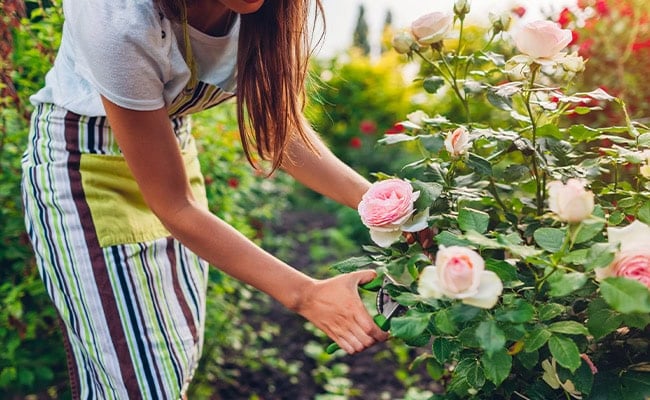
What Does Each Rose Color Mean?
The colors of roses lend much to the symbolism and meaning of this flower beyond its origins. In the language of floriography, where each type of flower and each flower color carries a unique meaning, roses mean love overall, but different colors represent different kinds of love along with other emotions and expressions.
- Classic red roses: Passionate, romantic, true love and devotion.
- Dark red roses: Intense passion, mourning.
- White roses: Motherly love, divine love, innocence, youth, purity, sympathy.
- Yellow roses: Friendly love, platonic caring, sympathy.
- Pink roses: Young love, innocent crush, femininity, gratitude.
- Peach roses: Friendly love, gratitude.
- Orange roses: Exciting passion, new love, creativity, pride.
- Purple roses: Enchanting love, royalty.
- Green roses: Freshness and new love, hope, fertility.
- Blue roses: Hidden love, mystery.
- Black roses: Mourning, lost love.
Any questions? Contact [email protected]
It is worth noting that no green, blue, or pure black roses exist in nature. Green and blue flowers are dyed, as are pure black roses. Some very dark shades of red and burgundy do exist, however, and can read as black roses, especially as buds.
Rainbow roses are also a popular dyed rose, with vibrant colors on different petals. These flowers can mean just about anything the giver or recipient wants, but they often carry a more playful and energetic feeling such as joy and happiness. Any mixed bouquet of different colored roses can represent both the combined meanings of the different hues and a sense of unity as the colors blend together into a lovely arrangement.

Rose Symbolism Around The World
Rose symbolism and meaning go far beyond love and romance. Greek mythology, in fact, still gives the rose a secret meaning today.
After its creation by the gods, Eros took a rose and gave it to Harpocrates, the god of silence, to ensure he would keep the gods’ secrets and not share them with mortals, particularly the secrets of Aphrodite. This association between roses and secrecy shows up in historical carvings in courtrooms, council chambers, Catholic confessionals, and other places where discretion is expected. If a rose is not carved into the lintels or furnishings, it may be part of a plaster ceiling decoration, or a real rose may be placed in the room or hung from the ceiling for all to see and note the expected confidentiality. This is the origin of the New Latin phrase sub rosa, meaning secrecy.
Beyond its mentions in Christian mythology, the rose appears in other faiths too, particularly Islam, Buddhism, and Confucianism, often with similar associations. In Islam the rose is said to represent both the Prophet Muhammad and love. In ancient Egypt roses were associated with the goddess Isis and often used in funeral rites. Archeologists have even found roses in ancient tombs as part of mummification.
The rose is the symbolic flower of the fifteenth wedding anniversary, while the yellow rose specifically marks the fiftieth wedding anniversary. Of course, roses make an ideal anniversary gift for any year given their connection to love, especially for June anniversaries. June is one of the most popular months for weddings, and roses are the most popular flower for wedding bouquets.
Psst … Planning a wedding? See Farmers’ Almanac Best Days to Get Married.
It is no surprise that a flower as widespread and recognizable as the rose has been put to many symbolic purposes, especially in heraldry and insignias. The rose is featured in some way on dozens of coats of arms, including those of Bournemouth, Calgary, Finland, Grenada, Montreal, and Saint Lucia, among many other cities, noble houses, and royalty.
The rose is also the official state flower of Iowa, North Dakota, Georgia, New York, Oklahoma, and Washington, DC, as well as the official provincial flower of Alberta, Canada.
Roses Of The Rich And Famous
It is not just ancient cultures and nobility that have venerated June’s birth flower, the rose. These flowers have stayed popular among celebrities in more recent history and right into our modern culture.
Cleopatra VII (Thea Philopator) was said to favor roses, wearing them for public appearances so her subjects would associate her reign with the sweet-smelling bloom. Centuries later, Josephine Bonaparte, wife of Napoleon, cultivated an extensive rose garden believed to have held more than 250 distinct types of roses.
In the United Kingdom, roses have long been tied to noble houses and royalty. White roses were the favorite of Eleanor of Provence, wife of King Henry III in the mid to late 1200s, as well as of Richard, Duke of York two centuries later in the mid-1400s. Because of heraldry tied to the principal houses, roses became highly symbolic for the civil wars surrounding the English throne from 1455 to 1487, commonly known as the Wars of the Roses. Even today, roses are still associated with the British monarchy, with special cultivars named for many royal figures. The Queen Elizabeth rose was introduced in 1954 in honor of the queen’s coronation, and additional roses have been named for Princess Anne, William and Catherine, Princess Alexandra of Kent, Queen Victoria, Diana Princess of Wales, Princess Alice, the Duke of Edinburgh, and more.
Today, dozens upon dozens of rose cultivars are named for celebrities and notable figures who may hold royal stature in society even without official royal titles. Julia Child, Barbra Streisand, Bing Crosby, Elizabeth Taylor, Marilyn Monroe, Abraham Lincoln, Dolly Parton, Freddie Mercury, Mozart, Caesar, Leonardo da Vinci, and countless other celebrities and powerful personalities have roses named for them.
Roses In Art And Literature
It is no surprise that roses have long been favorites in art, literature, poetry, songs, and more. There are countless still life photographs of roses and rose bouquets, but roses have also been painted in master works by Van Gogh, Renoir, and others. See Van Gogh’s “Roses” at the National Gallery of Art here.
In literature, roses have had memorable mentions in the works of Oscar Wilde, Shakespeare, Robert Burns, William Faulkner, and Emily Dickinson. Few can forget the iconic line in Romeo and Juliet, “A rose by any other name would smell as sweet,” and many other popular works reference these flowers.
For more modern tastes, roses turn up in movies, television shows, and music. The magical rose from Beauty and the Beast, the roses handed to contestants on The Bachelor, the rose sigil of the House of Tyrell on Game of Thrones, and the rock ballads of Guns ‘n Roses are just a few of countless examples.
Roses In Our Daily Lives
You do not have to be any kind of celebrity to enjoy roses, and these blooms are part of everyday life in countless ways. The fragrance of a rose is popular in aromatherapy through incense, candles, perfumes, and essential oils, and roses also show up on greeting cards, fashionable prints, and knick-knacks of all kinds.
Roses have featured in a wide range of jewelry, and the rose cut diamond is an older shape with facets that mimic the symmetry of an opening rose bud. Rose motifs were especially popular during the Edwardian and Victorian jewelry eras, when flowers, vines, and other romantic accents appeared often on rings, brooches, pendants, and other pieces.
Beyond their beauty, roses have had both medicinal and culinary uses over the centuries. With a light flavor reminiscent of green apples or strawberries, roses have gone into jams and jellies, custard, sorbet, and teas. Roses can also be worked into butter or salt, sugared petals make lovely decorations for cookies and cakes, and they are good in salads and granolas for a unique, unexpected flavor.
Medicinally, roses, particularly rose hips, have a variety of applications with varying success. Roses and rose hips have been used to treat kidney ailments, digestive disorders, ulcers, acne, nausea, and memory loss. These flowers are thought to boost immunity and may have anti-inflammatory properties that help with arthritis and joint problems.
But take care, because even everyday roses come with common superstitions. If you are cutting a rose, be sure no petals fall to the floor, or you may be in for bad luck. On the lucky side, if you dream of a red rose, you will meet good luck and find success in love. Your fortunes may reverse if you see a white rose blooming for the second time in late summer or early autumn, which can portend bad news or misfortune.
The Name Rose
For some people, the roses they meet most every day are the people they know named Rose. The name Rose was most popular in the early 1900s, when it sat in the top 50 of all names in the United States. Today the name ranks in the mid-70s and has been on the rise since 2010.
Familiar real-life Roses include Rose Kennedy, mother of President John F. Kennedy; actress and activist Rose McGowan; Rose Wilder Lane, journalist and daughter of author Laura Ingalls Wilder; comedian and talk show personality Rosie O’Donnell; and Rose Leslie, the actress who played the fierce wildling Ygritte on HBO’s hit show Game of Thrones.
Fictional Roses can be just as memorable, including Rose DeWitt Bukater from James Cameron’s Titanic; Rose Tyler of Dr. Who; spunky Rose Nylund from The Golden Girls; Rosie the robot maid in The Jetsons; Rose Tico from the Star Wars universe; and Rosalie Hale from the Twilight Saga.
One of the most iconic Roses of the last century is surely Rosie the Riveter, the poster gal for doing one’s part and supporting the working war effort in World War II, originally designed by Norman Rockwell.
Along with the classic name Rose, popular variations include Rosie, Rosanna, Roseanne, Rosalie, and Roselyn. Even traditionally male names such as Rhodes, Rosen, and Raushan are variations on Rose.
Growing Roses
No matter what you love most about roses, their mythology and folklore, the color symbolism of the blooms, their aroma, their medicinal or culinary uses, or their celebrity status, growing roses can be a rewarding addition to any garden or landscape. These flowers were first cultivated in China roughly 5,000 years ago, and today there are types of roses that can flourish in nearly any hardiness zone, so select a cultivar that will do best in your climate and region.
Roses prefer sunny locations, as 6 to 8 hours of sunlight per day will create the most luxurious blooms, though in southern areas a little late afternoon shade can keep roses from scorching. The soil should be slightly acidic and richly organic with good drainage, and a slow-release fertilizer can keep roses nourished through the bloom season. Most roses should be pruned in the spring to keep their shape, but they can be groomed year-round, and deadheading can encourage some varieties to rebloom in greater abundance.
Because roses are subject to powdery mildew, black spot, aphids, spider mites, and similar funguses and pests, it is important that plants are spaced well enough apart to have adequate air circulation. Good spacing minimizes problems and makes pruning and shaping easier.
Roses do not like damp foliage, and a soaker hose or drip system is best for watering them evenly. One inch of water per week is ideal for roses, but adjust any automatic watering systems if Mother Nature provides an unscheduled drink.
When cutting roses, choose blooms that are just beginning to open for the most longevity in a flower arrangement. Make cuts at an angle with a very sharp tool so you do not crush the flower’s circulation. Cutting flowers in the morning or evening, when they are cooler, yields the best results.
Remove the lower foliage from cut roses but leave as much upper foliage intact as possible to improve water uptake. Place them in lukewarm water. Changing the water and recutting the stems every 2 to 3 days will keep cut roses alive and luxurious as long as possible.
If you are not quite ready to grow your own roses, there are many outstanding rose gardens to enjoy, the largest of which is the Fineschi rose garden in Cavriglia, Italy with more than 6,500 rose species. For a truly historic rose, visit the Rose of Hildesheim at the Hildesheim Cathedral in Germany, a wild dog rose that has grown on the cathedral’s eastern apse for roughly 700 years, including surviving the cathedral’s destruction in 1945 during World War II.
Alternate June Birth Month Flower: Honeysuckle
With so much history, mythology, and floriculture behind the rose, it is no surprise that it is the June birth month flower. What surprises many people is that June claims a second birth flower, the honeysuckle. The sweet scent of this bloom can be just as lovely as the rose, but without the thorns.
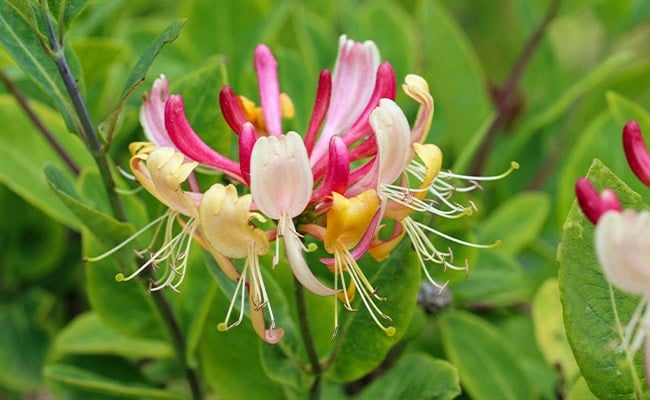
There are more than 180 types of honeysuckle, all native to the Northern Hemisphere, with different varieties found across North America, Europe, and Asia. Along with their alluring aromas, honeysuckles produce abundant nectar, which makes them a favorite for bees, butterflies, and hummingbirds.
Like roses, honeysuckle carries symbolic meaning connected to love. While not as passionate as roses, honeysuckle can mean affection, happiness, and the sweetness of new love, and the flower carries more nostalgic, youthful connotations. As with roses, the color of the flower can add nuance to the meaning, with white evoking innocence and purity, yellow representing friendship, pink showing a playful side, and red standing for more intense love.
A variety of legends surround honeysuckle, such as the Celtic mythology that uses honeysuckle to symbolize a loving or devoted embrace, since honeysuckle vines firmly twine themselves about the plants they use for support. Similarly, in both Chinese and French cultures, honeysuckle represents friendship and the connection between people.
Honeysuckle and rose are both sweet and symbolic options for the June birth month flower, and while the rose may be more prominent, a bouquet of both blooms could be a stunning and highly meaningful gift for any June occasion. June’s full Moon is the Strawberry Moon, so check the full Moon calendar while you plan. Which flower would you prefer? Comment below with your thoughts on the rose or your preference for honeysuckle.

June Flower Lore: Frequently Asked Questions
What are the June birth flowers?
June has two birth flowers, the rose and the honeysuckle. The rose is the better known of the pair and stands for love, while the honeysuckle is the recognized alternative and stands for affection and the sweetness of new love.
What does the June rose symbolize?
Roses mean love overall, but the meaning shifts by color. Red roses stand for true love and devotion, white for purity and sympathy, yellow for friendship, and pink for young love and gratitude. In Greek mythology the rose is also the flower of secrecy, the root of the Latin phrase sub rosa.
Why is the rose the June birth flower?
There is no single exact type of rose named the June birth flower. Roses earn the title because so many varieties come into full bloom across the northern hemisphere during June, which makes them a natural symbol for the beauty of early summer.
What does honeysuckle mean as a June birth flower?
Honeysuckle stands for affection, happiness, and the sweetness of new love, with nostalgic and youthful overtones. In Celtic lore it symbolizes a devoted embrace, since the vine twines tightly around its support, and in Chinese and French traditions it represents friendship.
What does each rose color mean?
In the language of floriography, red roses mean true love, dark red intense passion or mourning, white innocence and sympathy, yellow friendship, pink young love and gratitude, peach gratitude, orange new love and pride, purple enchantment and royalty, and blue hidden love. Green, blue, and pure black roses do not occur in nature and are dyed.
Are there superstitions about roses?
Yes. Folklore says that if petals fall to the floor while you cut a rose, bad luck may follow, while dreaming of a red rose points to good luck and success in love. A white rose blooming a second time in late summer or early autumn was taken as a sign of misfortune.
Join The Discussion
Which June birth month flower do you prefer: rose, honeysuckle, or another?
Did anything surprise you about rose symbolism and meaning?
Share your thoughts, tips, and tricks in the comments below.


Melissa Mayntz
Melissa Mayntz is a writer who specializes in birds and birding, though her work spans a wide range—from folklore to healthy living. Her first book, Migration: Exploring the Remarkable Journeys of Birds was published in 2020. Mayntz also writes for National Wildlife Magazine and The Spruce. Find her at MelissaMayntz.com.
- Melissa Mayntz

- Melissa Mayntz
- Melissa Mayntz
- Melissa Mayntz


Gostei do seu poste, existe muitos artigos em seu blog relacionado a este que acebei de ler gostei de seu blog.
Oh my gosh! My roses were looking poorly, and I read to put banana water on them. So I added chopped up peels from 3 bananas, added them to a gallon of water, let them sit for a few days, and poured some at the bottom of all 5 roses (different types). The results are amazing! They are all looking healthy and blooming. That was about a month ago. I’m going to make another batch today.
nice