A New Interstellar Comet Is Incoming: What Astronomers Have Found
We are being visited by a comet from another solar system. Here’s why it’s historic and what to expect.
Quick Reference: Interstellar Comets
- Three confirmed: 1I/’Oumuamua (2017), 2I/Borisov (2019), and a third (2024).
- Origin: ejected from another star system, passing through ours.
- Speed: too fast to be captured by the sun’s gravity. They visit once and leave.
- Telltale sign: hyperbolic orbit (not elliptical).
- Estimated total: about 7 interstellar objects pass through the inner solar system each year, but most are too small to detect.
Interstellar comets are visitors from other star systems, passing through our solar system on hyperbolic orbits that mean they will never return. Only three have been confirmed so far, and each has produced groundbreaking science about what other planetary systems look like. Here is what astronomers have learned, and the newest interstellar comet on the watch list.

What Makes a Comet Interstellar
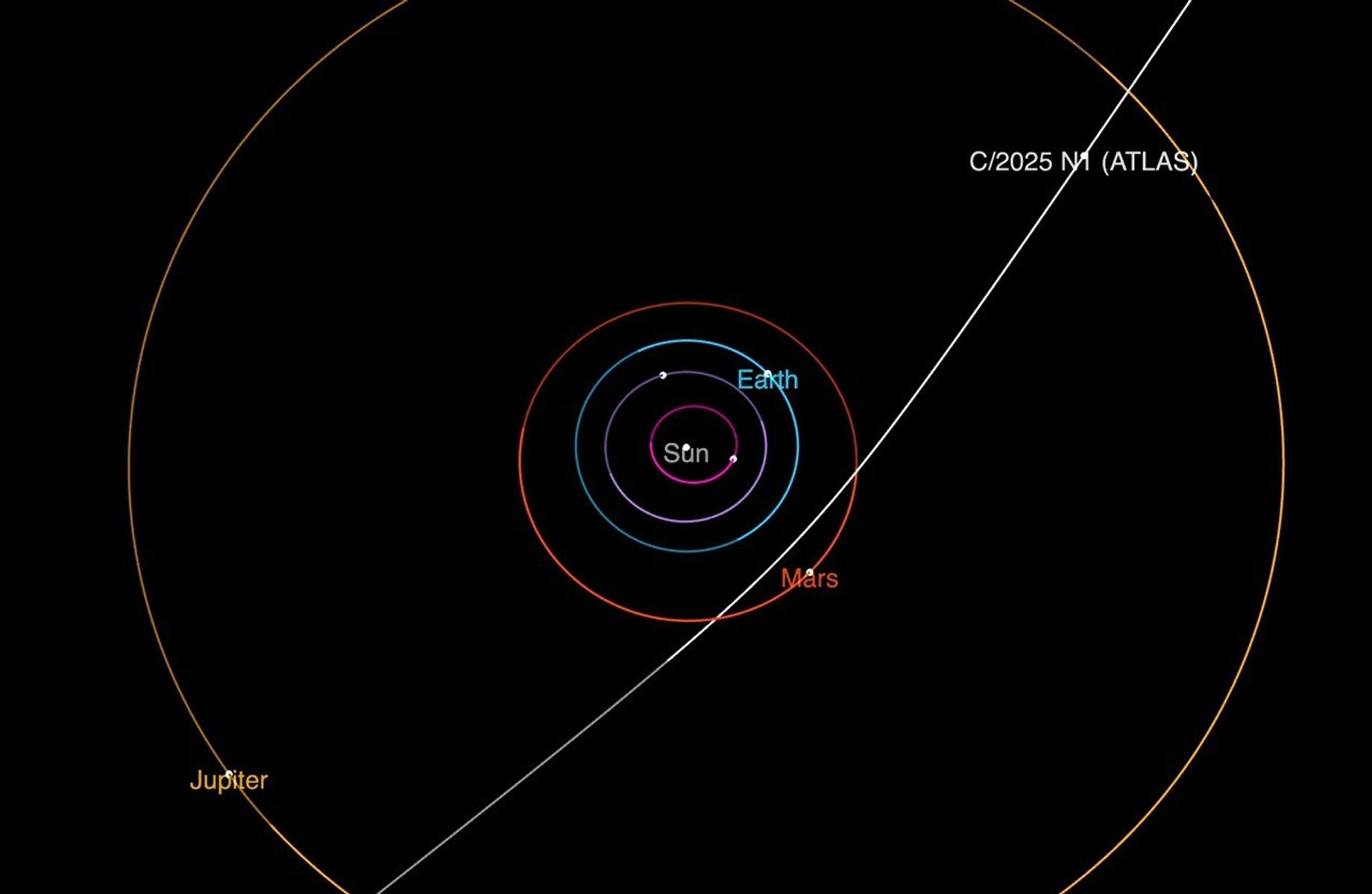
Most comets in our solar system are gravitationally bound to the sun, traveling on elliptical orbits that bring them back periodically (every few years to every hundred thousand years). An interstellar comet is on a hyperbolic orbit, traveling fast enough that the sun’s gravity can’t trap it.
Hyperbolic orbits are unmistakable in the math. When an astronomer plots a comet’s trajectory and gets a hyperbola, the object came from outside our solar system.
The Three Confirmed Visitors
Each confirmed interstellar object has been a scientific surprise.
- 1I/’Oumuamua (2017): the first confirmed interstellar object. Cigar-shaped, no visible tail. Origin is still debated.
- 2I/Borisov (2019): the first confirmed interstellar comet with a normal cometary tail. Spectroscopy showed unusual chemistry, especially high carbon monoxide.
- 3I/ATLAS (2024-2025): the newest confirmed interstellar visitor, on a clearly hyperbolic orbit. Astronomical study ongoing.
What Astronomers Are Learning
Each interstellar comet gives astronomers a direct sample of another star system’s chemistry. The chemical composition tells what conditions existed where the comet formed. So far the early findings: other planetary systems are chemically diverse, not all like ours.
The Vera Rubin Observatory (which began full operations in 2025) is expected to detect dozens more interstellar objects each year, finally giving astronomers a large enough sample to study patterns.

Frequently Asked Questions
How rare are interstellar visitors?
About 7 are estimated to pass through the inner solar system each year, but most are too small to detect. Only three have been confirmed as of 2025.
Could one hit Earth?
Extremely unlikely. Interstellar objects pass at very high speeds and are not gravitationally bound to the sun. The chance of a direct hit is similar to a random asteroid strike, which is rare.
Why is the third one (3I/ATLAS) special?
Each new interstellar comet provides new data on the chemistry and physics of other planetary systems. Number three has unique spectroscopic features still being analyzed.
When will the next interstellar comet be discovered?
Probably within 1-2 years. The Vera Rubin Observatory dramatically expanded the discovery rate starting in 2025.



Dean Regas
Dean Regas is an astronomer and author of seven books including 100 Things to See in the Night Sky and How to Teach Grown-Ups About Pluto and host of the popular astronomy podcast Looking Up with Dean Regas. He can be reached at: www.astrodean.com

This article was published by the Staff at FarmersAlmanac.com. Any questions? Contact us at [email protected].
-
Farmers' Almanac Staff

-
Farmers' Almanac Staff

-
Farmers' Almanac Staff

-
Farmers' Almanac Staff