
Why Can Owls Turn Their Heads So Far Without Hurting Themselves?

Watch an owl sitting on a branch, and you might see it do something that looks almost impossible. Without moving its body, the bird slowly turns its head to look behind itself. Then it keeps turning, until its face seems to be looking in completely the wrong direction.
It’s an extraordinary sight, especially around Halloween, when owls are already associated with all things mysterious.
But there’s nothing supernatural about this particular trick. Owls have remarkable adaptations that allow them to rotate their heads much farther than humans can without damaging their necks or interrupting the blood supply to their brains.
And scientists have discovered that the secret involves more than just an unusually flexible neck.
How Far Can Owls Really Turn Their Heads?
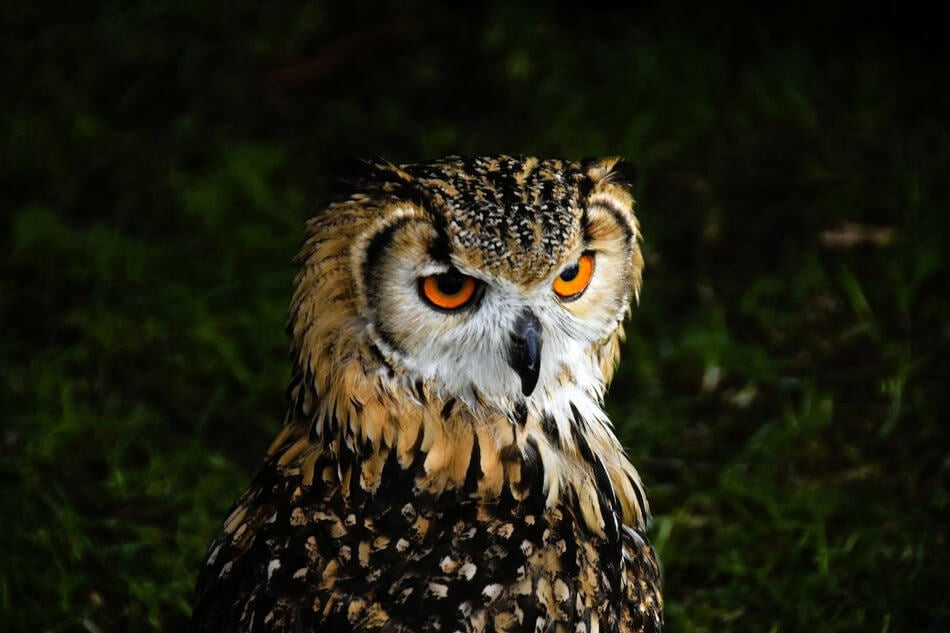
Owls can rotate their heads up to approximately 270 degrees in either direction. That’s three-quarters of a full circle.
It’s an impressive feat, but it doesn’t mean they can spin their heads completely around.
According to the Cornell Lab of Ornithology, owls can’t perform a full 360-degree rotation, despite what you may have heard.
To picture the difference, imagine an owl facing straight ahead. It can turn its head to look directly behind itself, then continue rotating until its face points almost over the opposite shoulder.
Humans, by comparison, can generally turn their heads only about 90 degrees to either side.
Trying to match an owl’s range of motion would be dangerous for us. Our necks and blood vessels simply aren’t built for that much twisting.
Why Do Owls Need to Turn Their Heads So Far?
The answer begins with their eyes.
Unlike humans, owls can’t move their eyes around freely inside their sockets. Their large, somewhat tube-shaped eyes are held in place by structures within the skull.
That arrangement helps provide excellent forward-facing vision, but it creates a problem. If an owl wants to look to one side, it can’t simply glance over the way you or I would.
It has to turn its entire head.
The National Audubon Society explains that owls also make small head movements to help judge the position and distance of objects around them, including potential prey.
For a hunting bird that needs to locate movement while keeping its body still, being able to turn its head so freely is especially useful.
And fortunately, its neck is built for the job.
Owls Have Twice as Many Neck Bones as Humans
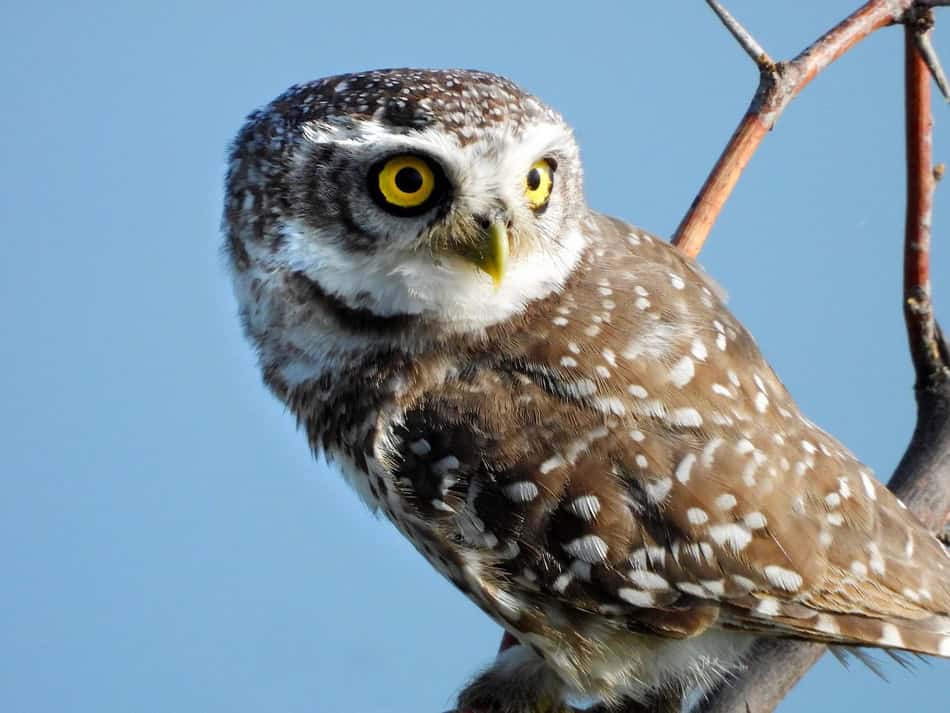
Here’s one of the biggest differences between your neck and an owl’s.
Humans have seven cervical vertebrae, the small bones that make up the neck. Most owls have 14.
Those additional bones help provide the extraordinary range of movement that allows an owl to look so far around.
But having extra vertebrae only solves part of the mystery.
Think about what would happen if you tried to twist your head almost all the way around. Even if your neck bones could somehow move that far, the blood vessels running through your neck could stretch, tear, or become compressed.
That could interrupt blood flow to your brain, with potentially devastating consequences.
So how do owls avoid that problem?
Researchers at Johns Hopkins University decided to investigate.
Scientists Discovered a Remarkable Blood Supply System
In a study reported in 2013, researchers examined the anatomy of 12 owls, using medical imaging and detailed illustrations to understand how their necks and blood vessels handle extreme rotation.
Their findings, reported by Johns Hopkins University, revealed several adaptations that help protect the birds from injury.
For one thing, certain arteries run through unusually spacious openings in the owls’ neck bones. Those openings give the blood vessels more room to move as the neck twists, reducing the chance of their being pinched or damaged.
The researchers also found that arteries near the base of the head can widen into small reservoirs. These may help maintain blood flow during extreme head movements.
And owls have connections between blood vessels that can provide alternate routes for blood to reach the brain if one pathway becomes restricted.
Together, these adaptations help explain how an owl can turn its head so dramatically without suffering the kinds of vascular injuries that would threaten a human.
It’s an elegant piece of anatomy, hidden beneath all those feathers.
Can an Owl Turn Its Head Too Far?
An owl’s neck is remarkably flexible, but that doesn’t make it indestructible.
Its bones, muscles, ligaments, and blood vessels are adapted to allow movements that would be dangerous for us. That doesn’t mean its head can rotate endlessly or that the bird is immune to neck injuries.
And despite what a particularly dramatic video might suggest, an owl doesn’t rotate its head through a continuous 360-degree circle. It turns within its natural range of motion and changes direction when needed.
The important distinction is that these movements are normal for the owl. What looks uncomfortable to us is simply part of how the bird observes its surroundings.
The Next Time You See an Owl, Watch Its Head
Owls have inspired centuries of stories about wisdom, mystery, and the supernatural. Their enormous eyes, quiet movements, and habit of appearing unexpectedly in the dark certainly help explain why.
But their real anatomy is every bit as fascinating as the legends.
Behind that almost impossible head turn are extra neck bones, specialized blood vessels, and a system that helps keep blood flowing to the brain.
So the next time you see an owl slowly turning its head to watch something behind it, remember that you’re witnessing one of nature’s more extraordinary engineering feats.
And if you’re tempted to try the same trick, don’t. Some talents are best left to the owls.

- Maggie Konrad

- Maggie Konrad
- Maggie Konrad
- Maggie Konrad