Why Do Thousands of Birds Suddenly Gather Into Giant Flocks in Fall?

You’re outside on a fall evening when something unusual catches your eye. Hundreds of birds are gathering overhead, then hundreds more. Within minutes, the sky seems to fill with them. The entire flock sweeps in one direction, suddenly changes course, and folds back on itself like a dark cloud caught in the wind.
It’s a remarkable sight, especially when thousands of birds appear to move as though they’re all following the same invisible instructions.
These enormous gatherings become particularly noticeable in fall and winter, when many birds leave their breeding territories and begin spending more time together. Some are preparing for seasonal journeys, others are searching for food, and many gather at communal roosts where they’ll spend the night.
But those spectacular, swirling formations have a name of their own: murmurations. They’re most famously associated with starlings, and scientists have spent years studying how the birds manage to perform such complicated maneuvers without crashing into one another.
The explanation is even more fascinating than the spectacle.
Why Do Birds Gather in Such Large Flocks in Fall?
During spring and summer, many birds are busy defending territories, finding mates, building nests, and raising their young. But once breeding season ends, the rules change.
For some species, there’s no longer much reason to defend a private patch of territory. Young birds have joined the population, and gathering with others can offer advantages as temperatures fall and food sources change.
Flocking also provides protection. A lone bird is easier for a hawk or falcon to single out than one moving among hundreds of others. More birds may also mean more eyes watching for danger.
In other cases, birds gather because they’re heading toward the same food supply or nighttime resting place.
The Cornell Lab of Ornithology notes that communal roosts are common among species such as crows, robins, starlings, and blackbirds, particularly outside the breeding season. For crows, these gatherings are especially characteristic of fall and winter.
That helps explain why a neighborhood that seemed relatively quiet all summer might suddenly host a noisy congregation of birds in October or November.
Not every large flock is migrating. Some birds remain in the same general area throughout the year, while others travel considerable distances. What you’re seeing may simply be hundreds of local birds assembling for the night.
What Is a Starling Murmuration?
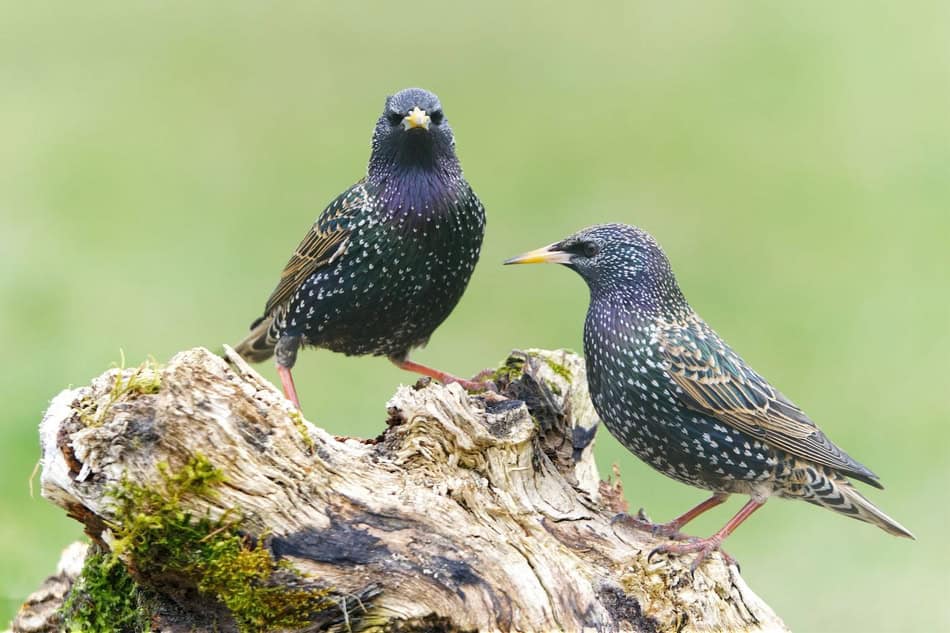
A murmuration is the mesmerizing aerial display created when a large flock of starlings flies in a tightly coordinated group. The birds twist, dip, rise, and change direction so quickly that the flock seems to have a life of its own.
One moment, it resembles a long ribbon stretched across the sky. The next, it contracts into a dense ball before spreading into an entirely different shape.
European Starlings are especially well known for this behavior. Despite their name, they’re now common throughout much of North America, where they were introduced during the nineteenth century.
According to the Cornell Lab of Ornithology, starlings are frequently seen in large, noisy flocks around towns, parks, fields, and other open spaces.
Murmurations are often associated with evening roosting. Birds arrive from different directions, gather above or near a shared sleeping site, and sometimes perform their extraordinary aerial maneuvers before settling down for the night.
But there’s an important distinction: Not every flock of starlings is a murmuration. A group feeding on a lawn or flying together in an ordinary formation isn’t necessarily performing the synchronized aerial display that makes murmurations so memorable.
How Do Thousands of Birds Fly Together Without Colliding?
Here’s the really astonishing part: There’s no leader telling the flock when to turn.
Instead, each bird responds to the movements of nearby birds. When one changes direction, its neighbors react, and the adjustment can travel rapidly through the group.
Researchers studying starling flocks discovered that individual birds tend to coordinate with approximately six or seven of their nearest neighbors rather than keeping track of every bird in the flock.
A scientific study published in PLOS Computational Biology investigated how these local interactions help maintain coordination, even as thousands of birds move through the air.
Imagine standing in a crowded room and trying to follow the movements of everyone around you. It would be nearly impossible. But if you only needed to respond to a handful of nearby people, the task would become much more manageable.
That’s a simplified way to think about what the starlings are doing.
Each bird makes its own adjustments, yet together those countless small decisions produce something that looks almost choreographed.
No conductor required.
Are the Birds Trying to Escape a Predator?
Often, that appears to be an important part of the story.
A tightly coordinated flock can make life difficult for a hunting bird of prey. Instead of chasing one easily identifiable target, the predator must navigate a constantly shifting mass of birds.
Scientists have investigated whether murmurations primarily help starlings avoid predators or serve other purposes, such as attracting more birds to communal roosts.
In a study published in PLOS ONE, researchers analyzed reports of more than 3,000 starling murmurations. Birds of prey were observed at nearly 30% of the reported displays, and their presence was associated with larger, longer-lasting murmurations.
The researchers concluded that protection from predators was a stronger explanation for these displays than the idea that starlings were primarily gathering to create warmer nighttime roosts.
That doesn’t mean every murmuration begins because a hawk is attacking. Large flocks can perform aerial displays without an obvious predator nearby.
Still, predator avoidance helps explain why the birds have developed such an extraordinary ability to move together.
Does Seeing a Giant Flock Mean Winter Is Coming?
You might be tempted to interpret a huge flock as an old-fashioned sign of approaching cold weather. After all, these gatherings often become more noticeable as the seasons change.
There is a seasonal connection, but a flock passing overhead doesn’t reliably predict an early winter, a snowstorm, or an especially cold season.
The behavior depends on the species, its breeding cycle, food availability, migration patterns, and roosting habits. Weather conditions can influence bird movements, but a single flock isn’t a forecast.
In some places, flocks begin assembling in late summer. Elsewhere, the largest gatherings may occur during winter.
A study of starling murmurations, based largely on European observations, found that flock sizes generally increased from October into early February before declining later in the season. That pattern shouldn’t be treated as a precise timetable for every location in North America.
The birds are responding to their own seasonal needs, not announcing what the next month’s weather will be.
Where Can You See a Murmuration?
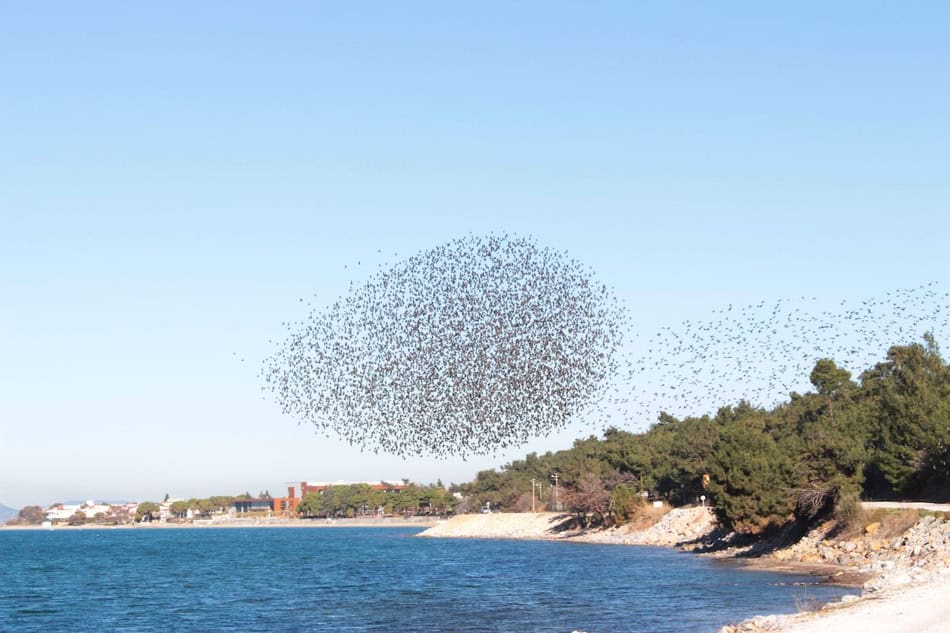
Your best chance is to look for large groups of starlings gathering around dusk, particularly near places where they roost together.
Open fields, wetlands, reedbeds, parks, and some urban areas can provide suitable viewing opportunities. A flock may gather over a stand of trees or circle above a roost before settling in.
The Royal Society for the Protection of Birds recommends looking around dusk during the colder months, when large starling gatherings are especially conspicuous in the United Kingdom.
In North America, starlings are widespread, but not every local flock will produce an enormous, dramatic murmuration. A smaller gathering may still be fascinating to watch.
If you spot one, find a safe place to stand and give the birds plenty of room. Watch how the flock stretches, tightens, and changes direction. Sometimes one portion turns before the rest, sending a visible wave through the entire formation.
It’s difficult to imagine that all those movements come from individual birds responding to their immediate neighbors.
Yet that’s exactly what makes the display so extraordinary.
There’s no grand plan that we can see, no appointed leader, and no rehearsed routine. Just thousands of birds reacting to one another, creating one of the most beautiful performances in the autumn sky.

- Maggie Konrad

- Maggie Konrad
- Maggie Konrad
- Maggie Konrad