Dragonfly Migration: Millions of Dragonflies Are Moving South This Fall
Dragonfly migration peaks in September across much of North America. Learn why dragonflies migrate, where they go, how far they travel, and when to watch for them.

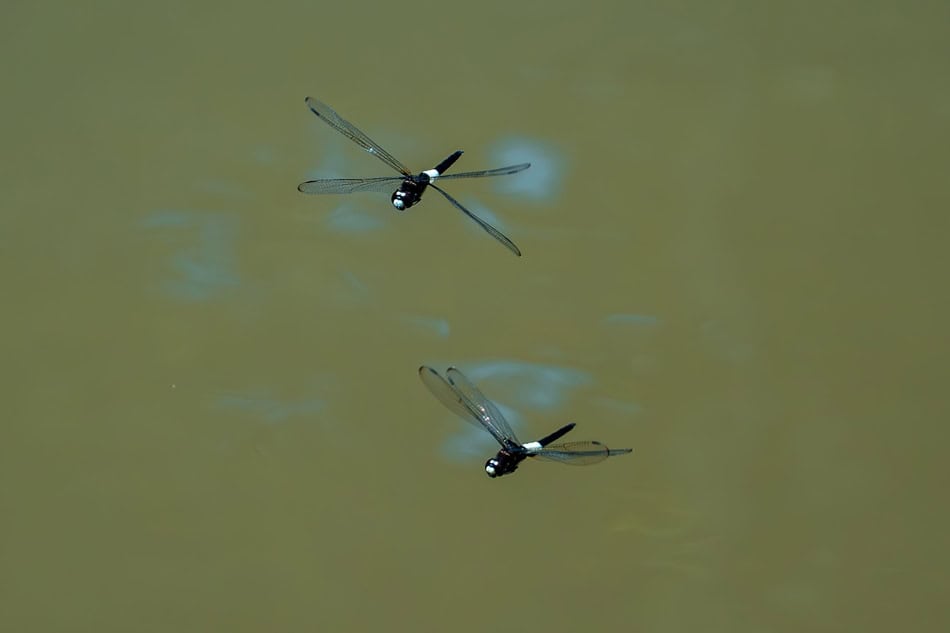
They’re not butterflies. They’re not birds. Look closely this September and you may see one of autumn’s most overlooked migrations unfolding right over your head.
Every fall, millions of migrating birds and monarch butterflies begin their journeys south. But another remarkable traveler is taking to the skies at the same time—and most people never realize it.
Dragonflies migrate, too.
In late summer and early fall, enormous numbers of dragonflies begin moving south across North America. Some travel hundreds or even thousands of miles, following coastlines, lakeshores, ridges, and favorable winds toward warmer regions.
And September is one of the best months to watch the dragonfly migration.
RELATED: How to Attract Dragonflies for Natural Mosquito Control
Researchers have documented major dragonfly flights from late July into October, with migration generally peaking in September. Some of the largest movements have appeared shortly after cold fronts pass through.
So if you suddenly notice dozens—or even hundreds—of dragonflies streaming past your yard, beach, field, or neighborhood this month, they may not simply be hunting insects.
They may be heading south.
Yes, Dragonflies Really Do Migrate
Dragonfly migration remains far less famous than the annual journey of the monarch butterfly, but scientists are learning that it is an important worldwide phenomenon.
A major scientific review published in 2026 identified 100 confirmed migratory species of dragonflies and damselflies around the world, including 85 dragonfly species and 15 damselfly species. Researchers identified another 85 species as possible migrants.
North America has several particularly notable migrants.
Five species have traditionally been a focus of North American migration monitoring:
- Common Green Darner
- Black Saddlebags
- Wandering Glider
- Spot-winged Glider
- Variegated Meadowhawk
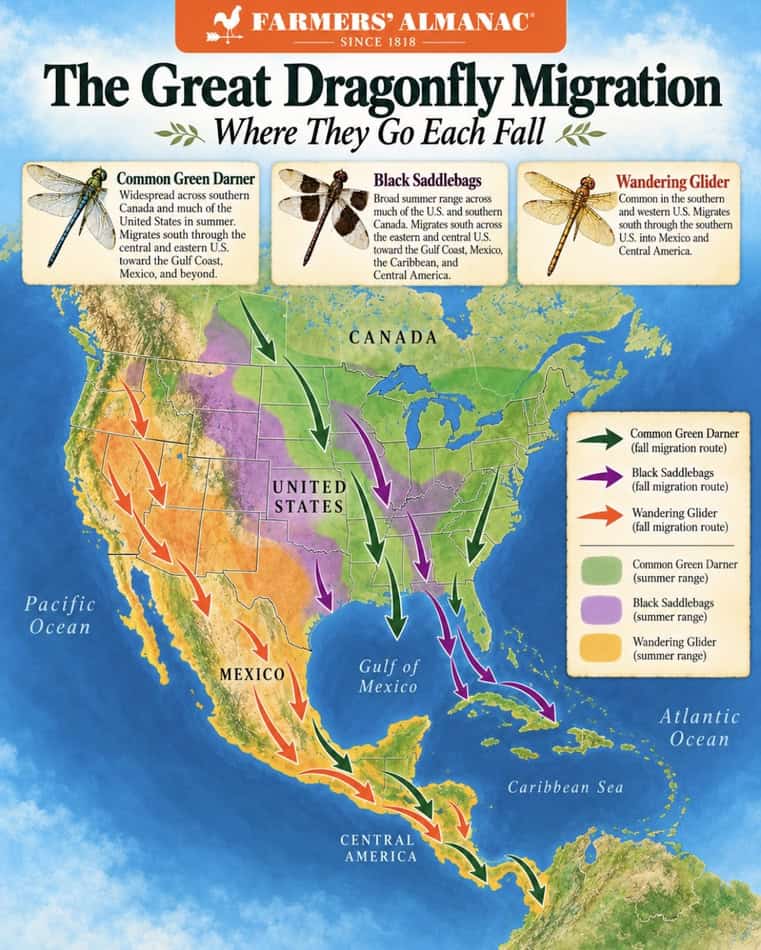
Of these, the Common Green Darner (Anax junius) is the star of the show—and one of the best-studied migrating dragonflies on the continent.
When Does Dragonfly Migration Happen?
If you want to see migrating dragonflies, late August through September is prime time across much of the United States and southern Canada.
Fall migration can continue into October and, at some monitoring sites, even early November. But observations of major flights consistently show a particularly strong peak during September.
That makes dragonfly migration one more subtle sign that autumn is arriving—even if the trees are still green and daytime temperatures still feel like summer.
Dragonflies respond to environmental cues rather than the calendar.
Temperature appears to be particularly important. Research on Common Green Darners found that their seasonal movements are closely associated with temperature, while large southbound flights have frequently been observed following the passage of cold fronts.
A cool September night followed by a clear, sunny day may therefore be a particularly good time to look up.
Where Are All Those Dragonflies Going?
For many migratory dragonflies in northern North America, fall means heading toward warmer territory.
Common Green Darners born farther north can travel south toward the southern United States and beyond. Researchers have documented the species moving across huge portions of the continent.
Smithsonian researchers found that migrating Common Green Darners traveled an average of more than 600 kilometers—about 373 miles—with some individuals traveling more than 2,500 kilometers, or roughly 1,550 miles.
That is an extraordinary journey for an insect only a few inches long.
Migrating dragonflies are often concentrated by geography. Great Lakes shorelines, ocean coasts, ridges, and other natural corridors can funnel them into more visible streams.
That is one reason people occasionally report spectacular gatherings near shorelines while someone only a few miles inland may see relatively few.
The Most Amazing Part: It Takes Generations
Perhaps the strangest part of the Common Green Darner migration is that the same dragonfly does not necessarily make the entire annual round trip.
Instead, the journey unfolds across generations.
Researchers studying Common Green Darners found an annual cycle involving three generations.
A generation moves north in spring. Their descendants emerge farther north and eventually make the great southward journey in late summer and fall. Another generation develops in the southern portion of the range during winter, helping continue the cycle the following year.
In other words, a dragonfly flying south past your house this September may be traveling toward a place it has never seen before.
Its parents did not give it directions.
Yet somehow, it goes.
Why Do Dragonflies Migrate?
For many species, the basic reason is survival.
Dragonflies begin their lives underwater as aquatic nymphs, so their life cycle depends heavily on suitable wetlands, ponds, marshes, streams, and seasonal temperatures.
A major 2026 review concluded that migration among dragonflies and damselflies appears to be driven largely by seasonal changes that make breeding habitat less suitable, including cold temperatures and changes in rainfall.
Moving allows some populations to take advantage of favorable conditions in different places throughout the year.
Not every dragonfly migrates, however.
Even within the Common Green Darner population, some individuals migrate while others remain farther north and survive winter underwater as nymphs.
Nature, as usual, does not rely on just one strategy.
Related: Monarch Butterfly Migration 2026: When and Where to See One of Nature’s Greatest Journeys
Cold Front Coming? Watch the Skies
Weather can dramatically affect how visible dragonfly migration becomes.
Historical observations of large migration events show several recurring patterns:
They often peak in September.
They frequently follow cold fronts.
They tend to concentrate along coastlines and lakeshores.
And Common Green Darners often make up a large portion of the flight.
One tracking study found that tagged green darners tended to migrate after nights of falling temperatures. They traveled during daylight and generally avoided flying when winds became too strong.
So after the next September cold front passes, take a few minutes to watch an open stretch of sky.
You might be surprised by what is moving through.
How to Recognize a Common Green Darner
Common Green Darners are among the largest and most recognizable dragonflies in North America.
Look for:
A bright green thorax: This is one of the species’ most noticeable features.
A long abdomen: Adult males often have a striking blue abdomen, while females are commonly more reddish-brown, though coloration can vary.
Large size: They can approach three inches in length.
Constant, powerful flight: Migrating darners may seem to move steadily in one general direction rather than repeatedly patrolling one small territory.
They can occur around ponds, marshes, lakes, fields, beaches, and even urban areas.
Dragonflies Are Traveling With the Birds
One of the more fascinating features of the fall dragonfly migration is how closely it overlaps with bird migration.
Observers stationed at hawk-watching sites have recorded migrating dragonflies moving south at the same time as hawks, eagles, and other birds.
That overlap is not always good news for the dragonflies.
Migrating dragonflies are also food for migrating birds. American kestrels, for example, take advantage of Common Green Darners during fall migration.
It creates an enormous seasonal movement of life that most of us barely notice: birds, butterflies, dragonflies, and other insects all responding to the shortening days and changing weather.
Are Dragonflies Good to Have Around?
Absolutely.
Dragonflies are formidable aerial predators that feed on mosquitoes, gnats, midges, flies, and other insects.
Their aquatic young are predators, too, feeding on other organisms beneath the surface of ponds and wetlands.
That means dragonflies connect two worlds: water and sky.
Healthy populations can also be an encouraging sign that ponds, wetlands, and other aquatic habitats remain available.
If you want more dragonflies around your property, see our Farmers’ Almanac guide to how to attract dragonflies for natural mosquito control.
Where Is the Best Place to See Dragonfly Migration?
You do not necessarily need to travel anywhere special.
Try watching from:
- Lake shores
- Ocean beaches
- Marshes and wetlands
- Open fields
- Ridgetops
- River corridors
- Parks with large open areas
- Gardens near ponds or other water
The Great Lakes and Atlantic Coast can be especially interesting because shorelines can funnel migrating insects into concentrated routes.
But dragonflies migrate through the interior of the continent, too.
The trick is simply to stop and watch.
Choose a clear afternoon after a change in the weather and look several feet above the ground as well as higher overhead. Instead of watching one individual, look for a pattern.
Are numerous dragonflies passing in roughly the same direction?
If so, you may be watching a migration.
Not Just Monarchs: September’s Other Great Insect Migration
The monarch butterfly deserves its reputation as one of nature’s great travelers. Its annual fall migration is spectacular.
But it isn’t alone.
As monarchs move south across North America this September, dragonflies are traveling alongside them—sometimes in enormous numbers.
Some will travel hundreds of miles. A few may travel more than a thousand.
They will follow shorelines and weather fronts, stop to feed, and continue south toward warmer places they have never visited before.
And most people underneath them will never notice.
So sometime this September, especially after a cold front has swept through, look up.
Those dragonflies darting across the autumn sky may be doing something far more remarkable than hunting mosquitoes.
They may be on their way south.
Dragonfly Migration FAQ
Do dragonflies migrate?
Yes. Some species of dragonflies undertake regular seasonal migrations. A 2026 global scientific review identified 85 confirmed migratory dragonfly species worldwide, along with 15 migratory damselfly species.
When do dragonflies migrate south?
In North America, major fall dragonfly movements are most commonly observed from late summer into fall, with September typically the peak month for large migration events.
Where do dragonflies go in winter?
It depends on the species and population. Many migratory Common Green Darners move toward the southern United States and farther south, while some northern populations survive winter underwater as nymphs rather than migrating.
How far can dragonflies migrate?
Smithsonian research found Common Green Darners traveling an average of more than 373 miles, while some individuals apparently traveled more than 1,550 miles.
What is the most common migratory dragonfly?
The Common Green Darner (Anax junius) is North America’s best-known and most regularly observed migratory dragonfly.


- Farmers' Almanac Staff

- Farmers' Almanac Staff

- Farmers' Almanac Staff

- Farmers' Almanac Staff