Is the North Star the Brightest Star? The Honest Answer, Plus How to Find Polaris
There are many misconceptions and myths about what happens in the cosmos. What does Farmers' Almanac Astronomer Joe Rao say about the North Star?
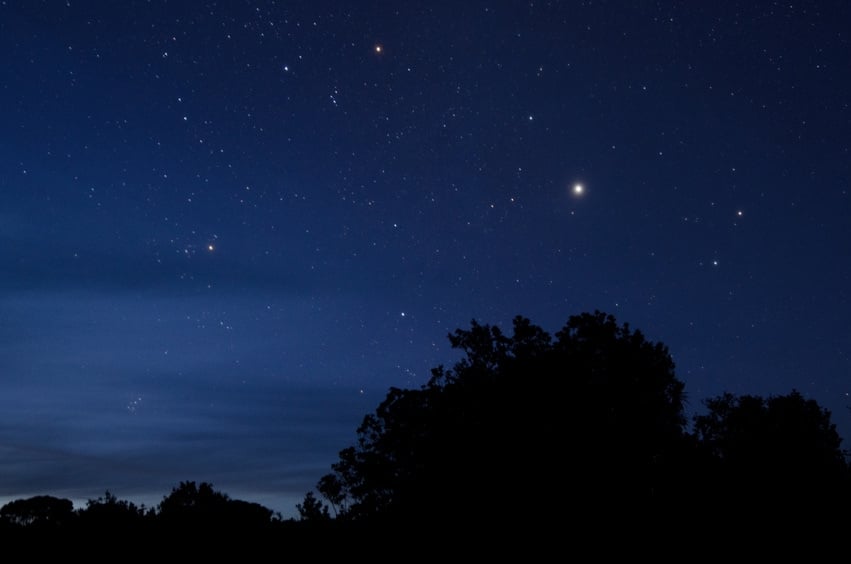
Quick Reference: The North Star (Polaris)
- Common name: the North Star.
- Scientific name: Polaris (Alpha Ursae Minoris).
- Brightest star in the sky? No. It is the 50th brightest. Sirius, Canopus, and several others outshine it.
- Why it matters: Polaris sits almost directly above the North Pole, so it appears fixed in the northern sky while every other star wheels around it.
- How to find it: use the Big Dipper. The two stars at the end of the cup point straight at Polaris.
- Visible from: the entire Northern Hemisphere, year-round.
The North Star is famous, but not because it is bright. Polaris is the 50th brightest star in the night sky, well behind Sirius, Canopus, Arcturus, and dozens of others. Its fame comes from where it sits: directly above the North Pole, so it appears not to move while the rest of the sky wheels around it overnight. For two thousand years that fixed position made it the single most important star for navigation in the Northern Hemisphere.
Why Polaris Appears Fixed
Earth’s axis points almost exactly at Polaris. As the planet rotates each night, every other star sweeps a circle around the North Celestial Pole, but Polaris sits within one degree of the pole itself, so it stays in nearly the same place all night. Stand still and watch the northern sky for an hour and you can see the circular drift of every star around the silent Polaris.
Polaris will not always be the North Star. Earth’s axis wobbles in a 26,000-year cycle called precession. About 4,000 years ago Thuban (in Draco) was the North Star; about 14,000 years from now Vega will be.
How to Find Polaris From the Big Dipper
Look for the Big Dipper (the Plough, in the UK) in the northern sky. The two stars at the outer edge of the cup, Dubhe and Merak, are called the Pointers. Draw an imaginary line from Merak through Dubhe and extend it about five Dipper widths. You will hit Polaris.
Polaris is part of the Little Dipper (Ursa Minor) and sits at the end of the Little Dipper’s handle. Once you have found Polaris, you have found true north: a line from Polaris straight down to the horizon points due north regardless of date or time.

Frequently Asked Questions
Is the North Star really not the brightest?
Correct. It is the 50th brightest. Sirius (the Dog Star) is the brightest star in the night sky. The North Star’s importance is its location, not its brightness.
Has the North Star always been Polaris?
No. Earth’s axis precesses (wobbles) on a 26,000-year cycle. Thuban was the North Star around 2,800 BC. In 12,000 AD it will be Vega. Polaris has held the spot only for the last few thousand years and will hold it for another few thousand.
Can you see Polaris from the Southern Hemisphere?
No. Polaris is below the horizon for anyone south of the equator. The Southern Hemisphere has no equivalent fixed pole star; the South Celestial Pole sits in a dim patch of sky between Octans and Crux.
How do you use Polaris to find your latitude?
Measure the angle from the horizon up to Polaris. That angle equals your latitude. A Polaris altitude of 40 degrees means you are at 40 degrees north.



Joe Rao
Joe Rao is an esteemed astronomer who writes for Space.com, Sky & Telescope, and Natural History Magazine. Mr. Rao is a regular contributor to the Farmers' Almanacand serves as an associate lecturer for the Hayden Planetarium in New York City.
- Joe Rao

- Joe Rao
- Joe Rao
- Joe Rao