Sirius, the Dog Star: How to Find the Sky’s Brightest Star Using Orion
Head outside on these chilly winter evenings to spot our galaxy's brightest star, Sirius.

Quick Reference: Sirius the Dog Star
- What it is: Sirius (Alpha Canis Majoris), the brightest star in Earth’s night sky at magnitude -1.46.
- Constellation: Canis Major, the Greater Dog.
- Distance: 8.7 light-years from Earth, the fifth-closest star to our Sun after Alpha Centauri.
- When to see it: highest in the southern sky around 10:30 p.m. local time in mid-winter (January through February).
- How to find it: trace the three stars of Orion’s Belt down and to the left until you hit an unmistakably bright blue-white beacon.
- Folklore anchor: ancient Egyptians called it the Nile Star because its heliacal rising signaled the annual Nile flood.
The brightest star in Earth’s night sky sits low in the south around 10:30 p.m. local time through the heart of winter. Sirius, the Dog Star, is the alpha of Canis Major (the Greater Dog) and lights up cold January skies like nothing else overhead. Once you learn to find it using Orion’s Belt, it becomes an unmistakable winter landmark.
In color, Sirius shines a brilliant white with a definite tinge of blue. When the air is unsteady it seems to flicker with all the colors of the rainbow, an effect you have almost certainly noticed if you have ever glanced south on a cold, dry night. See our companion piece on why stars twinkle for the atmospheric science behind the sparkle. NASA lists Sirius at 8.7 light-years away, making it the fifth-nearest known star to our own solar system. Among the naked-eye stars, only Alpha Centauri sits closer.

How to Locate Sirius in the Winter Sky
Locating Sirius is easy once you find Orion, the most recognizable constellation of the winter sky. Trace the three bright stars of Orion’s Belt from upper right to lower left, then continue that line down and to the left for about the same distance as the belt itself is long. You will land on an unmistakable, brilliant blue-white star hanging low in the southern sky. That is Sirius.
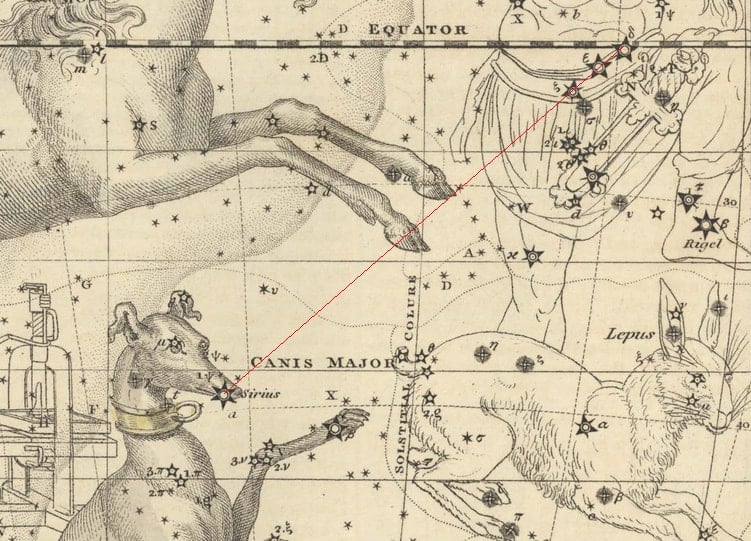
Sirius rises earlier each night as winter deepens. By mid-January it climbs high enough by 10:30 p.m. to clear most tree lines in the eastern and central US. By mid-March it is already sliding into the western sky at the same hour.
Best Sirius Viewing By Region
Sirius is visible to every observer in the continental US and Canada each winter, but the peak viewing window shifts a few weeks by latitude.
- US South (Florida, Gulf Coast, Southwest): Sirius rides highest around January 1 near midnight and stays visible through early May.
- Mid-latitudes (Mid-Atlantic, Ohio Valley, Northern California): peak transit falls in mid to late January, around 10:30 p.m. local time.
- Northern tier (New England, Upper Midwest, Pacific Northwest): Sirius sits lower on the horizon; find an open southern view to catch it clear of trees and rooftops.
- Canada: visible from every province south of about 60 degrees north; farther north, Sirius stays close to the horizon and can be lost in low haze.
The Nile Star: 4,000 Years of Sky Watching
About 4,000 years ago, ancient Egyptian priests noticed that Sirius rose just before dawn (its heliacal rising) at the time of the summer solstice, right when the Nile began its annual flood. The rising of Sirius told farmers to prepare for planting, so the star became known as the Nile Star. The Egyptian civil calendar was tied to this event for centuries, and the star was worshipped as the goddess Sopdet.
Sirius is also the star behind the phrase “dog days of summer.” Roman and Greek astronomers linked Sirius’s July heliacal rising to the year’s hottest, most languorous weeks. See our full explainer on the dog days of summer.
Sirius Is Actually Two Stars: Sirius A and Sirius B
Modern astronomy revealed something ancient sky-watchers could not know: Sirius is a binary system. The bright star we see is Sirius A, a hot main-sequence star roughly twice the mass of the Sun. Its companion, Sirius B (nicknamed the Pup), is a white dwarf about the size of Earth but nearly as massive as the Sun. It orbits Sirius A every 50 years. The Hubble and James Webb Space Telescopes have imaged Sirius B, though visually the Pup is drowned by A’s glare in home telescopes.
At more than 25 times the luminosity of our Sun, Sirius A pumps out about as much light as 25 Suns would from the same distance. Combined with its closeness, that is why it dominates the winter sky.
What You Need to See Sirius (Nothing Fancy)
Sirius is a naked-eye star, so you truly need nothing but a clear window facing south and a familiar view of Orion.
- Best time: two hours after sunset in January or February, or 45 minutes before dawn in late summer.
- Best conditions: a clear, moonless night; low humidity; away from streetlights.
- Optional gear: binoculars sharpen the blue-white color and reveal the rainbow twinkle. A backyard telescope of 6 inches or more may resolve Sirius B during its widest orbital separations (roughly 2028 through 2032).
- Photography: a 30-second tripod exposure at ISO 800, f/2.8, 50mm captures Sirius and the whole Orion field cleanly.

Sirius Star FAQ
What is the Dog Star’s name?
The Dog Star is Sirius (formally Alpha Canis Majoris), the brightest star in the constellation Canis Major, the Greater Dog. At magnitude -1.46 it is the brightest star in Earth’s entire night sky.
How far is Sirius from Earth?
Sirius sits 8.7 light-years away, making it the fifth-closest known star to the Sun (after the Alpha Centauri triple and Barnard’s Star). Among naked-eye stars, only Alpha Centauri is closer.
Why does Sirius twinkle so much?
Sirius twinkles because it sits low in our southern sky as viewed from the northern hemisphere, so its light passes through more of Earth’s turbulent atmosphere than higher stars. The turbulence bends the light and briefly disperses it into rainbow colors.
When can I see Sirius?
Sirius is visible in the northern hemisphere from December through April, rising in the southeast after sunset and reaching its highest point in the south around 10:30 p.m. local time in mid-January.
Is Sirius the North Star?
No. The North Star is Polaris, a modest star that sits nearly above Earth’s north celestial pole. Sirius is far brighter than Polaris but never near the pole.
Why is Sirius called the Dog Star?
Because it is the alpha star of Canis Major, the Greater Dog constellation, first named by Greek and Roman astronomers. Its rising also fell during the hottest weeks of Roman summer, giving us the phrase dog days.
Can I see Sirius from the southern hemisphere?
Yes, and often more comfortably. In the southern hemisphere Sirius climbs high overhead in January and February, avoiding the low-horizon haze that northerners have to plan around.


Joe Rao
Joe Rao is an esteemed astronomer who writes for Space.com, Sky & Telescope, and Natural History Magazine. Mr. Rao is a regular contributor to the Farmers' Almanacand serves as an associate lecturer for the Hayden Planetarium in New York City.
- Joe Rao

- Joe Rao
- Joe Rao
- Joe Rao