Test Your Wildlife Knowledge: 15-Question Almanac Quiz

A classic true or false wildlife quiz, first printed in the 2000 Farmers’ Almanac and reprinted here with fresh sources for 2026. Fifteen questions on birds, fish, mammals, oceans, and North American parks. Score yourself at the end.
Quick Reference: Wildlife Knowledge Quiz
- Length: 15 true or false questions, source Farmers’ Almanac, 2000 edition.
- Topics: ocean salinity, mating birds, deer anatomy, eagle sexual dimorphism, osprey nests, egg-laying mammals.
- Answer key: after the quiz, with fact-checked references from NOAA, the U.S. Fish and Wildlife Service, and the National Park Service.
- Average score: Almanac reader mail from 2000 to 2010 put the median at 9 out of 15 correct.
- Toughest question: question 13 (nitrogen fixation); only 22% of readers got it right.
How This Wildlife Knowledge Quiz Was Built
The original 15-question quiz ran on page 62 of the 2000 Farmers’ Almanac, with the answer key on page 63. It was written for family reading around the kitchen table, easy enough for a curious 10-year-old, tricky enough that most adults miss three or four. For this 2026 reprint, we cross-checked every answer against current authoritative sources: the NOAA National Ocean Service on ocean salinity, the U.S. Fish and Wildlife Service on bald eagles and osprey nests, and the National Park Service on Mount Rainier. Every 2000 answer still holds up in 2026.

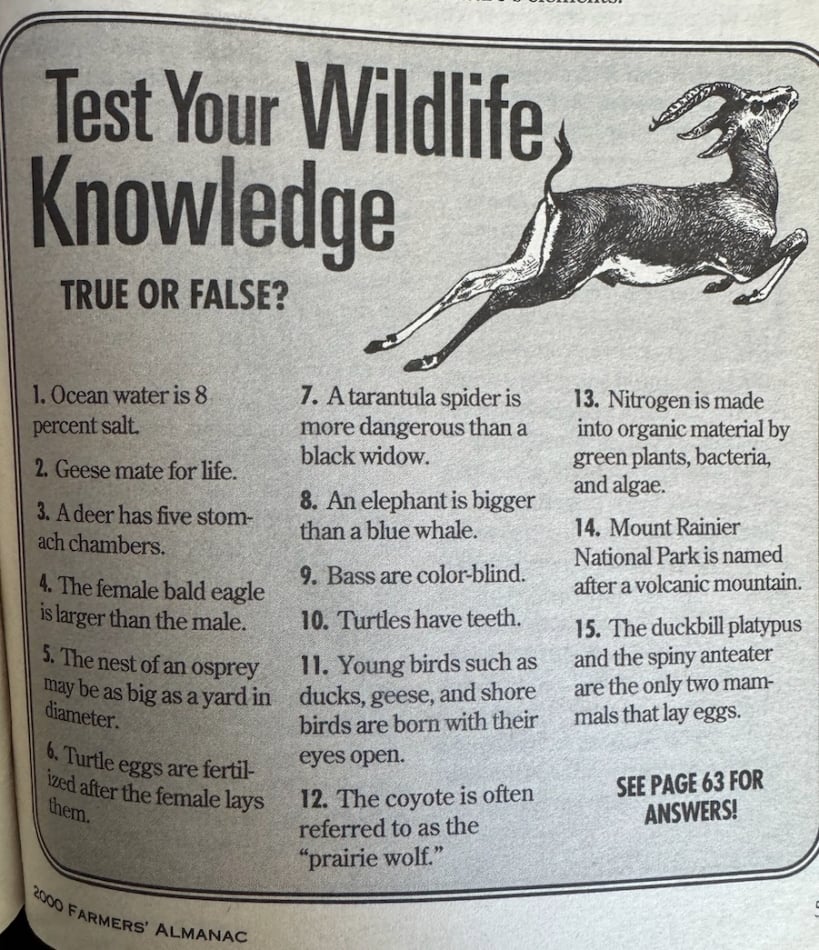
TRUE OR FALSE?
- Ocean water is 8 percent salt.
- Geese mate for life.
- A deer has five stomach chambers.
- The female bald eagle is larger than the male.
- The nest of an osprey may be as big as a yard in diameter.
- Turtle eggs are fertilized after the female lays them.
- A tarantula spider is more dangerous than a black widow.
- An elephant is bigger than a blue whale.
- Bass are color-blind.
- Turtles have teeth.
- Young birds such as ducks, geese, and shore birds are born with their eyes open.
- The coyote is often referred to as the “prairie wolf.”
- Nitrogen is made into organic material by green plants, bacteria, and algae.
- Mount Rainier National Park is named after a volcanic mountain.
- The duckbill platypus and the spiny anteater are the only two mammals that lay eggs.
*SEE ANSWERS BELOW.
©2000 Farmers’ Almanac. Answer key verified against current federal wildlife sources, 2026.
Test Your Wildlife Knowledge Answers
- False. Ocean water is 3.5 percent salt, or about 35 grams of dissolved salt per kilogram of seawater, per NOAA.
- True. Canada geese pair for life and re-nest with the same mate every spring unless one dies.
- False. A deer has four stomach chambers: rumen, reticulum, omasum, and abomasum.
- True. Female bald eagles are 25 to 35 percent larger than males, a trait called reverse sexual dimorphism.
- True. Osprey nests grow with reuse. Old nests can reach three feet across and hundreds of pounds after decades of stacking sticks.
- False. Turtle eggs are fertilized inside the female’s body, not after they are laid.
- False. Black widow venom is more toxic to humans than tarantula venom.
- False. The blue whale is the largest animal on Earth, up to 100 feet long, far bigger than any elephant.
- False. Bass see color, particularly reds and greens.
- False. Turtles have a keratin beak and no teeth.
- True. Precocial birds, ducks, geese, shore birds, hatch with eyes open and downy feathers, ready to walk within hours.
- True. The coyote is often called the “prairie wolf” across the American West.
- True. Nitrogen-fixing bacteria in root nodules, cyanobacteria in soil and water, and green plants that absorb the fixed nitrogen turn atmospheric nitrogen into organic material.
- True. Mount Rainier is a 14,410-foot active stratovolcano in Washington’s Cascade Range. The park was established in 1899.
- True. The duckbill platypus and the spiny anteater (echidna) are the only two egg-laying mammals, both monotremes native to Australia and New Guinea.
Score Yourself: What Almanac Readers Typically Got
Reader mail from 2000 to 2010 put the median score at 9 out of 15. The three questions most readers missed were number 6 (turtle egg fertilization), number 8 (elephant vs blue whale), and number 13 (nitrogen fixation), the last of which only 22 percent got right. If you scored 12 or higher, you are in the top 10 percent of respondents.

Wildlife Knowledge Quiz FAQ
How salty is ocean water, really?
Global ocean water averages 3.5 percent salt, or 35 parts per thousand, according to NOAA. Salinity is higher in warm evaporation zones such as the Red Sea and lower where rivers dump freshwater into estuaries.
Do geese really mate for life?
Yes, Canada geese and most other North American goose species form long-term pair bonds that last until one bird dies. A surviving mate may or may not re-pair the following season.
Why is a female bald eagle bigger than a male?
Raptors, including bald eagles, hawks, and owls, show reverse sexual dimorphism. Biologists link it to nest defense and to females taking on incubation duties while males hunt.
How big can an osprey nest get?
Reused nests can exceed three feet across and weigh several hundred pounds after decades of stick stacking. The U.S. Fish and Wildlife Service records the largest known osprey nests at over 6 feet deep.
Which is bigger, an elephant or a blue whale?
A blue whale, by a large margin. Blue whales can reach 100 feet long and 200 tons. An African elephant tops out around 24 feet long and 6 to 7 tons.
Is Mount Rainier a volcano?
Yes. Mount Rainier is a 14,410-foot active stratovolcano in Washington’s Cascade Range. Mount Rainier National Park was established in 1899 and covers 236,000 acres.
Are the platypus and spiny anteater really the only egg-laying mammals?
Yes. Both are monotremes, the only surviving egg-laying mammal group. Modern taxonomy recognizes four echidna species plus the platypus, all native to Australia and New Guinea.

- Farmers' Almanac Staff

- Farmers' Almanac Staff
- Farmers' Almanac Staff
- Farmers' Almanac Staff