

When Will Trees Go Bare Near You? See the Typical Timing Across the U.S.
One windy night can change the view from your window. Yesterday’s colorful canopy becomes a scattering of leaves, and branches that disappeared all summer suddenly stand against the sky.
But autumn rarely finishes everywhere at once. A mountain grove may be bare while trees in a nearby valley are still turning, and an oak may hold its brown leaves long after neighboring maples have let theirs go.
When do leaves fall? Across much of the United States, deciduous trees shed their leaves during October and November. Colder northern and mountain locations can start earlier, while some southern trees retain foliage into December or beyond.
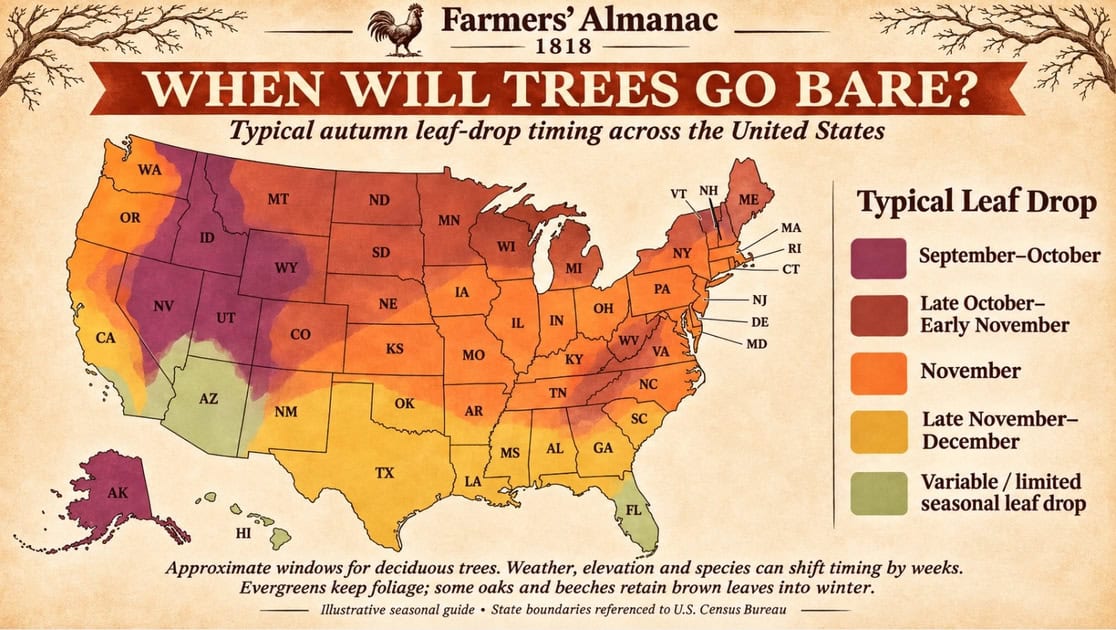
Our Farmers’ Almanac map illustrates broad seasonal windows for autumn leaf drop. Use it as a regional guide, with room for the weather, elevation, and tree species in your own neighborhood.
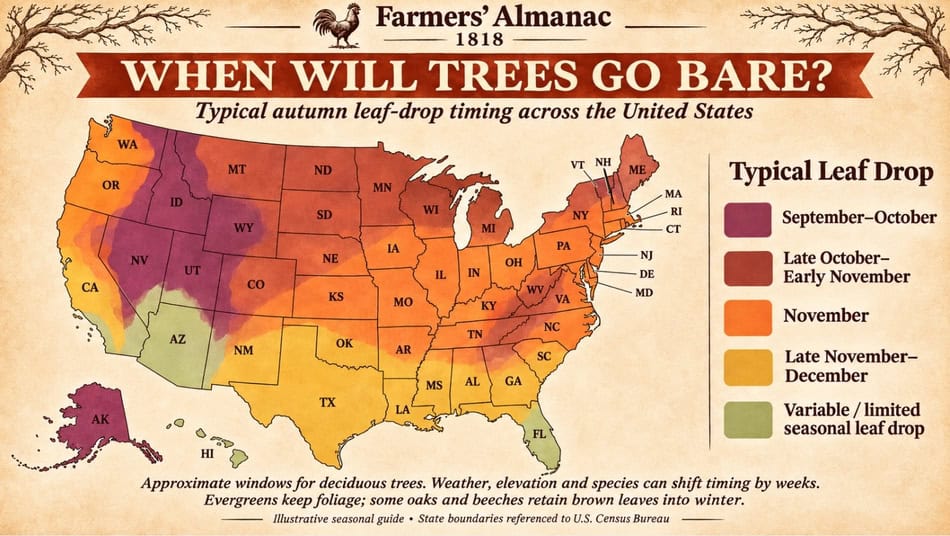
Typical autumn leaf drop windows across the United States. This Farmers’ Almanac illustration is a broad seasonal guide; timing varies with weather, elevation, and tree species.
When trees typically lose their leaves by region
The map’s colors show approximate seasonal windows. They are not a live foliage report or a forecast for an individual tree, and the borders between timing zones are gradual.
| Approximate window on the map | Areas represented | What to keep in mind |
|---|---|---|
| September–October | Alaska and higher mountain areas of the West | Applies to deciduous trees and groves; evergreen forests remain green. |
| Late October–early November | Much of the northern tier, northern Great Lakes, and northern New England | Some trees and colder locations can finish earlier. Later species can keep leaves longer. |
| November | Much of the central and eastern United States and Pacific Northwest lowlands | Coastal, urban, and sheltered locations can differ from nearby inland or exposed areas. |
| Late November–December | Parts of the southern Plains, lower South, Southeast lowlands, and California valleys | Local species and elevation create substantial variation. |
| Variable or limited seasonal leaf drop | Desert lowlands, warmer coastal areas, far southern Florida, and Hawaii | A single autumn leaf drop season may not describe the local vegetation. |
A state can contain several autumn schedules. The date that fits a mountain town may be a poor guide for a valley or coastal community in the same state.
Peak fall color and bare branches happen at different times
A fall foliage report tells you about the display of color. It does not necessarily tell you when the last leaves will fall.
A woodland can lose many of its leaves while a few late trees still provide brilliant patches of color. Conversely, strong wind can bring down colorful leaves before the display has run its course.
That is why a landscape described as “past peak” may still have plenty of leaves attached—and why a leaf drop map should not be read as a peak color calendar.
Elevation can change the timing within a few miles
In mountain country, elevation can matter as much as your position on a national map.
The National Park Service’s guide to fall colors in the Great Smoky Mountains describes a season that progresses from high elevations toward lower valleys over several weeks. Higher forests begin changing first, while lower and middle elevations can still have their brightest displays from mid-October into early November.
That difference helps explain why a drive downhill can seem to take you backward through autumn. It also explains the patches of earlier timing shown in mountain areas on our map.
Why do trees lose their leaves in fall
Shorter days and changing temperatures help signal the end of the growing season. As deciduous trees prepare for dormancy, changes take place where each leaf stalk joins its twig.
A separation zone, called the abscission layer, allows the leaf to detach. The familiar shower of falling leaves is the visible result of a process already underway inside the tree.
Minnesota’s Department of Natural Resources explains this autumn transition, including the breakdown of green chlorophyll and the eventual release of the leaf.
A chilly morning can accompany that transition, but trees do not need a frost to begin losing their leaves.
Why the same tree may lose its leaves earlier one year
The calendar provides a useful starting point. Weather helps determine how the season unfolds.
Drought and heat: A stressed tree may develop brown, shriveled foliage or shed leaves before a colorful autumn display develops.
Warm autumn weather: Warmer conditions can delay some seasonal changes. Day length continues changing, however, so warmth does not simply pause autumn.
Wind and storms: Once leaves are ready to detach, stormy weather can accelerate the visible change from a leafy canopy to bare branches.
Tree species: A neighborhood’s mixture of trees spreads the season out. Even nearby trees may respond differently.
The National Park Service explains how weather and tree diversity influence autumn foliage. These differences are why a broad map works best alongside observations of the trees around you.
Why some oaks and beeches keep brown leaves all winter
A tree covered in dry, rustling leaves may be following a different seasonal pattern.
Some deciduous trees retain dead leaves after the growing season ends, a condition called marcescence. It is especially noticeable on certain oaks and American beeches, including young trees and lower branches.
Those retained leaves are not living evergreen foliage. They are old leaves whose normal separation has been delayed.
Read more in our guide to those brown leaves still hanging on your tree—and the name for this familiar winter sight.
Evergreen does not mean keeping every leaf forever
Pines, spruces, hollies, and other evergreens keep foliage through winter, but they still replace older needles or leaves.
Other trees follow schedules that do not fit a northern autumn calendar. In warm regions, the species growing in your yard can tell you more than the month.
For example, the University of Florida’s guide to oak trees notes that live oaks replace old foliage around the time new leaves arrive. Seeing a green canopy through winter does not mean that tree has missed its autumn deadline.
Should you wait until every leaf falls before raking
Waiting for the last leaf may mean waiting well into winter—or until spring if a nearby tree holds onto its dead foliage.
Instead, pay attention to where leaves accumulate.
- On lawns: Mulch manageable amounts with a mower. Collect or move excess leaves when they form a heavy covering.
- Beneath shrubs and in suitable garden areas: Leave some whole leaves where they can decompose and provide winter habitat.
- On steps and walkways: Clear wet leaves so they do not create slippery footing.
University of Minnesota Extension recommends mulching leaves while enough lawn remains visible, then collecting excess material as the covering becomes too heavy.
For more practical advice, read Should I Leave Fallen Leaves on My Lawn?.
Common questions about falling leaves
What month do most trees lose their leaves
October and November are common months for autumn leaf drop across much of the United States. Colder locations can lose leaves earlier, while some southern trees retain them into December or follow a different seasonal pattern.
Do all trees lose their leaves after the first frost
No. Leaf drop can begin before frost. Shorter days, temperature changes, species, and the tree’s condition all influence the process.
How long after peak color will a tree be bare
There is no fixed interval. Species and weather make a difference, and a windy spell can shorten the display considerably.
Does a tree holding brown leaves mean a hard winter is coming
Brown leaves alone are not a reliable measure of the coming winter’s severity. On certain oaks and beeches, holding dead leaves is a familiar seasonal trait.
What is happening where you live? Tell us your state and whether your trees are still green, showing color, or mostly bare.

