Why Does the Moon Change Colors? The Science Behind Red, Orange, Yellow, and Blue Moons

Have you ever looked up and wondered why the Moon looked deep orange one night, bright white the next, or even reddish during a lunar eclipse? While the Moon itself doesn’t actually change color, Earth’s atmosphere—and occasionally special celestial events—can make it appear dramatically different from one night to the next.
Here’s why the Moon seems to wear so many different colors.
🌕 Why Is the Moon Usually White?
When the Moon is high overhead, its light passes through only a relatively thin layer of Earth’s atmosphere. Because very little of that light is scattered, the Moon appears bright white or silvery gray.
The Moon doesn’t produce its own light. Instead, it reflects sunlight. In fact, the Moon reflects only about 12% of the sunlight that reaches its surface—about the same reflectivity as worn asphalt—but against the dark night sky, it appears brilliantly bright.
🌅 Why Does the Moon Look Orange or Yellow?
One of the most common color changes happens when the Moon is rising or setting.
Near the horizon, moonlight must travel through much more of Earth’s atmosphere before reaching your eyes. Along the way, tiny air molecules scatter away the shorter blue wavelengths of light. The longer red, orange, and yellow wavelengths continue on, giving the Moon its warm golden appearance.
This is the same reason sunsets often glow with beautiful shades of orange and red.
Humidity, dust, pollution, and tiny particles in the air can make these colors even richer.
🔴 Why Does the Moon Sometimes Turn Red?
A reddish Moon is most famous during a total lunar eclipse, often called a Blood Moon.
During a total lunar eclipse, Earth moves directly between the Sun and the Moon. Although Earth blocks direct sunlight, some sunlight is bent—or refracted—through Earth’s atmosphere. The atmosphere filters out much of the blue light while allowing more red and orange light to reach the Moon, bathing it in a coppery glow.
No two Blood Moons are exactly alike. Some appear bright orange, while others become deep crimson depending on the amount of dust, smoke, and clouds in Earth’s atmosphere.
🔵 Can the Moon Really Look Blue?
Yes—but not because the Moon actually changes color.
After major volcanic eruptions or large wildfires, the atmosphere can become filled with tiny particles of just the right size to scatter red light instead of blue. Under these unusual conditions, the Moon may appear bluish.
True blue-colored Moons are quite rare.
It’s also worth noting that the phrase “Once in a Blue Moon” usually refers to an extra Full Moon occurring within a specific calendar period—not the Moon turning blue.
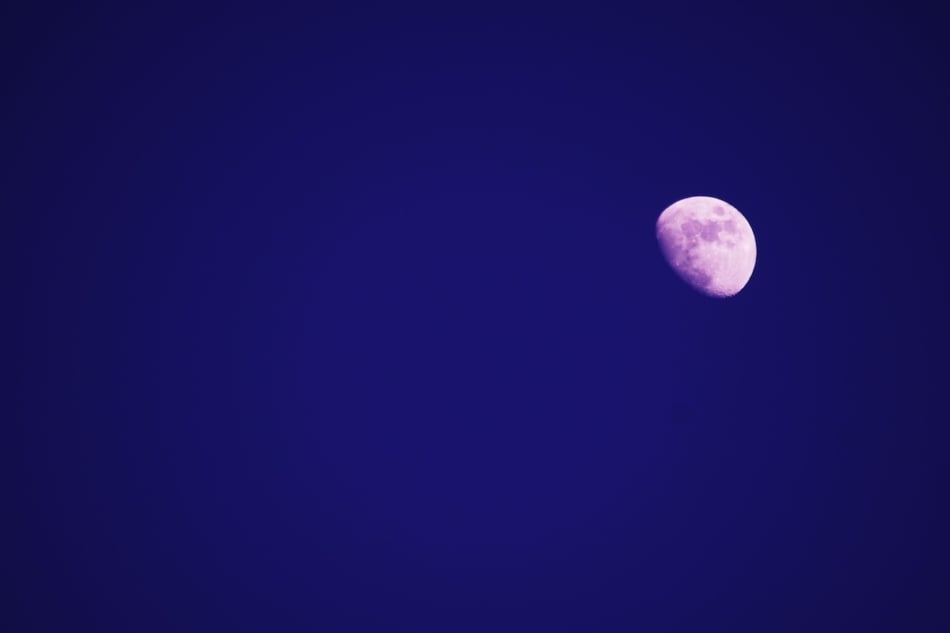
🌫️ Why Does the Moon Sometimes Look Pink, Brown, or Copper?
Atmospheric conditions can produce a surprising variety of Moon colors.
Smoke from wildfires, desert dust, pollution, fog, haze, or high humidity can all filter moonlight differently. Depending on what’s floating in the atmosphere, the Moon may appear:
- Pale yellow
- Golden
- Deep orange
- Copper
- Reddish
- Pinkish
- Brownish
The effect is especially noticeable when the Moon is low in the sky.
🌕 Why Does the Moon Look Bigger Near the Horizon?
Although it often happens at the same time as the Moon turns orange, this isn’t actually caused by the atmosphere.
The Moon Illusion is a trick played by your brain. When the Moon is near the horizon, nearby trees, buildings, and mountains provide points of reference that make it seem much larger than when it’s high overhead. In reality, the Moon’s size changes very little during the course of a single night.
Does the Moon Ever Actually Change Color?
No.
The Moon itself remains essentially the same gray-colored world it has always been. Nearly every color we see is caused by sunlight interacting with Earth’s atmosphere before the light reaches our eyes.
That’s one of the joys of moonwatching: every moonrise can be a little different depending on the weather, the season, and the condition of the atmosphere.
So the next time you notice a golden Harvest Moon, a fiery orange moonrise, or a dramatic Blood Moon during an eclipse, you’ll know that the colorful display is taking place much closer to home—right here in Earth’s atmosphere.
Moon Color Guide at a Glance
| Moon Color | What Causes It? |
|---|---|
| White | Moon high overhead; little atmospheric scattering |
| Yellow | Moon low on the horizon; some blue light scattered |
| Orange | Longer path through the atmosphere, often enhanced by dust or humidity |
| Red | Total lunar eclipse or heavy smoke and dust in the atmosphere |
| Blue | Rare atmospheric particles from volcanic eruptions or major wildfires |
| Copper | Total lunar eclipse or hazy atmospheric conditions |


- Farmers' Almanac Staff

- Farmers' Almanac Staff
- Farmers' Almanac Staff
- Farmers' Almanac Staff