Why the Moon Looks Sharper Some Nights, Plus the Best Phases to See Detail

Quick Reference: When the Moon Looks Sharpest
- Best phases for detail: first quarter and last quarter, when shadows are longest.
- Worst phase for detail: full moon. Light is flat with no shadows.
- Best atmospheric conditions: cool, calm, dry air. Stable atmosphere = sharp images.
- Worst conditions: hot, humid, turbulent air. Causes the moon to shimmer.
- Best tools: binoculars (7×50 are ideal). A small telescope shows much more.
On some clear nights the moon looks like a high-resolution photograph: every crater sharp, every mountain shadow distinct. Other nights, even when the sky is clear, the same moon looks soft, blurred, or shimmery. The atmosphere is the main reason, plus the angle of sunlight on the lunar surface. Here is why, and the best phases and conditions for seeing moon detail.
Atmosphere Matters
The biggest factor is atmospheric stability, what astronomers call ‘seeing.’ On nights when air layers are stable and cool, light passes through with minimal distortion. On nights when warm and cool air layers are mixing (often after a hot day), light gets bent and rebent, and the moon shimmers.
Cool autumn and winter nights, with clear high pressure, tend to have the best seeing. Hot humid summer nights have the worst. The same physics applies to stars (which twinkle hard on bad seeing nights, less on good ones).
Phase Matters Even More
The full moon is the worst phase for seeing surface detail, even though it’s the brightest. Because the sun is directly behind the observer’s perspective, there are no shadows. Craters and mountains all look washed out.
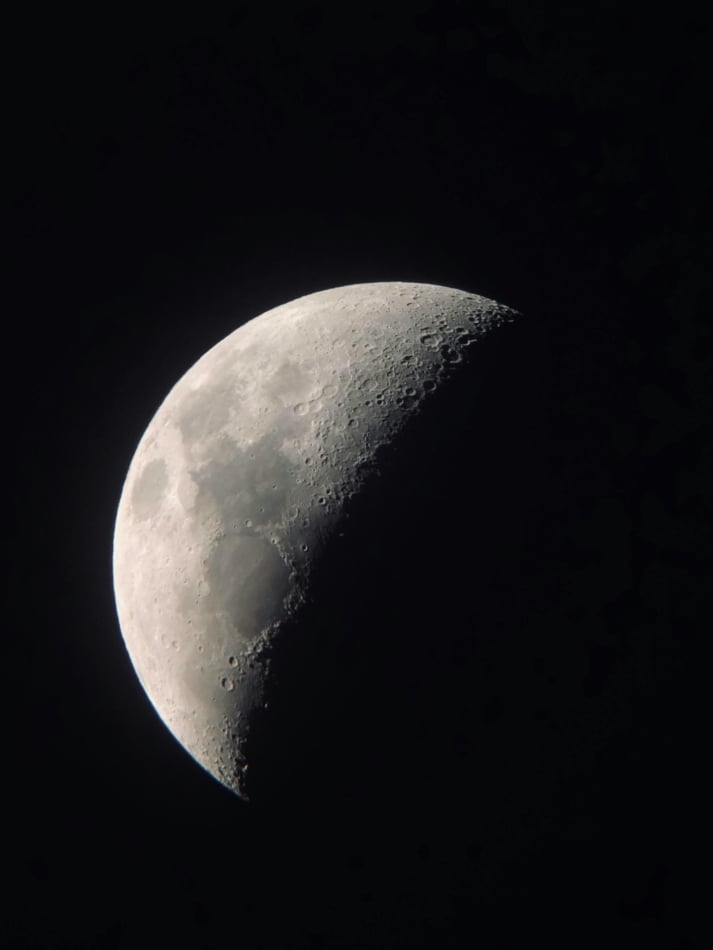
The best phases for detail are first quarter and last quarter (half moon), and the days on either side. The sun hits the moon at a low angle, casting long shadows from every crater and mountain. The ‘terminator line’ (the boundary between lit and dark sides) is where the most dramatic detail appears.
What to Look For
With binoculars during first quarter:
- The Apennine Mountains: visible as a curved chain along the terminator.
- Tycho crater: a bright crater in the southern highlands with prominent rays.
- Mare Tranquillitatis (Sea of Tranquility): the dark plain where Apollo 11 landed.
- Copernicus crater: a prominent young crater with terraced walls.

Frequently Asked Questions
Why is the full moon worst for seeing detail?
Because the sun is directly behind the observer’s line of sight, there are no shadows on the lunar surface. Without shadows, craters and mountains all look flat.
Is the moon really blurrier on hot summer nights?
Yes. Hot turbulent air causes more shimmering than cool stable air. The same effect that makes city skylines shimmer on a hot day applies to moon viewing.
What tools help see moon detail?
Binoculars (7×50 ideal) show much more than the naked eye. A 4-inch telescope at low to medium magnification shows fine surface detail. Higher magnification helps only if seeing is good.
When is the best time of night to look?
The moon is highest in the sky around midnight at full, but for fine detail viewing, the half moons at first and last quarter are best. They’re highest in mid-evening or pre-dawn respectively.


- Tim Konrad

- Tim Konrad
- Tim Konrad
- Tim Konrad