

Snow Lore: 15 Folk Signs That Point to a Snowy Winter
Will it snow? Here are some signs from nature you may want to look for.
Quick Reference
- Famous rule: For every fog in August, one snowfall the following winter.
- Animal signs: Tall ant hills, busy squirrels, high hornet’s nests, deep muskrat holes.
- Weather sign: Six weeks after September’s last thunderstorm, the first snow.
- Sky sign: A halo around the moon: rain or snow soon.
- Lunar sign: The age of the moon at first snow equals the number of snowfalls before planting season.
Winter means snow, and farmers used to need to know how much. A long, cold, snowy winter changed how much wood to cut, how much hay to keep, and which crops would do best the following summer. Today, many readers check snow lore against our extended forecast to see whether nature agrees with the Almanac. Each year when we publish our 20 Signs of a Hard Winter, readers send us their own snow predictions: persimmon seed shapes, woolly bear stripes, animal coat thickness. With winter approaching, the question is always: how much snow are we going to get? Here is the snow lore the Almanac has carried since 1818.
The Classic Snow Lore List
- As many days old as is the Moon on the first snow, there will be that many snowfalls by crop planting time.
- If ant hills are high in July, winter will be snowy.
- If the first week in August is unusually warm, the coming winter will be snowy and long.
- The first snowfall comes six weeks after the last thunderstorm in September.
- For every fog in August, there will be a snowfall the following winter.
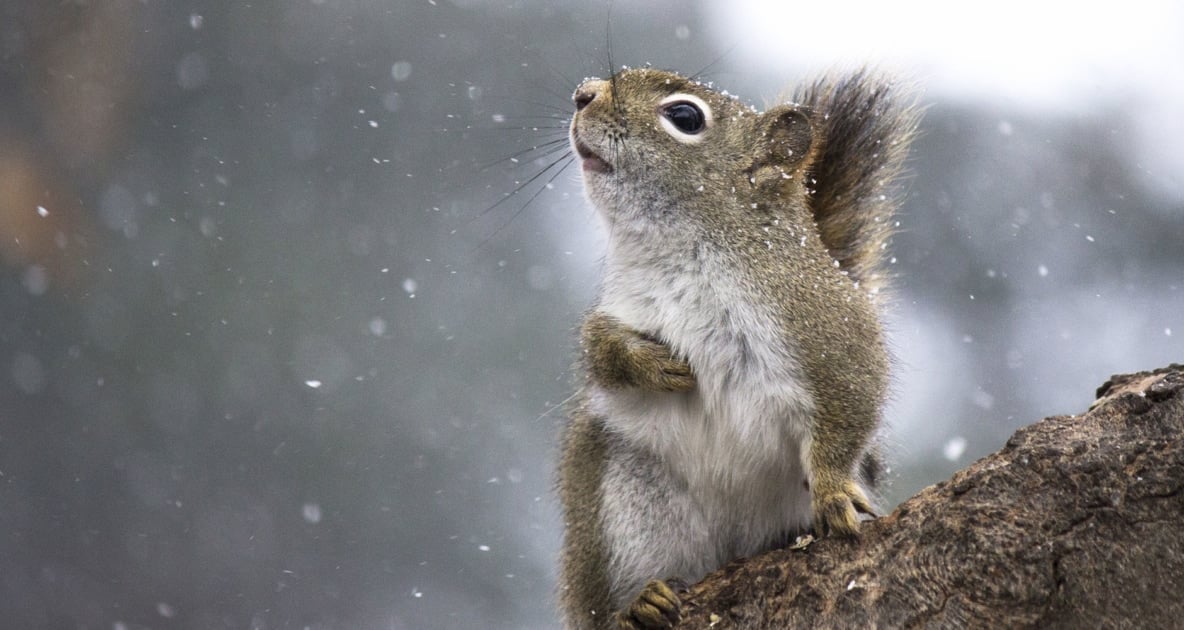
- Squirrels gathering nuts in a flurry will cause snow to gather in a hurry.
- As high as the weeds grow, so will the bank of snow.
- A green Christmas = a white Easter.
- If the first snowfall lands on unfrozen ground, winter will be mild.
- If there is thunder in winter, it will snow seven days later.
- See how high the hornet’s nest, ’twill tell how high the snow will rest.
- The higher muskrats’ holes are on the riverbank, the higher the snow will be.
- A halo ’round the moon means ’twill rain or snow soon.
- Mushrooms galore, much snow in store. No mushrooms at all, no snow will fall.
- The day of the month on which the first snowstorm comes gives the number of storms you can expect in the following winter.
The Science Behind a Few of These
Some snow lore rests on real ecology. Squirrels gathering nuts in a hurry usually means an early autumn temperature drop, which often signals a colder winter. High hornet nests off the ground correlate with insects responding to a wet spring and summer, which can also mean a snowy winter. A halo around the moon is light refracting through ice crystals in high cirrus clouds, which often run ahead of a warm front with rain or snow within 24 hours. The lunar age rule is harder to test, but it has been carried in American farm calendars since the 1800s.

Snow Lore by Region
| Region | Saying | Scientific basis (brief) |
|---|---|---|
| Northeast | “Onion skins very thin, mild winter coming in; onion skins thick and tough, coming winter cold and rough.” | No confirmed scientific basis. Onion skin thickness reflects moisture and growing conditions during summer, not forthcoming winter severity. Widely documented in American and British weather folklore. |
| Northeast | “Red sky at night, sailor’s delight; red sky in morning, sailor’s warning.” | Partial basis in atmospheric optics. A red evening sky often signals dry air moving in from the west (fair weather), while a red morning sky can indicate moisture-laden air with a storm approaching. NWS acknowledges the general principle holds in mid-latitudes with prevailing westerlies. |
| South | “If the woolly bear caterpillar has a wide brown band, expect a mild winter; a narrow band means a harsh one.” | No reliable scientific basis. Entomologists at NOAA and university extension programs note the caterpillar’s band width reflects its age and the quality of the prior growing season, not winter severity. Accuracy studies show roughly chance-level prediction rates. |
| South | “Thunder in winter, snow within ten days.” | Weak anecdotal basis. Some meteorologists note that winter thunderstorms can be associated with strong frontal systems capable of producing heavy precipitation, but the ten-day window is too vague to be testable. |
| Midwest | “When squirrels gather nuts early and in large numbers, expect a hard winter.” | No confirmed basis. Wildlife biologists note squirrel caching behavior is driven by current mast crop abundance, not a predictive response to future winter conditions. The Old Farmer’s Almanac and NOAA folklore reviews both classify this as popular but unverified lore. |
| Midwest | “As high as the weeds grow, so will the snow.” | No direct scientific basis. Weed height reflects spring and summer rainfall. However, wet summers in the central Plains can correlate loosely with active storm tracks in winter, giving the saying a very weak indirect connection at best. |
| Great Plains | “If the first snow falls on unfrozen ground, it won’t last; if it falls on frozen ground, it stays.” | Solid physical basis. Unfrozen soil retains heat that melts snow from below. Once ground is frozen, that heat sink is gone and snow persists much longer. Consistent with standard soil thermodynamics covered in NOAA and university extension cold-weather guides. |
| Great Plains | “Heavy corn husks mean a cold winter ahead.” | No scientific basis as a forecast tool. Husk thickness is determined by growing-season conditions, not by the plant anticipating winter. Dismissed by agronomists and atmospheric scientists. |
| Mountain West | “When the mountains put on their caps, prepare for rain or snow.” | Strong meteorological basis. Orographic cloud formation (cap clouds) over mountain peaks indicates moist, unstable air being forced upward. NWS forecasters use cap-cloud observations as real-time indicators of precipitation likelihood in mountain and valley locations. |
| Mountain West | “A year of snow, a year of plenty.” | Documented agronomic basis for the mountain West. Heavy snowpack provides spring and summer water supply for crops and livestock via snowmelt. NRCS snowpack data consistently links deep mountain snowpack to higher summer streamflow and irrigation availability. |
| Pacific Northwest | “Mackerel sky, mackerel sky, never long wet, never long dry.” | Moderate scientific basis. Altocumulus and cirrocumulus clouds arranged in fish-scale patterns often signal mid-level atmospheric instability ahead of a warm front. NWS meteorological guides note these cloud types frequently precede changing weather within 24-48 hours in maritime climates. |
| Pacific Northwest | “If it rains before seven, it will clear before eleven.” | Partial basis in Pacific Northwest weather patterns. Early morning rain in the region is often tied to overnight marine influence or passing fronts that move through relatively quickly. Local NWS offices note the saying holds better in spring and fall than in winter, when fronts can stall. |
Does Snow Lore Actually Work?
Most of these rules have not been tested under controlled conditions, and some are likely coincidence preserved by selective memory. That said, snow lore survived for 200 years because rural readers depended on it. The strongest rules tend to involve animals reacting to seasonal cues that humans miss: an early shift in squirrel behavior, deeper muskrat dens, higher hornet nests. The weakest rules tend to be the strictly numeric ones, like counting fogs day-for-day. The Almanac respects all of them, publishes them, and lets readers decide.

Frequently Asked Questions
What is the most famous snow lore rule?
“For every fog in August, there will be a snowfall the following winter.” It is the snow rule most commonly repeated in American farm folklore and survives in printed almanacs going back to the early 1800s.
Do animals really know if winter will be hard?
They respond to late-summer and early-fall cues that often correlate with the kind of winter ahead. Earlier nut-gathering in squirrels, heavier coats on cattle, higher hornet nests, all reflect animals reacting to weather signals humans tend to miss. None of these is a controlled experiment, but the patterns have been documented for centuries.
What does “six weeks after the last September thunderstorm” mean?
The folklore says the first snowfall in your region arrives six weeks after September’s last thunderstorm. The rule has held up well enough in Mid-Atlantic and Midwest farm diaries to keep being passed down, though the timing varies by latitude.
Does the Farmers’ Almanac use snow lore in its forecast?
No. The Almanac respects the lore and publishes it, but our long-range forecast comes from a mathematical and astronomical formula refined since 1818. We do not count fogs, squirrels, or wasp nests when we make our predictions.
How can I use these signs in my own yard?
Pick two or three signs that apply to your region, write them on the kitchen calendar, and check them through the fall. Treat any single sign as a guess. Three signs pointing the same direction is a working forecast.
Where can I read more winter folklore?
See 20 Signs of a Hard Winter for the full catalog, plus December weather lore and hurricane weather lore.
Related
- December weather lore
- What does weather lore say about hurricanes?
- Snow myths and odd facts


Caleb Weatherbee
Caleb Weatherbee is the official forecaster for the Farmers' Almanac. His name is actually a pseudonym that has been passed down through generations of Almanac prognosticators and has been used to conceal the true identity of the men and women behind our predictions.
- Caleb Weatherbee

- Caleb Weatherbee
- Caleb Weatherbee
- Caleb Weatherbee


My grandfather always pointed out a “Snow Sun” to me. The full sun has a mysterious glare to it the day before a snowstorm. It proved true today. Again!
. In one of the coldest decades of the Little Ice Age in Boston, Reverend Joseph Green wrote in his diary as early as September 6, 1703: “Snow at night 2 inches.” In Salisbury, Massachusetts, Reverend John Pike saw the first snow fall September 28, 1703 the diarist date October 31, 1703 as the beginning of Winter. Think about it snow in September?
Winter for Halloween?
I was writing about “Blood Snow” this time last year trust me no one would listen …. an omen found in the puritan writings of Reverend Cotton Mather was being cited in 2019 across the world before Covid-19 was ever known. Trust me no one would listen.
It is site to behold “Watermelon Snow”
I was always told whatever day the first snow that is how many measurable snows you are going to have. Our first was on 28th..we have had 25 snows, 2 ice with another forecast before the weekend.
I was told if a cat can see its footprints in the first snow storm, that date would predict the number of bad storms with large amounts of snow.
First snowstorm in 2021 was today (November 2) it was a dusting, but enough snow, on the ground, for a cat to see its footprints. Did you ever hear this?
My great grandmother said, Thunder in January (or February, forget which) snow in May. In the St. Louis snow storm of 85 or 86, it thundered, and in May there was still snow on the ground. Not sure if that counts for lore to be true, but I found it interesting.
My mother grew up in the 1930’s inTennessee and would say the fire is tromping snow when the fire made a a regular, whooshing sound. I never heard any weather connections. It was just a sound presumably caused by the wind across the chimney.
hi
Old mountain saying: the fire is tromping snow. My granny in the North Georgia mountains used this when sparkles ignited in the air outside of the wood heater, just after opening the door to replenish wood. These just happened in central Mississippi. We’ll see if snow follows. It is predicted for us.
Handed down, over many generations: “If you see the birds a flockin’, in six weeks the snow comes a knockin’.” I’m usually pretty amazed by how accurate that ends up being. This was from a southern Minnesota perspective for forecasting the first snow of the year.
What is the first date of snowfall for 2017?
My born & raised Bostonian Mom always said, “When it snows like sand, it will cover the land. If it’s big as a feather, it won’t last forever.” Works EVERY time!