

Daughter of the Wind: Tornado Weather Folklore
The Seneca Tribe once believed tornadoes were actually an evil spirit named Dagwanoenyent. Learn more!
Quick Reference
- Who: Dagwanoenyent, daughter of the wind spirit in Iroquois (Seneca) tradition. Took the form of a whirlwind. Could not be killed.
- Where: The Iroquois League of five nations, the Northeast woodlands of what is now New York and southern Ontario.
- What the legend says: She picks up anyone who angers her and throws them many miles. She gave a pair of brothers three hairs from her head, so they could pull rain from the sky.
- The science underneath: Tornadoes form inside supercell thunderstorms when warm moist air rises and collides with cooler dry air aloft. Funnel speeds can reach 100 mph or more. Roughly 800 touch down across the United States each year.
- For more lore: Pair this read with our Rain Dragon folklore and Anemoi wind myths.
Long before modern science began to understand the processes that create our weather, people made up their own explanations. Many of these accounts were fantastic in nature, with evil or benevolent gods, monsters, and spirits controlling the elements. In this series, we explore some of these ancient myths and share the science behind them. Weather + mythology = weather-ology!
Tornadoes are a frightening and deadly force of nature, so it is not surprising that the people who made up the five nations of the Iroquois League once viewed them as a cruel and powerful spirit. Their name for that spirit was Dagwanoenyent, the daughter of the wind. She still carries a name in modern weather records: an average of 800 tornadoes spin across the United States every year, killing dozens of people and injuring thousands.

Tornado Mythology and Lore
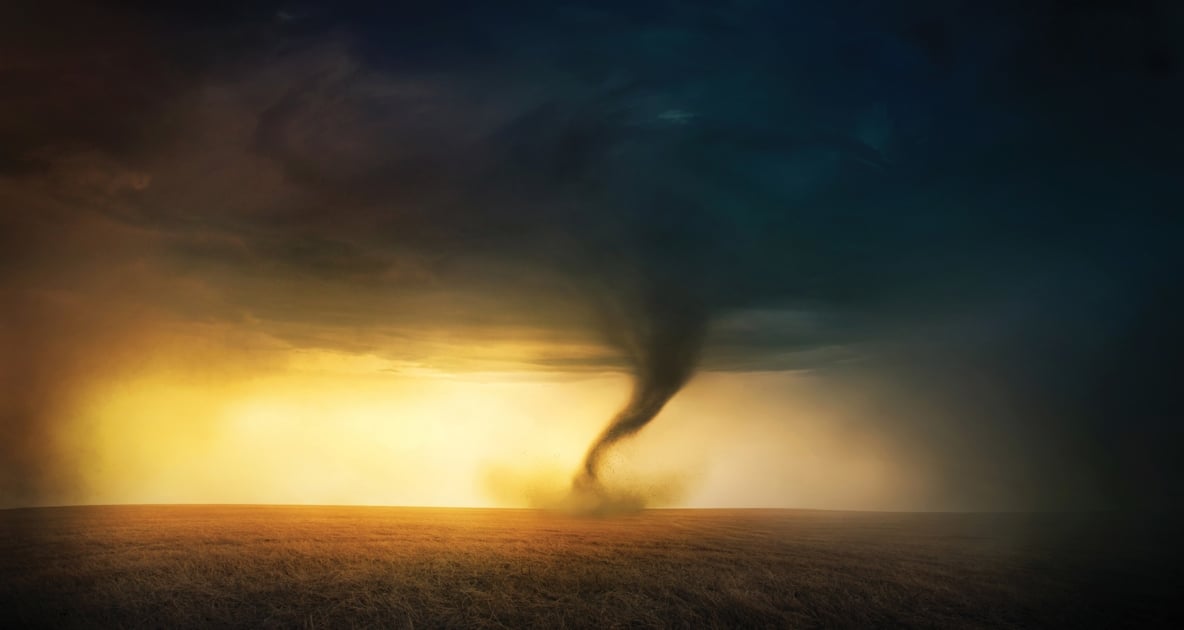
According to Iroquois mythology, tornadoes were Dagwanoenyent, the daughter of the wind spirit. She was said to take the form of a whirlwind. The Seneca Tribe considered her to be a dangerous witch and believed she could not be killed. Anyone who angered her would be picked up and thrown many miles away.
In other tellings, she was still fearsome but could be called upon for aid in battle by anyone who knew the right song to sing to her. She was even rumored to have given a pair of brothers three hairs from her head, which allowed them to draw rain from the sky whenever they needed it.
Another popular tale concerns her destruction at the hands of a man who was once her lover. After Dagwanoenyent attacked the man and his nephew several times, they burned her with fire and ground her bones to a fine powder. To prevent her from returning to life, they separated the powder into three bags and vowed to always keep them separate.
Dagwanoenyent must have outsmarted them, because she still visits us today. Each year, an average of 800 tornadoes sweep across the United States, killing dozens of people and injuring thousands.
Where the Myth Lived: The Iroquois Homeland
The Iroquois Confederacy, also called the Haudenosaunee, was a league of five (later six) nations: the Mohawk, Oneida, Onondaga, Cayuga, and Seneca, with the Tuscarora joining in 1722. Their territory ran across what is now upstate New York, southern Ontario, and parts of Pennsylvania and Quebec. That landscape is at the eastern edge of where modern Tornado Alley fades out, so historic twisters were rarer than on the Great Plains, but powerful when they hit. A storm system that could lift trees and tear off roofs was not a routine event there. It was the visit of a spirit.
Wind Spirits Around the World
The Iroquois were not alone in personifying the wind. Almost every culture that lived at the mercy of weather gave it a face. Some carried the same dread that Dagwanoenyent did. Some did not.
| Culture | Wind figure | Mood |
|---|---|---|
| Iroquois (Seneca) | Dagwanoenyent | Vengeful witch |
| Greek | The Anemoi (Boreas, Notus, Eurus, Zephyrus) | One per direction |
| Japanese | Fujin | Demon with a bag of wind |
| Aztec | Ehecatl | Breath of life and creator |
| Norse | Njord and Kari | Cold gales of the north |
What unites them is the recognition that something powerful was loose in the air. What sets the Iroquois telling apart is its emotional honesty. Dagwanoenyent is not a calm sky god. She is a witch who throws people miles, and the only protection is to stay on her good side.
Legend Aside, What Really Causes Tornadoes…
Today, of course, we know that tornadoes are caused by giant thunderstorms known as “supercells.” They form when warm, moist air rises from the ground and collides with cooler, drier air above it. The rising warm air cools, causing the moisture it carries to condense and form a massive thundercloud. These supercell clouds can reach heights of up to 70,000 feet.
At the same time the cloud is forming, the cooler air begins to sink, sending the warmer air spinning upward. This is what creates a tornado’s characteristic funnel shape. This spinning column of air picks up momentum as it goes, reaching speeds of up to 100 miles per hour. Once it gets going, a tornado can smash buildings into splinters, pick up automobiles, strip the bark from trees, and worse.
It is hard to believe air alone could be so destructive, so it is not a far leap to imagine such a deadly weather phenomenon to be the evil spirit of Dagwanoenyent, daughter of the wind.
Tornado Alley, Today
About 1,200 tornadoes are reported in the United States in a heavy year. The average is closer to 800. The peak months are April, May, and June, when warm Gulf air slams into cool air dropping out of the Rockies. The classic Tornado Alley runs from north Texas through Oklahoma, Kansas, and Nebraska, with a second active corridor across the Lower Mississippi Valley known as Dixie Alley. The NOAA Storm Prediction Center tracks every confirmed funnel and rates it on the Enhanced Fujita scale, EF0 through EF5.
The fastest wind speed ever measured inside a tornado was 318 miles per hour, recorded by Doppler radar on May 3, 1999, during the Bridge Creek-Moore tornado in Oklahoma. That is what Dagwanoenyent looks like when the science finally catches up to the legend.

Frequently Asked Questions
Who was Dagwanoenyent?
Dagwanoenyent was the daughter of the wind spirit in Iroquois mythology. The Seneca Tribe believed she took the form of a whirlwind, could not be killed, and would throw anyone who angered her many miles away. She is the figure behind the tornado in the oral tradition of the five nations.
Did the Iroquois experience many tornadoes?
Fewer than the Plains tribes did. The Iroquois homeland in upstate New York and southern Ontario sits east of the main Tornado Alley, so significant twisters were rare events. That rarity is part of why the legend frames Dagwanoenyent as a witch who visits with intent rather than an everyday weather pattern.
How do tornadoes actually form?
Tornadoes form inside supercell thunderstorms. Warm moist air rises from the surface and collides with cooler dry air aloft. The rising air cools, condenses into a towering thundercloud (up to 70,000 feet), and the descending cool air sets the column spinning. The result is a funnel that can reach 100 mph or more at the surface.
How many tornadoes hit the United States each year?
An average of 800 confirmed tornadoes are reported in the United States each year, with the count climbing past 1,200 in heavy seasons. Dozens of people are killed and thousands are injured. The most active months are April, May, and June.
What is the fastest wind speed ever recorded inside a tornado?
A Doppler radar reading of 318 miles per hour was captured during the Bridge Creek-Moore tornado in Oklahoma on May 3, 1999. That stands as the highest measured tornado wind speed on record.
Where does Tornado Alley actually run?
The classic Tornado Alley runs from north Texas through Oklahoma, Kansas, and Nebraska. A second active corridor, often called Dixie Alley, covers the Lower Mississippi Valley including Mississippi, Alabama, and northern Louisiana. The NOAA Storm Prediction Center tracks every confirmed funnel.
Why do so many cultures have wind spirits?
Wind is the most visible invisible force people lived with. It moved trees, knocked down homes, and sailed boats, all without showing itself. Almost every weather-aware culture personified it. The Iroquois had Dagwanoenyent. The Greeks had the Anemoi. The Japanese had Fujin. The Aztecs had Ehecatl. Different faces, same response to the same mystery.
Tell Us
Have you weathered a tornado, or stood under the eerie green sky that comes before one? Tell us in the comments. For more wind folklore, see our Anemoi piece and storm-of-the-century coverage.


Jaime McLeod
Jaime McLeod is a longtime journalist who has written for a wide variety of newspapers, magazines, and websites, including MTV.com. She enjoys the outdoors, growing and eating organic food, and is interested in all aspects of natural wellness.
- Jaime McLeod

- Jaime McLeod
- Jaime McLeod
- Jaime McLeod




It’s 2021! Not 2012!
“Super Cells”! Everyone knows tornadoes are actually demons in the form of destructive wind currents.
Jamie,
Thanks for this fantastic article. I love Native American thought. I’m also into organic wellness. Have you used the Bach FLower remedies and the Young Living Oils? I have just used Frankincesne & Lavender to heal a badly strained knee. Big relief of strained muscle and after surgery pain & swelling. Regards,Dee in New Jersey
Thanks for the interesting reading. Even at my age, you constantly teach me something and keep me interested without any gimmicks just interesting reading and learning. Your website asks if I still want to keep getting this almanac info and I would never consider declining. thanks again
Thank you for this interesting article. I always ask my children to read them because I think they are so informative and they have learned some interesting facts from you.
Farmers Almanac
Thank you very much for all the very informative information that I have received over the years! I have been with you-all for years starting with the yearly almanac that I purchase yearly.thanks again!!!
Thank You I enjoyed the article where I live in so. ca we don’t get many so thank you it is always nice to know how they form
I appreciate the interesting & insightful lore and always learn something from your articles.