

The Dying of the Light:A Weather Folklore
Norse mythology had its own explanation for why winter is so dark. Learn more!
Quick Reference
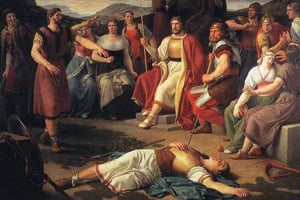
- Who: Baldur, Norse god of light. Killed at midwinter by his blind twin brother Hodur, god of darkness.
- The trick: Loki, god of mischief and fire, made a spear of mistletoe (the one plant Frigga forgot to ask for an oath of protection) and tricked Hodur into throwing it.
- Why the lore exists: The Scandinavian winter has very short days. The farther north, the shorter. The Norse used story to explain the dimming.
- The science: Earth’s axis is tilted 23.5 degrees. As the planet orbits the Sun, the Northern Hemisphere tips away from December through March, shortening daylight.
- Companion read: Our Lady of Autumn and Chariot of the Sun entries.
Long before modern science began to understand the processes that create our weather, people made up their own explanations. Many of these accounts were fantastic in nature, with evil or benevolent gods, monsters, and spirits controlling the elements. In this series, we explore some of these ancient myths and share the science behind them. Weather + mythology = weather-ology!
Winter can be a dreary time of year, not just because of the cold and snow, but also the darkness. Those who live in northern locales in the Northern Hemisphere can see very short days at this time of year, with the sun dropping below the horizon before evening has even arrived. The farther north you travel, the shorter winter days are.

The Death of Baldur
It is not surprising, then, that the ancient Nordic people who inhabited the Scandinavian Peninsula, the northernmost part of Europe, had a sinister explanation for why a quarter of the year was so dark. In Norse mythology, winter commemorates the death of the god of light, Baldur, at the hand of his blind twin brother, Hodur, god of darkness.
According to legend, Baldur had begun to experience terrible nightmares about his own death. To ease Baldur’s mind, his mother, Frigga, made everything in heaven and Earth, plants, animals, weapons, and the rest, swear an oath not to harm her son. Because Baldur was so universally loved, everything she asked gladly made this promise. In time, Baldur was so famously invincible that the ever-exuberant gods of Asgaard began to make a sport of throwing various objects at the light god, just to watch them clatter harmlessly to the ground.
Unfortunately, Frigga had made a fatal mistake. She neglected to ask mistletoe for a pledge, believing it was too harmless to matter. Seizing on Frigga’s oversight, Loki, the god of mischief and fire, fashioned a spear of mistletoe. He tricked Hodur into throwing it at his brother, under the pretext of joining in the popular game. Instead of bouncing off Baldur, the mistletoe pierced his heart, killing him and bringing darkness to the world.
Why Mistletoe?
Mistletoe is a parasitic evergreen that grows in the high branches of oak and apple trees. It bears fruit in midwinter, when nearly everything else is brown. The Norse, like the Druids before them, treated it as sacred, the one bit of green stubbornly persisting through the dark season. The story turns that resilience inside out: the green that survives winter is the same green that ends Baldur. The plant we now hang in doorways for kissing is, in the older telling, the murder weapon. The English custom of hanging mistletoe and the modern Christmas garland both descend from that pre-Christian reverence.
The Real Cause of the Dying Light
Of course, today we know that the real cause of the dark winter days is the tilt in the Earth’s axis. As the planet revolves around the Sun, its northern and southern hemispheres take turns soaking in the majority of the Sun’s light. During the part of the year when the northern hemisphere is inclined toward the Sun, that part of the Earth enjoys summer weather and the days grow longer. As time goes on, and the Earth continues its journey around the Sun, the southern hemisphere gets its proverbial day in the Sun. The days get longer down there and shorter in the northern hemisphere.
During the dark ages, though, the relationship between the Earth and the Sun was not widely understood. Without knowing about the tilt in the Earth’s axis, or our annual trip around the Sun, the Norse people used the power of storytelling to explain why the days grew shorter in winter.
How Short Do the Days Actually Get?
The amount of daylight on the December solstice depends entirely on how far north you are. Here is what the dying light actually looks like across the Norse world and the parts of North America settled by their descendants.
| Location | Latitude | Daylight on Dec 21 |
|---|---|---|
| Reykjavik, Iceland | 64.1 N | 4 hr 7 min |
| Tromso, Norway | 69.6 N | 0 hr (polar night) |
| Stockholm, Sweden | 59.3 N | 6 hr 5 min |
| Anchorage, Alaska | 61.2 N | 5 hr 28 min |
| Minneapolis, Minnesota | 44.9 N | 8 hr 46 min |
| New York City | 40.7 N | 9 hr 15 min |
| Miami, Florida | 25.8 N | 10 hr 32 min |
The further north you go, the more it makes sense that someone would invent a story to keep their courage up. Above the Arctic Circle, the sun does not rise at all in midwinter. For the Norse, that was not weather. That was the funeral of a god.
The National Weather Service publishes day-length and sunrise tables for every U.S. station, so you can watch the same light return your great-grandmother once watched.

Frequently Asked Questions
Who is Baldur in Norse mythology?
Baldur is the Norse god of light, son of Odin and Frigga. The legend says he died at midwinter when his blind twin brother Hodur, the god of darkness, was tricked by Loki into throwing a mistletoe spear at him. His death is the reason the days grow short in winter.
Why mistletoe of all things?
Frigga asked everything in heaven and Earth to swear an oath not to harm Baldur. She skipped mistletoe, thinking it was too harmless to matter. Loki noticed the gap and made a spear from it. Mistletoe was already a sacred plant in pre-Christian Northern Europe because it stays green through winter. The story turns that resilience inside out.
What is the real reason winter days are so short?
The Earth’s axis is tilted 23.5 degrees relative to its orbit around the Sun. From late September through late March, the Northern Hemisphere is tipped away from the Sun, so it receives sunlight at a lower angle and for fewer hours each day. The farther north you live, the more pronounced the effect.
How short do the days get in Scandinavia?
In Stockholm the December solstice brings about 6 hours of daylight. In Reykjavik, about 4 hours. North of the Arctic Circle, places like Tromso, Norway, see the sun never rise at all for several weeks, a stretch known as polar night.
Did the Norse celebrate the return of the light?
Yes. The midwinter feast known as Yule, observed roughly from the December solstice into early January, marked the moment when the sun finally stopped retreating and began to climb again. Many of its customs (the evergreen tree, the Yule log, mistletoe) survived as Christmas traditions.
Who is Loki and why does he kill Baldur?
Loki is the Norse god of mischief and fire, a trickster who often turns against the other gods. In this myth he engineers Baldur’s death partly out of spite, partly out of restlessness. Some scholars read him as the necessary disorder that lets the year turn at all.
Where can I find local sunrise and sunset times?
The National Weather Service publishes sunrise, sunset, and day-length tables for every U.S. station. The Farmers’ Almanac also publishes a daily sun and moon table for your zip code in our annual edition.
Tell Us
How short does midwinter get where you live? Tell us in the comments. For more weather folklore, see our Lady of Autumn and Chariot of the Sun entries.


Jaime McLeod
Jaime McLeod is a longtime journalist who has written for a wide variety of newspapers, magazines, and websites, including MTV.com. She enjoys the outdoors, growing and eating organic food, and is interested in all aspects of natural wellness.
- Jaime McLeod

- Jaime McLeod
- Jaime McLeod
- Jaime McLeod





I read a book about Norse mythology. Pretty interesting! Make sense.