

The Cuban Sandwich: History, Tampa vs Miami Debate, and a Pressed Cubano Recipe
We love this delicious Latin variation of the grilled ham and cheese. Learn how to make it at home.
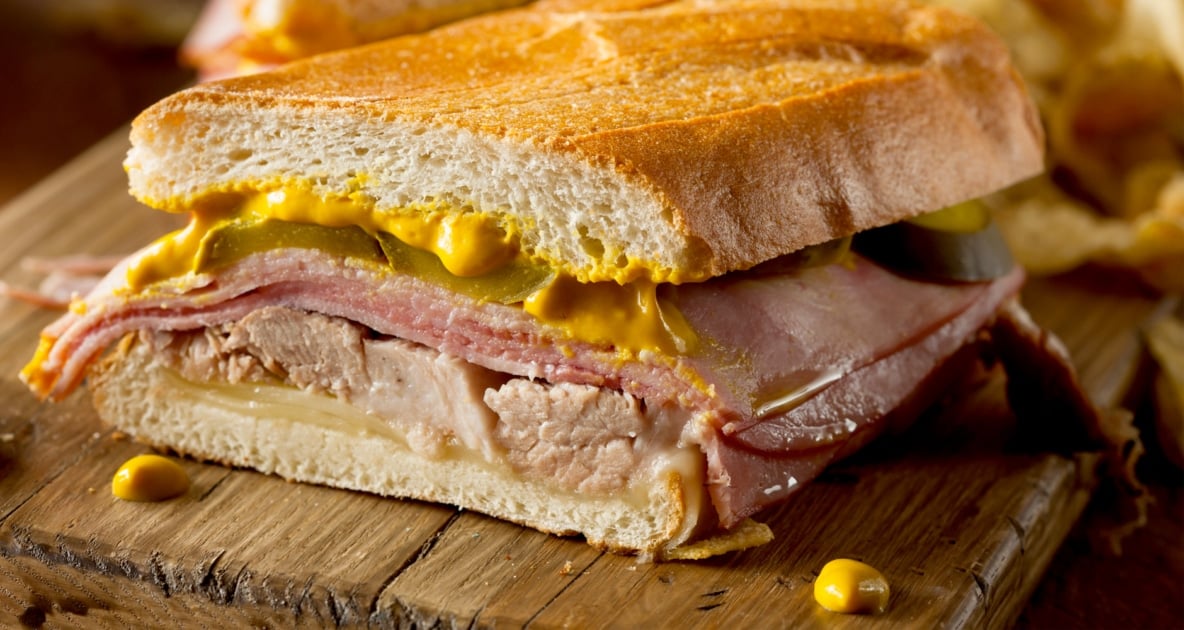
Cuban Sandwich at a Glance
- What goes in: Cuban bread, glazed deli ham, slow-roasted citrus pork (lechon asado), Swiss cheese, dill pickles, yellow mustard. Butter or olive oil for the crust.
- Where it comes from: Cuban cigar-factory and sugar-mill workers in Santiago de Cuba and Havana in the 1800s. It crossed to Key West, Tampa, and Ybor City with the cigar industry by 1900.
- The salami question: Tampa Cubans add Genoa salami (the Italian-immigrant influence at Ybor City). Miami Cubans don’t. Both sides are correct; both sides will argue.
- The right way to grill: in a hot plancha (ungrooved press) until the bread is golden, the cheese is melted, and the loaf is pressed to about a quarter of its original height.
- Related sandwich: the medianoche (“midnight”) sandwich, same fillings but on softer challah-like bread, sold in Havana nightclubs late at night.
The ingredients of the Cuban sandwich, glazed ham, roast pork, Swiss cheese, crunchy pickles, tangy mustard, are enough to tempt anyone to the nearest deli. But layered on Cuban bread (a baguette-like style), brushed with butter or olive oil and grilled in a plancha, or ungrooved sandwich press, the Cuban sandwich with its juicy, melded components is irresistible to longtime connoisseurs and brand-new converts alike.
According to the Encyclopaedia Britannica, the modern grilled, pressed sandwich is in fact one of the most internationally widespread food formats of the 20th century, but the Cuban version, born in the cigar factories of late-1800s Cuba and matured in the immigrant kitchens of Ybor City, is its most distinctive American expression.
What is a Cuban Sandwich?
Think of it as a grilled ham and cheese sandwich, kicked up a notch. Known also to culinary insiders as a cubano, Cuban Mix, Cuban pressed sandwich, or mixto, this specialty sandwich is reported to have been around since the mid-1800s, with some reports dating its genesis to the early 1500s. It was served to workers in cigar factories and sugar mills, first in cities like Santiago de Cuba and Havana, Cuba, and then in Key West, Tampa, and Ybor City, Florida as cigar factories moved to the United States. The Cuban sandwich was a portable meal that could be eaten without fuss during the long work day.
According to food historians, by the mid-1960s the Cuban sandwich found a welcome home in Miami restaurants too, following the large Cuban migration to that city after Batista’s fall. It made its way to New York, New Jersey, and Chicago as Cuban exiles moved further north. In Florida, street corner snack bars called rancherias readily serve the beloved Cuban sandwich, as they have for decades.
Variations on the sandwich include the medianoche, or midnight sandwich, popular at Havana nightclubs in the late-night hours. The ingredients are the same as its Cuban sibling, but it is smaller and made with soft bread similar to traditional Jewish challah.
Tampa vs Miami: The Salami Debate
| Element | Tampa Style (Ybor City) | Miami Style |
|---|---|---|
| Bread | Cuban bread (long loaf, scored with a palmetto frond before baking) | Cuban bread (same style) |
| Roast pork | Mojo-marinated, slow-roasted | Mojo-marinated, slow-roasted |
| Ham | Sliced baked or boiled ham | Sliced baked or boiled ham |
| Swiss cheese | Yes | Yes |
| Dill pickles | Yes | Yes |
| Yellow mustard | Yes | Yes |
| Genoa salami | YES. This is Tampa’s defining addition | No. Salami is absent from the Miami version |
| Pressed / grilled | Yes, on a flat plancha press | Yes, on a flat plancha press |
| Origin claim | Ybor City cigar-factory workers (Cuban and Italian immigrant communities), late 1800s to early 1900s | Cuban exile community in Miami, mid-20th century |
| Official recognition | 2012 Tampa City Council resolution declared the Ybor City Cuban the city’s “signature sandwich” | No equivalent formal designation |
Why salami in Tampa? The large Italian immigrant community in Ybor City worked alongside Cuban cigar workers and shared the lunch counter. Salami was an everyday Italian staple, and it crossed over into the sandwich that way.
Cuban Sandwich Recipe
Try this recipe for the ultimate Cuban sandwich, courtesy of Linda Stradley.
Cuban Sandwich Recipe
Ingredients:
- 1 loaf Cuban bread*
- Prepared yellow mustard
- 1/2 pound deli baked ham, thinly sliced
- 1/2 pound roasted pork, thinly sliced
- 8 thin dill pickle slices
- 1/2 pound Swiss cheese, thinly sliced
* Italian or French bread may be substituted
Instructions:
- Slice the bread horizontally to open.
- Spread a thin layer of mustard on top and bottom halves of bread.
- Arrange ham, pork, pickle slices, and Swiss cheese evenly over the bread.
- Cover the sandwiches with the top halves of the bread.
- Cut into 4 sandwiches and use one of the following methods for cooking:
Sandwich/Panini Press/George Foreman Grill: Grill sandwiches in a hot buttered sandwich press until flat, the bread is browned, and the cheese has melted. Remove from heat; cut each sandwich in half and serve immediately.
Waffle Iron: Turn over the metal plates to the flat surface. Place the sandwich in a hot buttered waffle iron, close the cover, and grill for 3 minutes on each side.
Griddle or Frying Pan: Place the sandwich on a hot griddle or frying pan, and position a heavy iron skillet or bacon press on top of the sandwich. Flatten the sandwich to about 1/4 of its original size. Grill the sandwich for 2 to 3 minutes on each side.

Frequently Asked Questions About the Cuban Sandwich
What’s on an authentic Cuban sandwich?
Glazed deli ham, slow-roasted citrus-marinated pork (lechon asado), Swiss cheese, sliced dill pickles, and yellow mustard, between two long halves of buttered Cuban bread, then pressed flat in a hot plancha until the bread is golden and the cheese melts.
What’s the difference between a Tampa Cuban and a Miami Cuban?
Genoa salami. The Tampa version, born in Ybor City where Italian and Cuban immigrants worked together in the cigar factories, includes salami. The Miami version, which became the dominant style after the 1960s Cuban migration, never includes it. Tampa swears its way is the original; Miami swears the same. Both are correct in their own city.
What is Cuban bread?
A long, soft-crusted loaf made with lard or vegetable shortening, baked under a wet palmetto leaf in the traditional Tampa method. The interior is light and pillowy; the crust is thin and just crisp enough to hold the press without shattering. Italian or French bread is the most common substitute.
What’s a medianoche sandwich?
“Medianoche” means “midnight.” Same fillings as a cubano, but smaller and on a softer, slightly sweet egg bread similar to challah. It was a late-night sandwich in Havana nightclubs and now appears on most U.S. Cuban-bakery menus alongside the regular cubano.
Do you put mayo, lettuce, or tomato on a Cuban?
No, and you will be corrected if you ask for them in a Cuban-American deli. The sandwich is built on the crunch of pickle and the melt of cheese against the press; lettuce and tomato release water that ruins the press, and mayo is unwelcome competition for mustard.
How do you press a Cuban sandwich without a plancha?
A panini press, a George Foreman grill, a flat-side waffle iron, or a hot skillet with a second heavy skillet weighted on top. The goal is to compress the loaf to about a quarter of its original height while crisping the bread and melting the cheese, about 2 to 3 minutes per side.
How long has the Cuban sandwich been around?
Documented at least to the mid-1800s in Cuban cigar factories and sugar mills, with some accounts pushing the format back to the early 1500s. It reached Tampa with the cigar industry by 1900 and Miami after the 1959 Cuban revolution.
For more sandwich and regional-food reading, see Thanksgiving leftovers sandwich, what the heck is poutine, and what is scrapple.


Beth Herman
Beth Herman is a freelance writer with interests in healthy living and food, family, animal welfare, architecture and design, religion, and yoga. She writes for a variety of national and regional publications, institutions, and websites.
- Beth Herman

- Beth Herman
- Beth Herman
- Beth Herman


I haven’t lived in FL for 20 years but I am sure there is still debate as to whether Tampa or Miami have the best Cuban sandwich, being from Tampa there is no other than the Silver Ring. Not sure which I miss the most Cubans or smoked mullet.
Oh my, I adore Cuban sandwiches! While I’ve only eaten then while vacationing in Florida, these Sammies are definitely the cat’s meow. Thanks for sharing the information and I also appreciate my fellow readers’ commentary about authentic vs. American. Viva el Sandwich Cubano!
Best on Ciabatta then grilled! Mmmmmmmmm
The problem some people have is determining the difference between a “sandwich” in Cuba and an American “Cuban sandwich.” The American Cuban sandwich cropped up in Tampa’s Ybor City at the turn of the century. As the immigrants shaped the landscape, the sandwich morphed accordingly by the 40’s, which is when Genoa salami became a crucial ingredient. Tampa Bay historian Andy Huse has evidence of Salchichon (a Spanish salami) being used prior to Genoa salami. I have written accounts from newspapers citing the use of Braunschweiger on Cubans, as well as an article from 1934 that calls for “soft salami.” So it seems that when the sandwich hit the sandy shores of west Florida, there was always a salami/sausage in play, and with the vast number of Cubans and Italians mingling in Tampa, it seems the Genoa salami found it’s home between two pieces of Cuban bread. The Miami Cubans came roughly 70 years after Tampa’s Cubans, and what they brought to Miami was a salamiless sandwich, and this is why we have a 300 mile salami divide. Either way, with or without salami, it’s the best sandwich in the world. Oh, and that Cuban sandwich pic needs to be updated. Please.
Hello and thank you for posting a note about the yummy Cuban sandwich. Just so your readers know, I lived in Cuba until the age of 14 and ate plenty of Cuban sandwiches there. The Cuban sandwich DEFINITIVELY does not contain salami. No, no no. Home baked ham, (no sweet ham) home baked pork, pickles, Swiss cheese and mustard. No mayonnaise either. Thanks! Oh, and serve hot!! Melt that cheese! Caliente! Thanks and a happy and healthy New Year for all.
The correct spell would be “Viva el Sandwich Cubano”
The ingredients are correct, but the apparience is not. I post a real cuban sandwich from Miami. Thank you