

5 Beautiful Songbirds to Invite to Your Backyard
Send an avian invitation to these songbirds this year. They're musical and beautiful and they keep the backyard bug population in check!
Quick Reference: Songbirds for Your Backyard
- Top 5 songbirds to invite: Northern Cardinal, House Wren, White-Breasted Nuthatch, American Goldfinch, Eastern Phoebe.
- Best all-round feeder food: Black oil sunflower seeds (covers 3 of the 5: cardinal, nuthatch, goldfinch).
- Best insect eaters: House Wrens and Eastern Phoebes (they cut pests without pesticide).
- Year-round resident: Northern Cardinal (does not migrate).
- Population trend to know: North America has lost about 3 billion breeding birds since 1970 (Cornell Lab / Science, 2019).
- What matters most: Water, native plants, and a pesticide-free yard beat any premium seed mix.
There are more than 900 bird species in North America, some of which can only be found east of the Mississippi River, others only in the West. Some grace our yards with their presence only when migrating, while others live in our neighborhoods year-round. A little research online, at your public library, or at a local wild birdfeed store can teach you about some of the birds you can attract to your yard. Below are our top picks of beautiful and beneficial songbirds you might want to invite over for a backyard bird party, along with what to feed each one, when to expect them, and one honest note on why every backyard matters more than it used to.
Why Songbirds Deserve a Standing Invitation
A 2019 study led by the Cornell Lab of Ornithology, published in the journal Science, reported that North America has lost roughly 3 billion breeding birds (about a 29% drop) since 1970. Grassland species took the hardest hit. Songbirds in your yard are not just cheerful company. They are pest control, seed movers, and living data points for citizen-science counts. A yard with clean water, native plants, and no pesticide spray is a small refuge on a very long flyway.
What Every Songbird Yard Needs
- Water: A shallow birdbath cleaned twice a week beats a fancy feeder.
- Cover: A shrub or brush pile within 10 feet of the feeder gives smaller songbirds a safe dart.
- Native plants: Berry shrubs, seed-bearing flowers, and a few tall grasses feed more birds than seed alone.
- Pesticide-free lawn: Insects are baby-bird food. Nesting House Wrens can raise two broods of six to eight in one summer, and every one of those chicks is fed insects.
- Quiet corner: A brush pile in a back corner offers winter shelter that no store-bought house can match.

5 Songbirds To Invite To Your Yard
1. Northern Cardinal
This bird has it all for the new backyard birder. Its cheery whistle, distinctive head crest, and bold coloring make it easy to identify. The male is a stunning shade of red that he keeps all year rather than molting into a dull winter shade. That is why he shows up on holiday greeting cards and winter landscape paintings. The female, mostly warm brown, has splashes of red on her wings, tail, and crest, plus the same sharp crest her mate wears. Cardinals do not migrate, so if you attract some to your yard, you may have year-round company. Listen to the female cardinal here.
Fill your feeder with:
- Sunflower seeds
- Peanut hearts
- Berries and fruit
- Suet crumble
- Grape jelly
Berry trees and bushes like mulberry and blueberry make the yard even more appealing to these red beauties. Cardinals feed heavily just after sunrise and again in the last hour before sunset, so keep the feeder topped up at both ends of the day.
2. House Wren
What these compact birds lack in color, they make up for in song. They also eat a lot of insects. If you are lucky enough to get a pair of wrens nesting in your yard, they may raise two broods of six to eight babies in a summer, which means real insect-eating protection for your garden. If you are not sure that the little brown songbird you are seeing is a House Wren, check the eyes. House Wrens never go out without eyeliner: a thin light line encircles each eye.
Wrens prefer live food over seeds, so they may not always show up at seed feeders. They do get thirsty, and they visit birdbaths. They love to nest almost anywhere they can, so a small wren house (a 1-inch entrance hole is the trick) may convince a pair to make their home in your backyard.
Wrens eat and may be attracted to:
- Peanut pieces
- Suet blends
- Mealworms
- Insects
3. White-Breasted Nuthatch
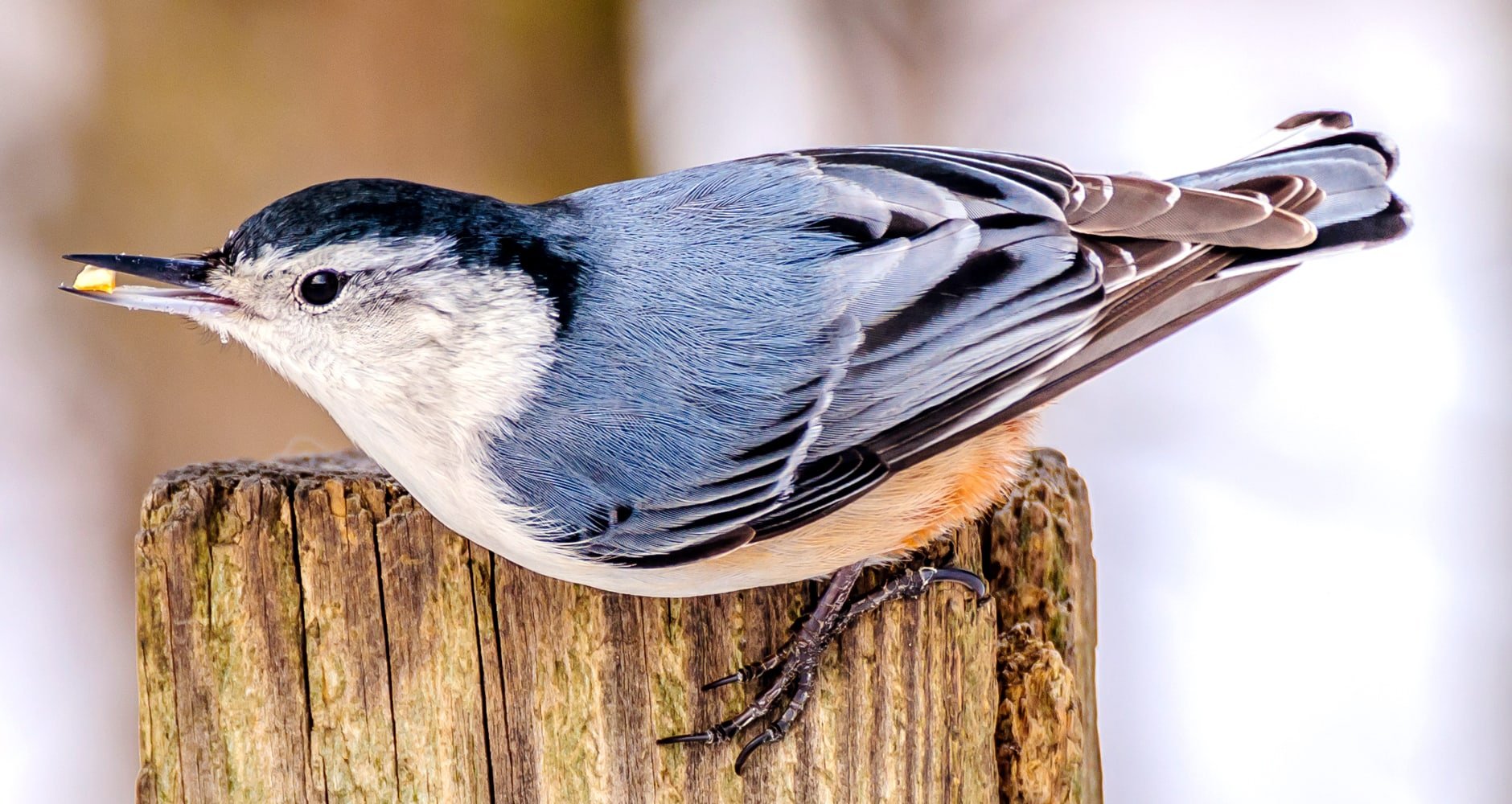
This little bird has a white face and belly, stylish gray-blue back feathers, and almost no neck. Nuthatches have a big appetite for bugs, nuts, and seeds. They are entertaining to watch because they will turn sideways or even upside down on feeders. The nuthatch got its name because it wedges an acorn or nut into tree bark, then hits it with its sharp bill to hatch the seed from the outer shell. Listen to their call here.
Attract nuthatches with:
- Suet
- Sunflower seeds
- Peanuts
- Live mealworms
Nesting boxes may also entice nuthatch pairs to breed. Position the box on a mature tree trunk between 12 and 20 feet up for the best chance of a nesting pair.
4. American Goldfinch
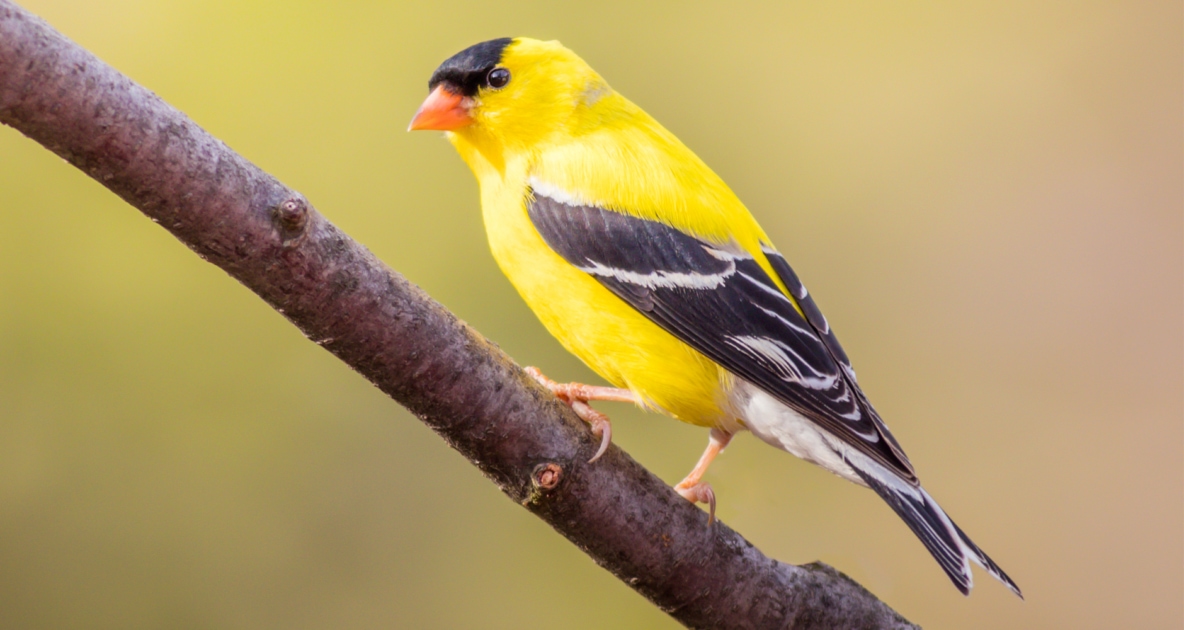
A well-known visitor to yards and gardens from coast to coast is the American Goldfinch. There is no trouble spotting the male with his bright yellow plumage, black wings, and black cap. The female is a duller yellow in summer and does not have a cap. In winter, they both lose their yellow coloring and turn drab brown, which makes them harder to identify. They are peppy little birds, flying in a bouncy pattern and often calling out while they fly. They eat mostly seeds and have a talent for clinging to tall plants or swaying feeders.
The food they love:
- Thistle or Nyjer seeds
- Black oil sunflower seeds
Finches love seed-bearing flowers. To pull in more, plant sunflowers, purple coneflowers, coreopsis, cosmos, zinnias, and asters. They are also drawn to grasses and tall weedy plants. American Goldfinches nest later than most songbirds (July through August) so that late-summer thistledown is available for lining the nest.
5. Eastern Phoebe
Listen closely, and these songbirds will tell you their name. Their call is a high-pitched, raspy “fee-bee! fee-bee!” They are brownish-gray on top, whitish-gray on their bellies, and have dark heads. Phoebes like to build nests under eaves and porch beams, then swoop around the yard catching flying insects for dinner. Phoebes migrate but are some of the first birds to return to northern locales in the spring, sometimes as early as mid-March.
To pull more into your yard, put up nesting boxes or leave a small shelf under a covered porch beam, away from predators. These birds prefer insects but will occasionally eat fruits or seeds. Make your yard insect-friendly by cutting back on pesticides. Elderberry, wild grape, or Virginia creeper along a back fence increases your chances of seeing more Eastern Phoebes.
Learn how to protect them from predators!
At-a-Glance Songbird Feeding Chart
| Songbird | What it eats | At the feeder | How to actually attract it |
|---|---|---|---|
| Northern Cardinal | Seeds, grain, fruit and some insects | Black oil sunflower, safflower, white millet, cracked corn | A platform or hopper feeder. Cardinals are poor clingers and prefer somewhere to perch |
| House Wren | Almost entirely insects and spiders: beetles, caterpillars, earwigs, daddy longlegs, flies, leafhoppers | Rarely visits feeders | A nest box. Wrens take old woodpecker holes, natural crevices and boxes |
| White-Breasted Nuthatch | Mainly insects: weevil and beetle larvae, ants, caterpillars, stinkbugs, spiders | Sunflower seeds, peanuts, suet, peanut butter | Suet or a peanut feeder near mature deciduous trees. It forages head-down along big trunks and limbs |
| American Goldfinch | Seeds almost exclusively. One of the few North American birds that is essentially vegetarian | Nyjer (thistle) and sunflower | A nyjer feeder, plus leaving thistle and coneflower heads standing |
| Eastern Phoebe | Flying insects: wasps, beetles, dragonflies, moths, flies, midges, cicadas | Does not visit seed feeders | A sheltered ledge under an eave, porch or bridge, and no pesticides |
Regional Songbird Guide: US and Canada
| Region | Which of the five you can expect | Notes |
|---|---|---|
| Northeast and New England | All five | Cardinal is a year-round resident. Phoebe arrives early in spring, often before the last snow |
| Southeast and Gulf | All five | Cardinal and nuthatch year-round. Goldfinches are duller in winter plumage, so are often missed |
| Midwest and Great Lakes | All five | Classic range for the whole set |
| Great Plains | Cardinal (eastern half), house wren, goldfinch, phoebe (eastern half) | Nuthatch presence is patchy across the treeless middle. It needs mature trees |
| Mountain West and Southwest | House wren, goldfinch, white-breasted nuthatch | Cardinal reaches Arizona and New Mexico but is absent from most of the interior West. Eastern Phoebe is largely an eastern bird |
| Pacific Northwest and California | House wren, goldfinch, white-breasted nuthatch | No Northern Cardinal. Its range does not reach the West Coast. No Eastern Phoebe either; the western counterpart is Black Phoebe |
| Southern Canada | Cardinal (east, and pushing north), house wren, goldfinch, nuthatch, phoebe | Cardinals have expanded northward with towns and suburbs. Wren and phoebe are summer visitors only |
A Little Songbird Folklore
The old Almanac readers used birds as their calendar. The return of the Eastern Phoebe was a spring reliable in New England, sometimes ahead of the last snow, and old-timers took the first “fee-bee!” as a signal to start hardening off seedlings. A Cardinal at the window was long said to be a visit from a missed loved one. The First Peoples of the northeastern woodlands watched for the goldfinch’s summer yellow as a sign that late thistle was ready for medicine and lining. None of it replaces a good forecast, but it does add a little joy to keeping an ear on the yard.

Songbirds FAQ
What are the easiest songbirds to attract to a backyard?
Northern Cardinals, White-Breasted Nuthatches, and American Goldfinches are the easiest for most North American yards, because they take common feeder foods (black oil sunflower seeds cover all three). House Wrens and Eastern Phoebes follow if the yard has cover, water, and few pesticides.
What is the best all-round food for songbirds?
Black oil sunflower seed. It has a thin shell most songbirds can crack, high fat for winter energy, and it draws cardinals, nuthatches, and goldfinches to the same feeder. Add a suet cage for wrens and nuthatches, and a Nyjer sock for goldfinches, and you have covered four of the five species in this guide.
Do songbirds really eat garden pests?
Yes. A single pair of House Wrens raising two broods of six to eight chicks in one summer can pull thousands of caterpillars, beetles, and mosquitoes out of the yard. Eastern Phoebes are dedicated flycatchers. Trading pesticides for a bird-friendly yard often reduces pest pressure inside a season.
Will songbirds visit a small city yard?
Yes, especially cardinals, nuthatches, and goldfinches. A birdbath, one dense shrub for cover, and a feeder positioned near a window with a clear view (but not close enough for glass strikes) is enough to attract several species in most US and Canadian city yards.
When should I put out my songbird feeders?
Year-round in cardinal and nuthatch country (they do not migrate). For migrating species, put suet and mealworms out by mid-March in the North to catch returning phoebes and wrens, and keep Nyjer up all summer for nesting goldfinches.
How do I keep songbirds safe from cats and windows?
Place feeders either within 3 feet of a window (too close for a strike run-up) or more than 30 feet away. Keep cats indoors during spring and summer when fledglings are on the ground. A dense shrub near the feeder gives songbirds a fast escape from hawks and cats.
Do songbirds return to the same yard every year?
Cardinals and nuthatches often stay resident on the same territory year-round. Phoebes and wrens frequently return to the same nesting shelf or box in successive springs, and goldfinches usually return to the same feeding grounds. Consistent food, water, and safe cover build a loyal roster.
Fill one feeder, hang one birdbath, plant one native shrub, and watch what shows up. The best backyard bird party rarely comes from spending more, it comes from paying attention.


Judy Kneiszel
Judy Kneiszel is a freelance writer from De Pere, Wisconsin. She contributes to regional and national magazines and newsletters, writing on a wide variety of topics including food, farming, health, renewable energy, and running a small business.
- Judy Kneiszel

- Judy Kneiszel
- Judy Kneiszel
- Judy Kneiszel




I really enjoyed this article especially since it specifies the food and plants that attract these birds. I had no idea Cardinals didn’t migrate. I have a pair this year. I love planting bird friendly plants that provide berries and seeds for birds. I knew about planting Viburnum for birds but now I’m going to add some blueberry plants, asters, and elderberry, which I currently only have one of.
I feed the goldfinches thistle seed from a wire thistle-feeder. They are beautiful – a stunning bright yellow color that resembles parakeets. And they are a joy to watch.