

Plant Hardiness Zones: What They Are and How to Use
Quick Reference: Plant Hardiness Zones
- What they are: map areas, numbered 1 through 13, that tell you which plants survive winter where you live.
- Based on: the average lowest winter temperature, a 30 year average of the single coldest reading.
- Each zone: covers a 10 degree Fahrenheit band, with “a” and “b” splitting it into 5 degree halves.
- Set by: the United States Department of Agriculture (USDA), last updated November 2023.
- How to use it: match the zone number on a plant tag to your own zone before you buy.
Plant hardiness zones are areas on a map that tell you which plants will do best where you live. Also known as “growing zones” and “gardener’s zones,” they are based on the average lowest temperatures of each region of the United States, which is a different thing from your last frost dates. Pay attention to your zone and you stack the odds in your favor, so the work you put into the garden pays off. The USDA refreshed the map in November 2023, so this 2026 season is a good time to check where you stand.
Here is a plain example. If you live in Maine, the growing zone range runs roughly 3 to 6. So as much as you would love a stand of orange trees (Zone 8) in the yard, their odds of surviving a Maine winter and bearing fruit are slim. Oranges grow naturally only as far north as North Carolina. Ure pears, on the other hand, which are similar to Bartlett pears, do nicely in Maine (Zone 4). The zone tells you which fight is worth picking.
Find your current growing zone on the USDA Plant Hardiness Zone Map.
Look For Zone Numbers On Plant Tags Before Buying
When you buy a plant or a packet of seeds, look for the growing zone number on the tag. That number, from 1 to 13, refers to the lowest temperature the plant can withstand without withering away. The lower the number, the lower the temperature it can endure. A Zone 3 plant is built for harder cold than a Zone 8 plant.
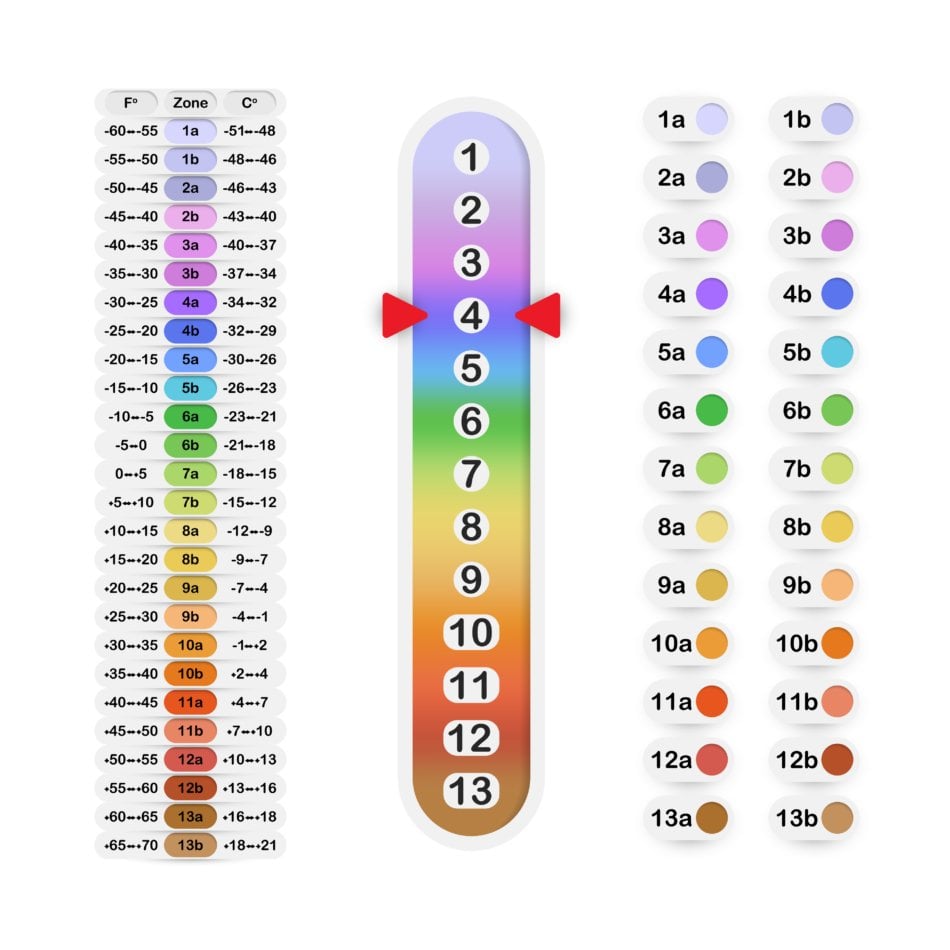
Each zone covers a 10 degree Fahrenheit band. For instance, Zone 3 is 10 degrees colder than Zone 4. Sometimes the letters “a” and “b” are added to be more specific, splitting a zone into 5 degree halves. Zone 4a has an average lowest temperature of -25 to -30 degrees Fahrenheit, while Zone 4b’s lowest temperature is -20 to -25 degrees. Each city within a state can vary, so the tag is a starting point, not the last word.
This information is calculated and updated periodically by the United States Department of Agriculture (USDA), based on a 30 year average of the single lowest temperature recorded in each spot.
Plant Hardiness Zones at a Glance
Each zone number maps to a band of average lowest winter temperature. Here is the full range, from the coldest reaches of the country to its warmest corners. Find the band that matches your winter and you have found your zone.
Remember that the letters split each band in half. A Zone 5a winter dips a touch colder than a Zone 5b winter, even though both sit inside the same number. When two plants both list your zone, read the letter before you decide.
Do Growing Zones Change?
Growing zones are adjusted on occasion. The first major changes were made in 1990, when scientists at the USDA began looking at climate change data (here is the difference between weather and climate). A shift of the growing zone seemed to be moving north at a rate of 13 miles per decade. The map was adjusted in 2012 to introduce two new zones, 12 and 13, where before the range had only run from 1 to 11. The map was then updated in November 2023 to indicate a shift by one-half zone warmer for half of the United States, mostly across the Midwest states. The bobvila.com team has a rundown of the most recent changes if you want more detail.
If the USDA changed the growing zone in your region, do not worry. Whatever you have already planted should keep right on growing. When you start sowing new seeds, though, it is wise to stay current with any changes to the zone maps so your choices still match your ground.
History Of Growing Zones
During the Great Depression, when people were growing their own food out of dire necessity, researchers began building visual aids to teach folks which crops would yield the best results across the country. Maps were drawn separating the United States into temperature zones. Before that, the Farmers’ Almanac was the only way gardeners could get a read on the upcoming season in terms of planting. The zone map gave that long tradition a coast-to-coast picture.
Using Your Zone in the Garden
Your zone tells you what will survive the winter, but it does not tell you everything about a good harvest. Pair the zone with your own frost dates, your soil, and a little planning. Many gardeners use their zone to choose perennials and fruit trees that can take the cold, then lean on planting dates for the annual vegetables that come and go with the season. If you want neighbors that help each other along, our companion planting guide pairs crops that grow well side by side, and our walkthrough on how to grow your own potatoes is a forgiving place to start in almost any zone.
Plant Hardiness Zones: Frequently Asked Questions
What are plant hardiness zones?
Plant hardiness zones are areas on a map, numbered 1 through 13, that tell you which plants will survive the winter where you live. They are based on the average lowest winter temperature, calculated by the USDA from a 30 year average of the single lowest temperature recorded. The lower the zone number, the colder the plant must be able to withstand.
How do I find my growing zone?
Check the USDA Plant Hardiness Zone Map and look up your area, then match that number to the zone listed on plant tags and seed packets. Keep in mind that each city within a state can vary, so use the map as your starting point and read the “a” or “b” letter for a more exact fit.
How many degrees is each hardiness zone?
Each zone covers a 10 degree Fahrenheit band of average lowest winter temperature, so Zone 3 is 10 degrees colder than Zone 4. The letters “a” and “b” split a zone into 5 degree halves. For example, Zone 4a averages a low of -25 to -30 degrees, while Zone 4b averages -20 to -25 degrees.
Did the USDA hardiness zones change?
Yes. The first major changes came in 1990, the map added Zones 12 and 13 in 2012 where the range had only run 1 to 11, and the map was updated in November 2023 to show a shift one-half zone warmer for half of the United States, mostly across the Midwest. The zones have been creeping north at roughly 13 miles per decade.
What is the difference between a growing zone and a frost date?
A growing zone is based on the average lowest winter temperature and tells you what can survive the cold season. A last frost date tells you when it is safe to set tender plants outside in spring. They are easy to confuse but answer different questions, and good gardeners use both together.
Do I need to dig up my plants if my zone changed?
No. If the USDA changed the growing zone in your region, whatever you have already planted should keep right on growing. The change matters most when you sow new seeds or choose new perennials, so stay current with the zone maps before your next planting.
Join The Discussion
Tell us about your experience using growing zones.
Share with your community in the comments below!


Larry Fleury
Larry Fleury is a writer and outdoor photographer who has a background in atmospheric science, marketing, astrophotography, creative writing, and all things outdoors. His photography has been featured by The Weather Channel, Midwest Living Magazine, and National Geographic Your Shot. Larry lives on the edge of the Ozark Mountain Range in Southeast Kansas, where he spends his free time fishing, camping, hunting, hiking, storm chasing, and playing guitar on the porch.
- Larry Fleury

- Larry Fleury
- Larry Fleury
- Larry Fleury


I moved from the Northeast to the Southeast, on the western coast of Central Florida. I had to spend a lot of time learning about local plants and trees, and I started with the USDA growing zones. Gardening is SO much different here than in the Northeast, or Southern California where I had grown up with two parents who were avid (AVID!) gardeners. They both grew up on farms, and knew what they were doing!
If one of us 4 children wanted one-on-one time with one of our parents, all we had to do was join them in their gardening tasks. We lived on 3 acres about 30 minutes north of downtown LA, near the base of the 6,000 foot mountains that form the northern border of L.A. County. We had chickens and goats and we rescued injured wildlife. I had such a magical childhood, and our gardens and gardening with our parents was a big part of that.
Thanks for sharing your memories Karen! I am one of four too, and we grew up helping my parents with their greenhouse business which was at our house. At the time I hated having to help transplant seedlings, wait on customers, water the plants …but now I can look back and realize how special it was. We had goats, a pony, and chickens before we moved to the greenhouse home. So fun walking down memory lane.