Parade of Planets 2024: What the Morning Sky Showed
Quick Reference: The Parade of Planets 2024
- When it happened: before sunrise from June 24-July 4, 2024.
- What lined up: Jupiter, Uranus, Mars, Neptune, Saturn, the dwarf planet Pluto, and the Moon.
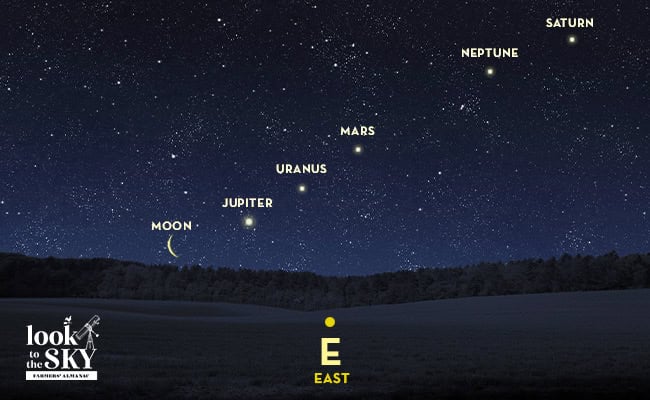
- Order, left to right: Jupiter, Uranus, Mars, Neptune, Saturn.
- Easy to see with the naked eye: Jupiter, Mars, and Saturn. Uranus, Neptune, and Pluto needed a telescope.
- Where to look: low across the eastern and southeastern sky, in the hour or two before dawn.
For 11 mornings in the summer of 2024, early risers who looked east before dawn saw something worth setting an alarm for. Jupiter, Uranus, Mars, Neptune, Saturn, and even the dwarf planet Pluto stood in the sky at the same time, with the Moon drifting past each one in turn. This is a record of what that 2024 parade of planets looked like, what folks actually saw, and how these alignments come around again so you know what to watch for next time. The dates below are from the original 2024 event and are kept here for the record.
What Is a Parade of Planets?
A parade of planets is the popular name for a morning or evening when several planets appear in the same stretch of sky at once. The term is not a formal astronomical event so much as a sky-watcher’s nickname. The planets all travel along nearly the same line across the sky, called the ecliptic, because they orbit the Sun in roughly the same flat plane. Now and then their separate orbits carry them to the same side of the Sun as we see them from Earth, and they string out along that line like beads. NASA keeps a plain-English rundown of all the planets and their orbits in its solar system planets guide if you want the full tour.
It helps to know that a parade is about line of sight, not about the planets bunching together in space. They are still tens or hundreds of millions of miles apart. They only look gathered because we are viewing them along the same direction. Some parades feature three or four planets, others line up five, six, or more, and the rarest include every planet at once.
Look Before Sunrise
The important thing to know about the 2024 parade is that it only happened before sunrise and was not visible in the evening. In fact, nighttime sky-watchers had been in a planet drought that season, with no planets visible just after dark. That drought ended with Mercury making a brief appearance in early July and Venus slowly emerging from behind the Sun to pop out in the evening sky later that summer.
The first planet to rise above the eastern horizon was Saturn, which cleared the treetops about 1 a.m. local time. Neptune quickly followed, rising about 30 minutes later. Mars rose about 3:30 a.m., just north of east. It was equal in brightness to Saturn but shone with a distinctly orange color. Uranus rose one half hour later at 4 a.m., and then brilliant Jupiter came up a little before 5 a.m. The planets appeared in this order from left to right: Jupiter, Uranus, Mars, Neptune, and Saturn. (See a reference illustration in the feature image for this story.)
The Sun quickly followed the planets. As dawn approached and the sky brightened, the planets became invisible. The trick on any parade morning is the same: get out under a clear, dark sky in the window after the last planet rises and before the first light of dawn washes everything out.
Any questions? Contact [email protected]
Parade Of Planets 2024: Key Dates
To help sky-watchers keep track of the planets, the Moon passed through the parade between June 24 and July 4, 2024. As the Moon circles the Earth, its position shifts slightly each morning. The Moon, like the planets, also appears to travel near the ecliptic, so it passed by each object on the list and helped people locate the tougher-to-find worlds. Here is how that played out, morning by morning.
June 24
After midnight on June 24, Pluto rose before any of the planets. You could not see Pluto with the naked eye, but a waning gibbous Moon shone brilliantly in the southeastern sky. That morning, the Moon served as a landmark for knowing approximately where Pluto was.
With a really good telescope, an observer could attempt to find Pluto about 2 degrees above the Moon. But there was no need to worry about missing the dwarf planet Pluto, since few trained astronomers can spot it.
June 27
The significant Moon-planet pairings began on the morning of June 27, when the waning Moon shone three degrees to the right of the planet Saturn.
With even a simple backyard telescope aimed at the Moon, observers could study the rough cratered lunar surface in more detail, then shift over to Saturn. To the naked eye, Saturn looked like an ordinary yellow star. But through a telescope you could see the rings around the planet.
Related products: Starry Night Gift Guide
June 28
On June 28 about an hour before sunrise, the Moon had shifted remarkably close to the planet Neptune. In fact, for portions of that morning, the Moon appeared less than one half degree below Neptune.
Sky-watchers who aimed a telescope at the Moon that morning, then moved their view ever so slightly up, could look for a deep blue dot of light. For many, that was the best chance all year to find Neptune, since the Moon acted as a guide.
July 1
The Moon passed the final three planets in the parade quickly. Before sunrise on July 1, the Moon appeared up and to the right of Mars.
July 2
On July 2, the Moon was to the left of Uranus. Although you cannot see Uranus with the naked eye, observers could try for another astronomical sight to the left of the Moon. The Pleiades star cluster, also known as the Seven Sisters, just barely shone through the approaching dawn near the Moon.
July 3
Finally, before sunrise on July 3, the waning crescent Moon shone to the left of Jupiter. This one had to be timed well, since Jupiter and the Moon were low in the eastern sky as the Sun was rising. The Moon-planet pairing showed about 30 to 45 minutes before sunrise on July 3.
July 4
There was still a chance to catch the Parade of Planets 2024 on the morning of July 4, but the Moon was very low on the horizon and therefore extremely tough to catch.
Psst … did you check your Fourth of July Weather Forecast? Tap here!

Visibility Details
Although it did sound impressive to have five planets and Pluto lined up in the sky, the visibility may have disappointed some folks. The planets Uranus and Neptune cannot be seen with the naked eye. And to even spot Pluto as a tiny pale dot, you would need a sufficiently large or professional telescope. So that really left just three planets that observers actually saw in an arc across the east and southeastern pre-dawn sky: Jupiter low in the east, Mars up and to the right of Jupiter, and Saturn far off to the right of Mars. That said, knowing all of these planets were together in the morning sky between St. John’s Day and the Fourth of July was symbolically special.
Planet Distances
The planets vary in size and distance from Earth. When we see planets in the sky, we are seeing sunlight reflecting off their surfaces, and some planets are more reflective than others. This all leads to a variety of planet brightness. The distances below are the figures cited for the 2024 parade, and they shift over time as the planets move along their orbits.
Jupiter
Although it was about 540 million miles away, the planet is so large and reflects so much sunlight that it was easily the brightest of the five planets up in the morning sky that summer.
Mars and Saturn
Mars and Saturn are nearly equally bright and easily detected with the naked eye. Mars is a much smaller planet than Saturn but also significantly closer to Earth. Mars was about 160 million miles away while Saturn was about 860 million miles away.
Uranus and Neptune
Although Uranus and Neptune are large planets, each about four times the diameter of Earth, they are so far away that you need a telescope just to see them. Uranus was almost 1.9 billion miles from Earth and Neptune was more than 2.7 billion miles away.
Pluto
Whether you consider it to be a planet or not, Pluto was also in the morning sky that summer. It is almost 3.2 billion miles away and so tiny that only a small amount of sunlight reaches its icy surface to weakly reflect to Earth.
Previous Planet Parades
It’s tough to compete with the Parade of Planets 2022, which also occurred at the end of June. During that rare sky event all the planets were in the sky at the same time in their exact order: Mercury, Venus, Mars, Jupiter, Saturn, Uranus, and Neptune, with even Pluto standing at the end of the arc. In 2023, the most impressive parade of planets was in late March, when the Moon passed by Mercury, Jupiter, Venus, Uranus, and Mars. Read more about Parade of Planets 2023.
When the Planets Line Up Next
Planet parades are not a once-in-a-lifetime affair. Because the planets are always moving along their orbits, the same kind of lineup comes around again every year or two, sometimes in the morning sky and sometimes in the evening. Some gatherings are modest, with two or three bright planets close together. Others string five or more across the sky like the 2024 parade. The biggest ones, with every planet at once, are the rarest, but even a three-planet morning is worth the early alarm.
The way to catch the next one is to keep an eye on the sky rather than a single date on the calendar. A few habits make it easy. Watch the bright planets, since Jupiter, Venus, Mars, and Saturn are the ones you can spot without any gear. Learn the line of the ecliptic, the path the Sun, Moon, and planets all follow, so you know where to scan. And use the Moon as a pointer, the way it guided sky-watchers from planet to planet during the 2024 parade. Our visible planets guide tracks which planets are up right now, and the full Moon dates and times page helps you plan around moonlight that can wash out the dimmer worlds.
While you are learning your way around the night sky, it is worth remembering that the shapes overhead are easier to find than they look. Our piece on why constellations don’t look like anything can help you make sense of the star patterns you will use to find the planets. The same clear, dark mornings that make for a good parade are also good for getting back out in the garden, and our Gardening by the Moon Calendar lines up your outdoor work with the right days. A little planning goes a long way.

Parade of Planets: Frequently Asked Questions
What was the parade of planets in 2024?
The Parade of Planets 2024 was an alignment in which Jupiter, Uranus, Mars, Neptune, Saturn, and the dwarf planet Pluto all appeared in the sky at the same time before sunrise, from June 24 to July 4, 2024. The Moon passed by each one in turn. From left to right the planets ran Jupiter, Uranus, Mars, Neptune, and Saturn across the eastern and southeastern sky.
How many planets could you actually see with the naked eye?
Three. Jupiter, Mars, and Saturn were bright enough to see without any equipment. Uranus and Neptune needed a telescope, and Pluto required a large or professional telescope, so most people saw three planets arcing across the pre-dawn sky.
What time did the planets rise during the 2024 parade?
Saturn rose first, about 1 a.m. local time, with Neptune following about 30 minutes later. Mars rose about 3:30 a.m. just north of east, Uranus rose at 4 a.m., and brilliant Jupiter came up a little before 5 a.m. The whole lineup faded as dawn brightened the sky.
Is a parade of planets rare?
A gathering of a few planets happens fairly often, every year or two, in either the morning or evening sky. What makes a parade more notable is how many planets join in and how bright they are. Lineups of five or more, like the 2024 parade, are less common, and a parade with every planet at once is the rarest of all.
Why do the planets line up like a parade?
The planets all orbit the Sun in roughly the same flat plane, so from Earth they appear to follow the same line across the sky, called the ecliptic. When their separate orbits carry them to the same side of the Sun in our line of sight, they string out along that line. They are not truly close together in space, only in the direction we view them.
How can I catch the next parade of planets?
Watch the bright planets, Jupiter, Venus, Mars, and Saturn, since you can spot those without gear, and follow the line of the ecliptic where the Sun and Moon also travel. Use the Moon as a pointer the way sky-watchers did in 2024. Check the Farmers’ Almanac visible planets guide for what is up now, and pick a clear, dark morning away from bright moonlight.


Dean Regas
Dean Regas is an astronomer and author of seven books including 100 Things to See in the Night Sky and How to Teach Grown-Ups About Pluto and host of the popular astronomy podcast Looking Up with Dean Regas. He can be reached at: www.astrodean.com
- Dean Regas

- Dean Regas
- Dean Regas
- Dean Regas