

Parade of Planets: The Rare 2022 Sky Show Explained
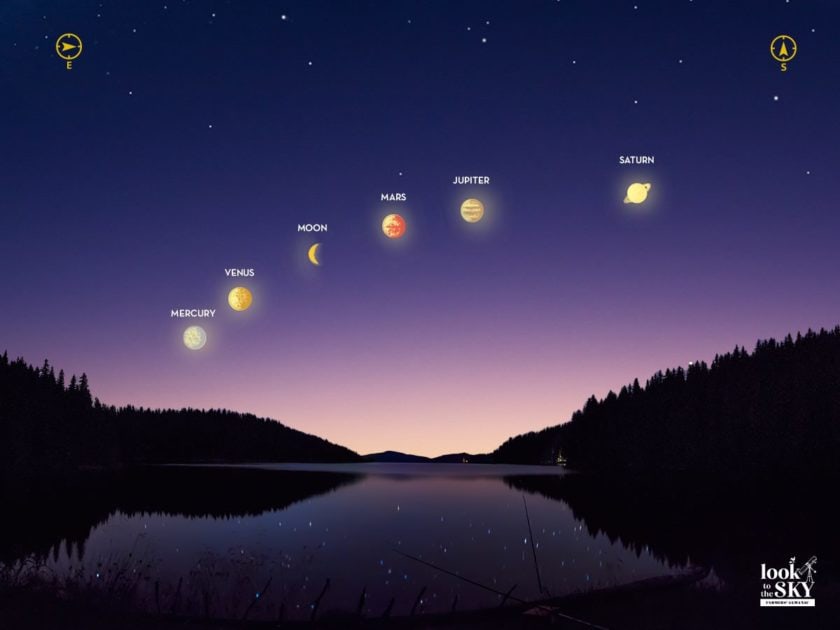
Quick Reference: The 2022 Parade of Planets
- What it was: all five naked-eye planets, plus the Moon, strung across the dawn sky at once.
- When: the mornings of June 24, 25, and 26, 2022, best about 40 minutes before local sunrise.
- The order: Mercury, Venus, the Moon, Mars, Jupiter, and Saturn, in their true order out from the Sun.
- Why it mattered: the last similarly compact parade in this order graced our skies in 1864.
- Gear needed: none. No telescope required. Just clear eastern sky and an early alarm.
In June 2022, sky watchers across the world set early alarms for one of the best naked-eye sights of the decade. For three mornings, all five visible planets lined up with the Moon in the pre-dawn sky, arranged in their true order out from the Sun. This page is the record of that event, kept here as it happened, along with a plain-English look at what a parade of planets actually is and how to catch the next one. If you missed it, the photo below is a fine reminder of what the fuss was about.
In case you missed the Parade of Planets with the Moon in June 2022, here is a beautiful record of the event. This photo was taken on June 24, 2022 at 4:35 am:
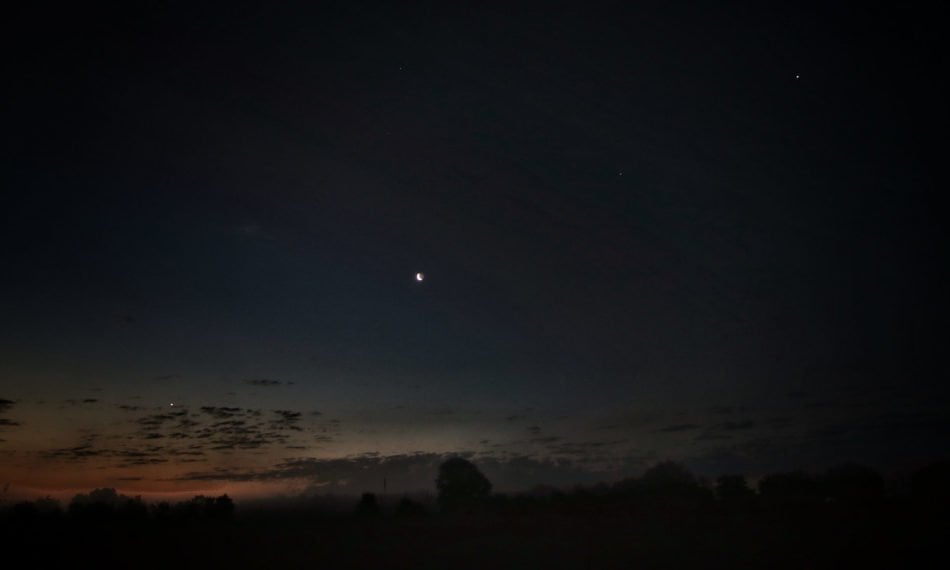
Thank you to Scott Readman and all of our readers who shared photos of this spectacular celestial event on Facebook (and Instagram). Follow Scott or send him a note of appreciation here: @dadzilla2u.
Never miss another fantastic celestial event: Join our weekly Newsletter now.
Published on June 22, 2022:
Dear readers, we are pleased, and a bit stunned, to announce that our “Parade of Planets” post reached 10 million people over the course of the last 10 days. Thank you for taking the time to share this rare astronomical event with your friends, families, and classrooms around the world. Many of you voiced questions, so we wanted to take a moment to provide answers. We consulted our esteemed astronomer, Joe Rao, to give you accurate information that you can trust. Read on to learn when and where to witness this special moment!
What Is a Parade of Planets?
A parade of planets is the popular name for a planetary alignment, when several planets appear close together in the sky at the same time. They are not truly lined up in space. Each planet keeps to its own orbit around the Sun, and from our spot on Earth they simply happen to land along roughly the same stretch of sky, a band astronomers call the ecliptic. NASA’s overview of the planets of our solar system is a good place to see how those orbits stack up.
The five “naked-eye” planets, the ones bright enough to spot without a telescope, are Mercury, Venus, Mars, Jupiter, and Saturn. When all five gather on the same side of the sky, and the Moon joins them, you get the kind of dawn lineup that draws people out of bed. The tighter the grouping, and the more the planets fall in their natural order out from the Sun, the rarer the show.
The planets are easy to tell from the stars around them. They shine with a steady light rather than twinkling, and over days and weeks they drift against the fixed background of stars. If you enjoy that contrast, our guide to why the constellations don’t look like anything is a friendly companion read for any night under the sky.
The 2022 Parade of Planets: What Happened
The 2022 event was a rare sky show that began on Midsummer morning and repeated on the mornings of June 25 and 26. All five naked-eye planets, along with the Moon, were visible in the sky at once. To view it, you simply stepped outside about 40 minutes before your local sunrise and looked east to south.
The most interesting part was the order. The planets were arranged in their true order out from the Sun: Mercury, Venus, the Moon, Mars, Jupiter, and Saturn. The last time a similarly compact parade of planets graced our skies was in 1864. These same planets were visible in 2020, but not in this particular order, which is what made the 2022 lineup so special.
Catching Future Planetary Alignments
Planetary alignments are not one-time events. Because each planet moves at its own pace, the visible planets regularly drift into loose groupings, and every so often they bunch up tightly the way they did in 2022. Some gatherings sit in the evening sky after sunset, others in the hours before dawn, and the brightest ones, Venus and Jupiter, are the easiest to find first.
You do not need fancy gear to enjoy the next one. The same rules that worked in 2022 still apply: find an open horizon away from streetlights, give your eyes 15 to 20 minutes to adjust to the dark, and check your local sunrise or sunset time so you know when to look. NASA’s monthly What’s Up skywatching guide lists which planets are visible and when, month by month, and is the simplest way to know a parade is coming.

While you are tracking the sky, the Moon is worth following too. Our list of full Moon dates and times tells you when the Moon will be bright enough to wash out fainter stars, and the Gardening by the Moon Calendar shows how those same lunar phases have guided planting for generations.
The 2022 Parade of Planets: Reader Questions and Answers
These are the questions readers asked at the time, answered with help from astronomer Joe Rao. They describe the 2022 event, and most of the viewing advice holds for any parade of planets.
1) What time was best to look for the Parade of Planets?
The best look was 40 minutes before sunrise on the morning of June 24, 2022. The planetary alignment, including the Moon, was also visible through the weekend at roughly the same time before sunrise each day until Sunday, June 26. The trick was to look up the sunrise time for your own area.
2) 40 or 45 minutes before sunrise? How specific was the timing?
Each planet emerged on its own from the eastern horizon, beginning with Saturn at around 5 hours before sunrise. The others then followed. By 40 minutes before sunrise, Mercury, the last of the five planets to join the parade, was visible just above the horizon. The planets appeared across the sky along a line from lower left (Mercury, east-northeast) to upper right (Saturn, due south).
3) Was this event only visible in the Northern Hemisphere?
No, it was visible just about everywhere on the planet. In the Southern Hemisphere, all five planets were visible about 40 minutes before sunrise, but instead of running along a diagonal line from lower left to upper right, the planets were oriented along a line almost perpendicular to the east-northeast horizon, going almost straight up. In fact, the array was more favorably placed for far-southerners (Cape Town, Santiago, Sydney, Auckland) than for those in the Northern Hemisphere. Mercury, for instance, appeared higher above the horizon “down there” than for those at mid-northern latitudes.
4) Which US states or cities had the best view?
Longitudinal differences (east to west locations) were about the same, but latitude was a factor. The farther south you were, the higher up in the sky the planets appeared. So in the United States, a place like Miami had a slight edge over cities like Chicago or Seattle.
5) Were the planets in a straight line?
If you imagined a smooth arc stretching from Mercury to Saturn, the other three planets were not positioned exactly on that arc, but pretty close to it.
6) Did the planets look like bright stars?
The planets did resemble stars of varying brightness. Unlike stars, planets seldom twinkle. Over a span of days or weeks they appear to wander in the heavens, while the stars remain rooted in their positions.
7) Did you need a telescope?
No, no telescope was necessary to see the Parade of Planets.
8) Were Saturn’s rings visible?
Saturn’s rings are not visible with the naked eye. If you had binoculars magnifying 25x you might have been able to pick them out.
9) Only on Friday, June 24? How about over the weekend?
You could see the alignment of the planets until the end of June. However, the Moon was positioned between Mars and Venus Friday through Sunday morning. On Sunday, the Moon sat right next to Venus, making for a beautiful celestial tableau at about 45 minutes before sunrise.
Did you watch the 2022 parade? Let us know in the comments below.
Learn about June 24 (Midsummer) folklore and traditions.
See our Night Sky Guide for July 2022.

Parade of Planets: Frequently Asked Questions
What is a parade of planets?
A parade of planets is the popular name for a planetary alignment, when several planets appear close together in the same stretch of sky at the same time. They are not lined up in space. Each keeps to its own orbit, and from Earth they simply happen to fall along roughly the same band of sky we call the ecliptic.
When was the 2022 parade of planets?
It ran on the mornings of June 24, 25, and 26, 2022, with the best view about 40 minutes before local sunrise. All five naked-eye planets and the Moon appeared in their true order out from the Sun: Mercury, Venus, the Moon, Mars, Jupiter, and Saturn.
Why was the 2022 alignment so rare?
The five planets fell in their natural order out from the Sun in an unusually compact group. The last time a similarly compact parade graced our skies in that order was in 1864. The same planets were visible in 2020, but not arranged in this particular order.
Do you need a telescope to see a parade of planets?
No telescope is necessary. The five naked-eye planets are bright enough to see without any gear. Binoculars magnifying 25x may let you pick out Saturn’s rings, which are not visible to the naked eye, but for the parade itself your own two eyes are enough.
How do I tell a planet from a star?
Planets shine with a steady light and seldom twinkle, while stars flicker. Over days and weeks the planets also appear to wander against the fixed background of stars. Venus and Jupiter are the brightest, so they are the easiest to find first when you are scanning a dawn or dusk sky.
When is the next parade of planets?
Planetary alignments recur regularly because each planet moves at its own pace, though tight groupings like 2022 are less common. The simplest way to know one is coming is to check NASA’s monthly What’s Up skywatching guide, which lists which planets are visible and when, then pick a clear night with an open horizon away from city lights.


This article was published by the Staff at FarmersAlmanac.com. Any questions? Contact us at [email protected].
- Farmers' Almanac Staff

- Farmers' Almanac Staff

- Farmers' Almanac Staff

- Farmers' Almanac Staff



When will a similar event occur in the future?”
Hi there! The next Parade of Planets happens in August 2025. Here is the article with details: https://www.farmersalmanac.com/planet-parade-2025
.,.,The democrat created food crisis is going to hit you hard inthe coming months as more than 100 food plants have been burned to the ground so you have to do this ASAP!!!
Visit……….. snnvb65.Blogspot.Com
..,,,…
sweet
I got up in plenty of time, the sun wasn’t up yet but could not see anything on June 24 due to cloud cover. I appreciate what you do, I will try every day until Monday, would love to see this. If anyone gets pictures, would you post it? Thank you!
I’m all sad went outside to see it but we have a thick cloud cover in Albuquerque NM
Couldn’t get them all in one picture and missed Mercury because of cloud cover. In South Central Kentucky
im trying to spot them from my rooftop. its the last day to do so and before your picture i had no idea what i was looking for :p
Thanks for sharing your photo!
Went out this morning and could see Venus and Saturn well but Jupiter was a bit fuzzy. In central VA
I was just out & I think I barely saw “Mercury”? Not able to see anything else. I’m in NE PA
Anyone have pictures?
Missed it this morning but hope to see it tomorrow morning!