

Giant Joro Spider Invasion Map 2026: Range, Spread, and What to Do
Quick Reference
- Species: Trichonephila clavata, the giant Joro spider, an orb-weaver native to East Asia.
- First U.S. record: Georgia, 2014 (possibly arriving as early as 2010 in shipping containers).
- Size: Adult females up to 4 inches across; webs up to 10 feet wide in gold-tinted yellow silk.
- Range as of 2026: AL, FL, GA, KY, MS, NC, SC, TN, VA, WV, OH, MD; satellite sightings as far north as Baltimore.
- Bite risk: Mild. Compared to a bee sting. Mouth parts rarely break human skin.
- What to do: Leave them alone, knock down nuisance webs with a broom, do not spray pesticides.
The Giant Joro spider invasion map below shows confirmed and predicted spread across the eastern United States in 2026. Plus identification photos, range estimates, behavior notes, and what to do if you find one in your yard.
The giant Joro spider has been spreading north out of Georgia since 2014, and as of 2026 the documented range stretches from Alabama up through Maryland with a few satellite sightings creeping into Ohio and the mid-Atlantic. Trichonephila clavata is a four-inch, gold-silk orb-weaver from East Asia. It looks alarming. It is not dangerous. Here is what we know about where it lives, how it travels, and what to do if one builds a 10-foot web across your porch.
What is a giant Joro spider?
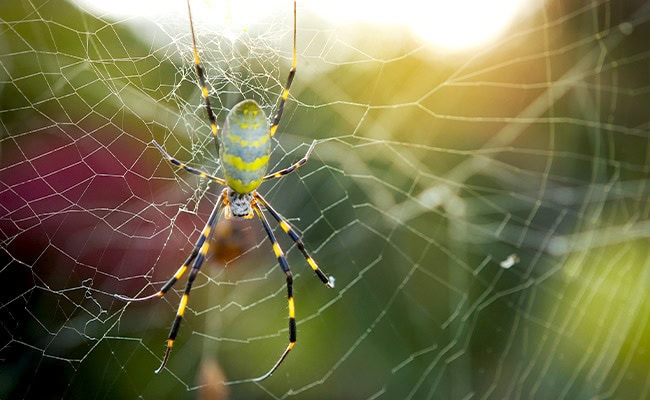
Trichonephila clavata, also called the Joro spider or giant Joro spider, is one of the largest orb-weaving spiders. Hatchlings start out the size of a grain of sand. Adult females finish at roughly four inches across, brightly striped in blue-black and yellow, with a red marking on the underbelly. Adult males are far smaller and duller, as is the case with most spiders.
Adult Joros are most commonly spotted in August and September. Their webs reach up to ten feet across and are spun in a yellow silk that flashes gold in direct sunlight. They favor the gap between two trees or the corner of a porch, especially where artificial light pulls in insects after dark.
Females reach full maturity in September and die off in late November. Before they go, each lays a single light-brown egg sac holding 1,000 or more eggs. The eggs overwinter inside the sac, and the tiny juveniles scatter the following spring.
Where did the giant Joro spider come from?
The Joro is native to East Asia. Its historical range covers China, Japan, Korea, and Taiwan. This palm-sized spider almost certainly arrived in the United States on shipping containers. The first formal U.S. record is from Georgia in 2014, though researchers at the University of Georgia note the species could have arrived as early as 2010 and gone unnoticed for several years.
Where have giant Joro spiders been spotted in the United States?
The Joro was first spotted in Georgia, then spread quickly to the Carolinas and Tennessee. A satellite population set up around Baltimore. According to records submitted to iNaturalist, the spiders have now been observed in Alabama, Florida, Georgia, Kentucky, Mississippi, North and South Carolina, Tennessee, Virginia, West Virginia, Ohio, and Maryland. One lone spider hitchhiked all the way to Oklahoma, but it was killed and no population took hold there.
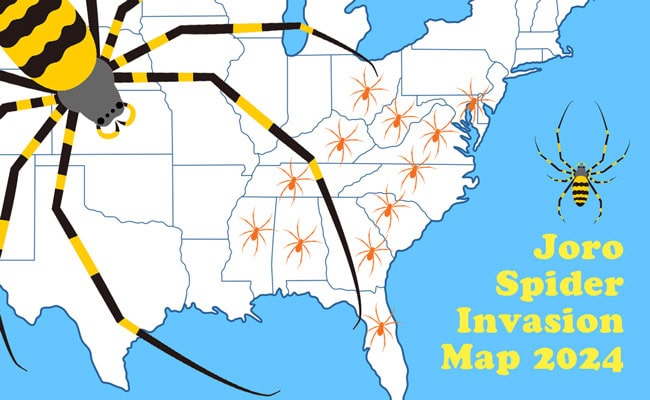
For more than a decade the Joro stayed mostly inside the warmer Southeastern states. That is changing. The spider shows what researchers call urban tolerance, meaning it is unbothered by noise and vibration. You will find webs along busy roadsides and on highway overpasses. Spread into cooler regions is no longer a question of if. It is a question of how fast.
Where are the Joro spiders headed in 2026 and 2027?
The Joro spider’s ability to adapt to different environments and reproduce quickly has researchers convinced it is only a matter of time before the species fills in much of the Eastern United States or pushes farther. Scientists are not positive when Joros will be common in the Northeast. It could be this year. It could be ten years out. Organic travel is slow. Hitchhiking populations on cars, trailers, and shipping pallets could speed the spread.

Can Joro spiders survive the cold?
The Joro’s native range stretches from northern Japan all the way down to Taiwan, which covers a wide band of latitude. Researchers conclude that the adaptable Joro could plausibly live in Maine or south Florida if it wanted to. During the summer months the spider can thrive almost anywhere in the United States. Cold weather acts as a reset, closing out a short adult life cycle. The eggs, though, ride out winter in their thick sac. That cold tolerance lets Joros operate in higher latitudes than most native orb-weavers.
How do Joro spiders travel?
The Joro is moving up the East Coast with real efficiency. Sensationalist headlines call them “flying” spiders. They are not flying in the bird sense. Hatchlings do something called ballooning, sometimes called kiting. They release a gossamer thread, catch the wind or a static electric field, and lift off, much like the baby spiders at the end of “Charlotte’s Web.” A single hatchling can travel a hundred miles or more on the right air current. Only the tiny juveniles can do this. You will not see an adult Joro in the air.
Thousands of spider species can disperse this way. It is not a Joro superpower. What does make the Joro effective is its willingness to hitch a ride. A spider riding inside a moving truck or hidden in luggage can leapfrog hundreds of miles in a day. If you are coming home from one of the Joro’s strongholds, look over your gear before you unload.
Will the weather impact the spread?
The Farmers’ Almanac is predicting a lot of rain across the Northeast and Midwest this summer, but the giant Joro spider will not be washed out. Joros, like most spiders, take shelter during heavy rain and become more active afterward. Rainfall lifts humidity, which brings out the prey. That sends the spider into predatory mode.
Researchers say weather will not change the trajectory of the Joro’s spread much in either direction. Hatchlings will continue to balloon during a rainy season as long as there is wind or an electromagnetic field to lift them.
Wet seasons also boost moisture-loving insects, including mosquitoes, cockroaches, stink bugs, and termites. With the rainy stretch the Farmers’ Almanac is calling for, you may actually be glad to have a few of these pest controllers in the yard.
A similar spider
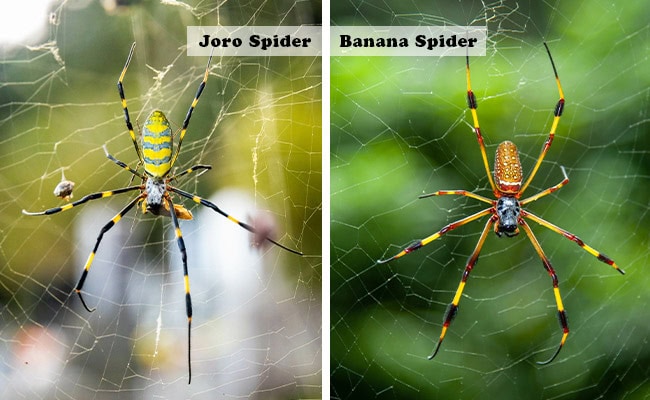
The Joro’s closest North American look-alike is the banana spider, also called the golden silk spider. It is a related species originally from tropical Southeast Asia that has already settled into the same Southeastern U.S. regions. The two species share body shape, habits, and size. The banana spider’s coloration is duller and it carries noticeable tufts of hair on three of its four pairs of legs. The Joro handles cold significantly better than its banana spider cousin.
Are giant Joro spiders dangerous?
Despite the size and the bright color pattern, the giant Joro spider is essentially harmless. The look is alarming. The behavior is shy. The Joro is more afraid of you than the other way around. They are technically venomous, like nearly all spiders, but their mouth parts are too small to bite a human reliably.
In the rare case a Joro does bite, the result is closer to a bee sting. It can itch. A very small number of people may have an allergic reaction. Brown recluse and black widow spiders, both far smaller, are far more dangerous than the reluctant-to-bite Joro.
What do giant Joro spiders eat?
The Joro is a skilled hunter and, like most spiders, is not picky. It eats anything caught in the web, including stink bugs, yellow jackets, flies, mosquitoes, and other arthropods such as ladybugs. That open menu is why Joros survive everywhere from open farmland to busy city blocks.
Are giant Joro spiders harmful to the environment?
It is still too early to know whether the Joro spider will have a measurable impact on local ecosystems. So far, there is no negative impact on crops or trees. Because the Joro will eat almost anything, it works as a pest controller, helping cut populations of unwanted invasive species that do threaten plant life, including the troublesome spotted lanternfly that has invaded the eastern U.S. over the past few years.
For perspective, all the spiders on Earth combined are estimated to eat up to 880 million tons of insects each year, more than the meat and fish all humans eat in a year. Adding one more spider species to the mix could spare us from dozens of other pest insects. That said, there is a chance Joros may disrupt local ecosystems in places where their numbers swell.
The Joro spider does not harm vegetation. Researchers are still working out whether it affects native spider species or pulls food away from local insectivorous birds and lizards. Their predatory nature could trim native insect populations and reshape some local food chains. Time will tell. On the upside, Joros may turn out to be a useful food source for native predators like birds.
What should you do about giant Joro spiders?
Joro spiders are harmless to humans and pets. Most experts encourage leaving them alone. Your primal instinct may be to squash them. Killing these giant, timid creatures is not necessary, and a few squashed spiders will not move the population needle.
They are not dangerous, but they can be a nuisance. Joro webs run large and are often strung between trees or along the front porch. The simple play is to use a broom or a stick to remove the web and relocate the spider. It may build another web in the same spot. Repeat as needed.
Round off-white egg sacs show up in fall and winter. The female usually tucks her sac into the thickest part of her web, somewhere sheltered, such as under a clump of leaves or in the highest corner of a home’s soffit. If you find one and want to take it down, use a long stick with a rough end to wind up the web around the sac and pull it down. Soak it in a bucket of water with a bit of dish detergent. That will knock back a small local cluster, but it will not change the regional population.
Researchers do not recommend pesticides for Joro control. Pesticides are unnecessary for a spider that does not threaten people or pets, and they will kill many beneficial species nearby. One bit of good news for nervous homeowners: the Joro strongly prefers outdoor environments and rarely sets up shop indoors.
Where does the name “Joro” come from?
The Japanese name for the Joro is “joro-gumo,” which translates to “entangling bride” or “binding bride.” The Joro is named after the Jorogumo, a mythical creature from Japanese folklore that has fascinated people for centuries. The Jorogumo is one of the yokai, supernatural spirit entities in Japanese folklore that can be benevolent or malevolent. The Jorogumo is depicted as a giant spider that shape-shifts into a beautiful woman to prey on young, unsuspecting men. In folklore, the figure represents the danger of temptation and the cost of giving in to desire. In spiritual teachings, the story is used to teach the importance of self-control.
Spider symbolism runs deep in Japanese folklore. Spiders are often associated with female deities and goddesses and are believed to possess supernatural powers. The Jorogumo is also tied to the legend of the “Spider’s Thread,” a famous Japanese story about a criminal who is offered a chance to escape hell by climbing a single spider’s silk. These influences have helped the Jorogumo myth endure across generations of Japanese storytellers.
Spider folklore around the world
Despite the spider’s intimidating look, it is also a source of positive symbolism, with a long role in cultures across the globe. Spiders have inhabited the Earth for more than 300 million years, so it is no wonder they have woven themselves into mythology and folklore for centuries. Many stories cast them as symbols of protection, intelligence, and wisdom.
In many cultures, spiders are seen as messengers between the physical world and the spiritual one. Some African traditions associate them with good spirits that bring luck. Several Asian cultures regard them as sacred entities that bring blessings. In Native American culture, spiders often appear as symbols of strength, protection, and creative energy, with the carefully spun web embodying artistry and patience.
According to Irish folklore, finding a spider in the house is good luck and killing one will call up a storm. A common Irish and Scottish proverb captures the rule: “If you wish to live and thrive, let a spider run alive.” The implication is plain. Kill a spider, invite bad luck.
Spiders in your garden
Spiders are among nature’s best pest-control agents and are beneficial inhabitants of your garden. Their appetite for the insects that damage produce makes them a welcome guest. Gardens with healthy spider populations also tend to show lower levels of plant disease, because many plant pathogens, viral, bacterial, or fungal, are carried by insect vectors such as aphids, whiteflies, and mealybugs. Every aphid a spider eats is one fewer carrier in the row.
Spiders create ecological balance in the garden without the need for harmful pesticides. In fact, broad-spectrum pesticides will kill the helpful spiders along with the pests, freeing up the unwanted insects to surge. That sets off an endless chemical cycle: more spray, more pests, more spray. You do not need to plant anything special to attract spiders. They naturally settle in. You can encourage them with these steps.
- Lay a loose layer of mulch over your beds early in the season when spiders are dispersing. Grass clippings and dead leaves between plants and rows give them shelter from sun, wind, and weather.
- Leave small piles of rocks or sticks around the edges of the garden as protection.
- Set a planting pot on its side somewhere quiet. It creates a sheltered micro-habitat where spiders can build a web and trap an unsuspecting meal.
- Provide a shallow dish of water or a bird bath, which also helps pollinators.
- Plant tall structural crops like sunflowers and corn stalks where spiders can string webs.
- Avoid spraying pesticides.
Can spiders predict the weather?
Animal behavior has long been tied to upcoming weather in folklore. Spider web size is one of the classic signs. When spiders spin larger than usual webs, or move indoors in large numbers, the folklore reads that as a sign of a cold winter to come. Another rule says spiders climb down from their webs before rain. The scientific evidence is thin, but the observations are old enough that they are worth a quick look around the porch eaves before you trust the forecast app alone.
What can we expect in the future?
The Joro’s trek up the East Coast has caught a lot of attention. Researchers at the University of Georgia and the Clemson Cooperative Extension say there is no immediate cause for public alarm. New species, both invasive and native, are turning up all the time. In a single recent year, scientists described ten new species of spiders, three of them in the Great Smoky Mountains. Learning to live with new and unfamiliar species is part of the deal.
The bigger concern is the increased prevalence of other invasive species that can damage crops and trees. Other invaders are not as gentle or as easy to ignore as the Joro. Tree borers and fruit flies do real damage to orchards, vineyards, and forests, a problem made worse by global trade and milder winters letting pests survive farther north than they once could.
Joro spiders are gentle giants that look like they may be here to stay. How fast and how far they spread, researchers say, only time will tell.

Frequently Asked Questions About the Giant Joro Spider
What is the giant Joro spider?
Trichonephila clavata is a large orb-weaving spider native to East Asia. Adult females reach roughly four inches across, with blue-black and yellow stripes and a red marking on the underbelly. Webs can stretch up to ten feet and shimmer gold in sunlight. The Joro is now established in the southeastern United States and parts of the mid-Atlantic.
Where are giant Joro spiders found in 2026?
iNaturalist records put the Joro in Alabama, Florida, Georgia, Kentucky, Mississippi, North and South Carolina, Tennessee, Virginia, West Virginia, Ohio, and Maryland, with a satellite population around Baltimore. Sightings creep farther north each year. Researchers expect a continued push into Pennsylvania, New Jersey, and southern New England over the next several years.
Are giant Joro spiders dangerous to humans or pets?
No. The Joro is technically venomous, like nearly all spiders, but its mouth parts are too small to bite a human reliably. In the rare case of a bite, it feels closer to a bee sting and may itch. A very small number of people may have an allergic reaction. The Joro is far less dangerous than the brown recluse or the black widow.
How big does a giant Joro spider get?
Adult females can be up to four inches across including the legs. Males are much smaller and duller. The web itself can reach up to ten feet across, made of a yellow silk that glows gold when direct sun hits it.
Can Joro spiders really fly?
Not in the bird sense. Hatchlings can balloon, releasing a thread of silk that catches the wind or an electric field and lifts them up to a hundred miles. Only the tiny juveniles do this. Adult Joro spiders cannot fly.
How do I get rid of a Joro spider on my house or porch?
Use a broom or a stick to knock down the web and relocate the spider. The Joro will often rebuild in the same spot, so plan to do it more than once. For egg sacs, wind the sac onto a stick and soak it in soapy water. Do not use pesticides. They are unnecessary for a harmless spider and will kill helpful species in your garden.
Are Joro spiders good or bad for the environment?
The verdict is still out. Joros are not harming crops or trees. They eat a wide range of pests, including the invasive spotted lanternfly. They may put some pressure on native spider species and local insect populations where their numbers get dense. Researchers will need several more years of data to settle the question.
Join the discussion
How do you feel about the giant Joro spider’s spread north?
What does your state look like on the Giant Joro Spider Invasion Map?
Share your sightings, questions, and folklore in the comments.


Natalie LaVolpe
Natalie LaVolpe is a freelance writer and former special education teacher. She is dedicated to healthy living through body and mind. She currently resides on Long Island, New York, with her husband, children, and dog.
- Natalie LaVolpe

- Natalie LaVolpe
- Natalie LaVolpe
- Natalie LaVolpe





I truly wish a Specific set of birds would be released in the states that have these and other species of spiders…
Birds that will eliminate the traveling demonic spiders.
They need to use Wolbachia as a biological control tool to slow down the Joro spider invasion. I’ve heard the scientists at Georgia Gwinnett College are working on that. It is definitely needed as these spiders are out of control, as of June, today I see at least 12 of them in the top of a small myrtle tree and no native spiders. Plus they are terrifying to anyone with a fear of spiders, they make enjoying the outdoors impossible, they are everywhere, it’s not like your average spider.
The photo you have included is not a Joro spider. I believe it is a yellow argiope.
I do not like spiders! And my hobby is gardening. Not looking forward to any new spiders!